



 Chat with AI
Exam 10: Intermolecular Forces: The Uniqueness of Water

Exam 1: Matter and Energy: The Origin of the Universe103 Questions
Exam 2: Atoms, Ions, and Molecules: Matter Starts Here144 Questions
Exam 3: Stoichiometry: Mass, Formulas, and Reactions141 Questions
Exam 4: Solution Chemistry: The Hydrosphere148 Questions
Exam 5: Thermochemistry: Energy Changes in Reactions139 Questions
Exam 6: Properties of Gases: The Air We Breathe164 Questions
Exam 7: A Quantum Model of Atoms: Waves and Particles166 Questions
Exam 8: Chemical Bonds: What Makes a Gas a Greenhouse Gas156 Questions
Exam 9: Molecular Geometry: Shape Determines Function188 Questions
Exam 10: Intermolecular Forces: The Uniqueness of Water165 Questions
Exam 11: Solutions: Properties and Behavior150 Questions
Exam 12: Solids: Crystals, Alloys, and Polymers130 Questions
Exam 13: Chemical Kinetics: Reactions in the Atmosphere155 Questions
Exam 14: Chemical Equilibrium: How Much Product Does a Reaction Really Make111 Questions
Exam 15: Acidbase Equilibria: Proton Transfer in Biological Systems122 Questions
Exam 16: Additional Aqueous Equilibria: Chemistry and the Oceans127 Questions
Exam 17: Thermodynamics: Spontaneous and Nonspontaneous Reactions and Processes186 Questions
Exam 18: Electrochemistry: The Quest for Clean Energy167 Questions
Exam 19: Nuclear Chemistry: Applications to Energy and Medicine165 Questions
Exam 20: Organic and Biological Molecules: the Compounds of Life168 Questions
Exam 21: The Main Group Elements: Life and the Periodic Table96 Questions
Exam 22: Transition Metals: Biological and Medical Applications142 Questions
Select questions type


Which of the following pairs of compounds is most likely to be immiscible?
(Multiple Choice)
4.9/5  (72)
(72) Maple syrup is harder to pour out of a container than water due to its ________
(Multiple Choice)
4.9/5 (86)
(86) The phase diagram for carbon dioxide is shown below. What are the phase changes in order as carbon dioxide is cooled from 40oC to 70oC, at 200 atm pressure? 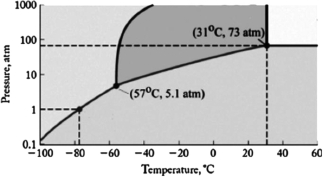
(Multiple Choice)
4.9/5 (74)
(74) Which of the following compounds is capable of dipole-dipole interactions?
(Multiple Choice)
4.8/5 (81)
(81) Consider the phase diagram for a substance such as the one shown here. If the line between the solid and liquid phases has a negative slope, then the solid phase is ________ than the liquid phase. 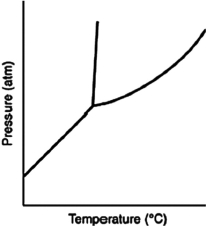
(Multiple Choice)
4.9/5 (87)
(87) The structure of an unsaturated phospholipid is shown below. Which region of the molecule is most hydrophilic? 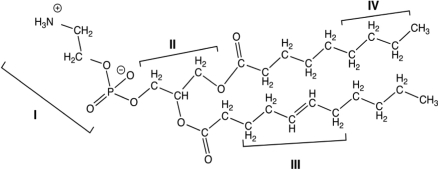
(Multiple Choice)
4.8/5 (81)
(81) The phase diagram for carbon dioxide is shown below. What are the phase changes in order as the pressure is increased starting at 0.5 atm, and the temperature is kept at 80oC? 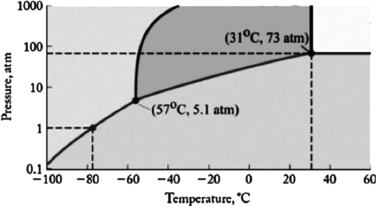
(Multiple Choice)
4.8/5 (79)
(79) Which of the following compounds would be most soluble in water?
(Multiple Choice)
4.7/5 (71)
(71) Why do gases behave nonideally at high pressures and low temperatures?
(Essay)
4.9/5 (73)
(73) Under similar conditions, which of the following gases will behave less like an ideal gas than the others?
(Multiple Choice)
5.0/5 (74)
(74) Which is the dominant interaction between oxygen and nitrogen molecules in air?
(Multiple Choice)
4.8/5 (80)
(80) Which of the following substances has a solid that is less dense than the liquid?
(Multiple Choice)
5.0/5 (85)
(85) Which is the dominant interaction that leads to the formation of a hydration sphere in a salt solution?
(Multiple Choice)
4.9/5 (85)
(85) Which of the following compounds would you expect to be a solid at room temperature and atmospheric pressure?
(Multiple Choice)
4.8/5 (76)
(76) Henry's law constant (mol/L · atm) for carbon dioxide dissolving in water is 3.50 102 mol/(L atm) at 20C. Calculate the molar concentration of carbon dioxide in a soda can where the air pressure is 2.45 atm. The mole fraction of carbon dioxide in air is 0.0397.
(Short Answer)
4.9/5 (82)
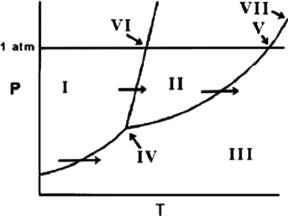
(82) 
The phase diagram for carbon dioxide is shown below. What are the phase changes in order as carbon dioxide is heated from -90oC to 50oC, at 1 atm pressure? 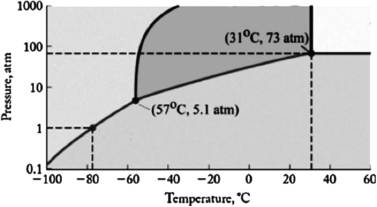
(Multiple Choice)
4.9/5 (78)
(78) Which of the following compounds do you expect to be most soluble in water?
(Multiple Choice)
4.9/5 (85)
(85) If water contains about 42 mg of oxygen per liter at 20C and 1.0 atm, what would be the value of Henry's law constant for oxygen dissolving in water? The mole fraction of oxygen in air is 0.21.
(Multiple Choice)
5.0/5 (86)
(86) Indicate which of the following pairs of compounds is most likely to be miscible.
(Multiple Choice)
4.8/5 (80)
(80) 
Filters
- Essay(0)
- Multiple Choice(0)
- Short Answer(0)
- True False(0)
- Matching(0)