



 Chat with AI
Exam 15: Acidbase Equilibria: Proton Transfer in Biological Systems

Exam 1: Matter and Energy: The Origin of the Universe103 Questions
Exam 2: Atoms, Ions, and Molecules: Matter Starts Here144 Questions
Exam 3: Stoichiometry: Mass, Formulas, and Reactions141 Questions
Exam 4: Solution Chemistry: The Hydrosphere148 Questions
Exam 5: Thermochemistry: Energy Changes in Reactions139 Questions
Exam 6: Properties of Gases: The Air We Breathe164 Questions
Exam 7: A Quantum Model of Atoms: Waves and Particles166 Questions
Exam 8: Chemical Bonds: What Makes a Gas a Greenhouse Gas156 Questions
Exam 9: Molecular Geometry: Shape Determines Function188 Questions
Exam 10: Intermolecular Forces: The Uniqueness of Water165 Questions
Exam 11: Solutions: Properties and Behavior150 Questions
Exam 12: Solids: Crystals, Alloys, and Polymers130 Questions
Exam 13: Chemical Kinetics: Reactions in the Atmosphere155 Questions
Exam 14: Chemical Equilibrium: How Much Product Does a Reaction Really Make111 Questions
Exam 15: Acidbase Equilibria: Proton Transfer in Biological Systems122 Questions
Exam 16: Additional Aqueous Equilibria: Chemistry and the Oceans127 Questions
Exam 17: Thermodynamics: Spontaneous and Nonspontaneous Reactions and Processes186 Questions
Exam 18: Electrochemistry: The Quest for Clean Energy167 Questions
Exam 19: Nuclear Chemistry: Applications to Energy and Medicine165 Questions
Exam 20: Organic and Biological Molecules: the Compounds of Life168 Questions
Exam 21: The Main Group Elements: Life and the Periodic Table96 Questions
Exam 22: Transition Metals: Biological and Medical Applications142 Questions
Select questions type


How would you calculate Kb for the formate ion, given that the Ka for formic acid is 1.8 104?
(Multiple Choice)
4.9/5  (70)
(70) The pH of a popular soft drink is 3.4; what is its hydronium ion concentration?
(Multiple Choice)
4.9/5 (78)
(78) What is the pH of a 0.030 M solution of oxalic acid? Ka for oxalic acid is 5.9 102.
(Multiple Choice)
4.8/5 (70)
(70) What is the actual concentration of molecular NH3 in a 0.200 M solution of ammonia? The Kb value for ammonia is 1.80 105.
(Multiple Choice)
4.8/5 (87)
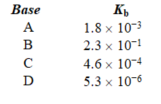
(87) Solutions of each of the hypothetical bases in the following table are prepared with an initial concentration of 0.100 M. Which of the four solutions will have the lowest pH and be least basic?
(Multiple Choice)
5.0/5 (85)
(85) What is the pH of a 0.35 M solution of sodium azide? The Ka value for hydrazoic acid is 1.9 105.
(Multiple Choice)
4.8/5 (69)
(69) The acid ionization equilibrium constant, Ka, describes the reaction (where HA is a generic weak acid) ________
(Multiple Choice)
4.9/5 (82)
(82) What is the Ka for nitrous acid, given that the pKb for the nitrite ion is 10.61?
(Multiple Choice)
4.9/5 (69)
(69) A solution of the weak acid HF and a solution of the strong acid HCl have the same pH. Which solution will require the most sodium hydroxide, NaOH, to neutralize?
(Multiple Choice)
4.8/5 (89)
(89) Identify the weakest and strongest acids in the group below. The weakest acid is listed first in the responses. HCl, HBr, HI
(Multiple Choice)
4.9/5 (82)
(82) Diethylamine ((CH3CH2) NH2) is a weakly basic compound. Calculate the Kb for diethylamine if a 0.127 M solution is 9.61% ionized.
(Multiple Choice)
4.9/5 (74)
(74) Lactic acid is a major component of Ringer's solution, which is used as an intravenous fluid to maintain fluid balance in trauma patients. The pH of a 0.100 M lactic acid solution is around 2.44. Based on this information, determine the value of the acid ionization constant, Ka, for lactic acid.
(Multiple Choice)
4.9/5 (74)
(74) Which one of the following salts does not produce a basic solution when dissolved in water?
(Multiple Choice)
4.8/5 (80)
(80) The hydronium ion concentration of a dilute solution of vinegar is 1.45 105. What is the pH of this solution?
(Multiple Choice)
4.9/5 (72)
(72) 
Filters
- Essay(0)
- Multiple Choice(0)
- Short Answer(0)
- True False(0)
- Matching(0)