



 Chat with AI
Exam 1: Colliding Worlds, 1491-1600

Exam 1: Colliding Worlds, 1491-160084 Questions
Exam 2: American Experiments, 1521-170086 Questions
Exam 3: The British Atlantic World, 1607-175080 Questions
Exam 4: Growth, Diversity, and Conflict, 1720-176380 Questions
Exam 5: The Problem of Empire, 1754-177687 Questions
Exam 6: Making War and Republican Governments, 1776-178981 Questions
Exam 7: Hammering Out a Federal Republic, 1787-182088 Questions
Exam 8: Economic Transformations, 1800-184886 Questions
Exam 9: A Democratic Revolution, 1800-184884 Questions
Exam 10: Religion, Reform, and Culture, 1820-184888 Questions
Exam 11: Imperial Ambitions, 1820-184878 Questions
Exam 12: Sectional Conflict and Crisis, 1844-186081 Questions
Exam 13: Bloody Ground: the Civil War, 1861-186582 Questions
Exam 14: Reconstruction, 1865-187786 Questions
Exam 15: Conquering a Continent, 1860-189083 Questions
Exam 16: Industrial America: Corporations and Conflicts, 1877-191085 Questions
Exam 17: Making Modern American Culture, 1880-191785 Questions
Exam 18: Civilizations Inferno: the Rise and Reform of Industrial Cities, 1880-191784 Questions
Exam 19: Whose Government Politics, Populists, and Progressives, 1880-191784 Questions
Exam 20: An Emerging World Power, 1890-191883 Questions
Exam 21: Unsettled Prosperity: From War to Depression, 1919-193289 Questions
Exam 22: Managing the Great Depression, Forging the New Deal, 1929-193893 Questions
Exam 23: The World at War, 1937-194588 Questions
Exam 24: Cold War America, 1945-196385 Questions
Exam 25: Triumph of the Middle Class, 1945-196383 Questions
Exam 26: Walking Into Freedom Land: the Civil Rights Movement, 1941-197389 Questions
Exam 27: Uncivil Wars:liberal Crisis and Conservative Rebirth, 1961-197290 Questions
Exam 28: The Search for Order in an Era of Limits, 1973-198086 Questions
Exam 29: Conservative America in the Ascent, 1980-199185 Questions
Exam 30: Confronting Global and National Dilemmas, 1989 to the Present88 Questions
Select questions type


Which of the following describes the first peoples who migrated to the Americas?

Free
(Multiple Choice)
4.8/5  (82)
(82) Correct Answer: Verified
B
How did the climate affect the rise and decline of various Native peoples between about 10,000 B.C.E.and A.D.1500?
Free
(Essay)
4.7/5 (79)
(79) Correct Answer:Verified
VerifiedNative people succumbed rapidly to European diseases because of their lack of immunity.Climate changes,including drought,shaped the migratory patterns of North American Indians over time.
- Food Production: Climate shaped the development of farming technology in the Americas.Corn,bean,and squash cultivation was concentrated in the warm and moist soil of Mesoamerica;these crops later spread as far north as Canada.
Answer the following questions :
-hunters and gatherers
Free
(Multiple Choice)
4.7/5 (79)
(79) Correct Answer:Verified
VerifiedA
By the early 1500s,Europe had become a major international influence,and its incursions into Africa and the Americas had set world history on a new course.How did Europe's activity in Africa and North America in the sixteenth century affect each of the three continents? Who were the beneficiaries and who were the victims of Europe's activities?
Answer Key
(Essay)
4.7/5 (58)
(58) How were eastern woodland Indian societies organized and governed around the time European explorers arrived in the New World?
(Essay)
4.9/5 (67)
(67) Which of the following statements characterizes the legacy of the Spanish conquest in the New World in the sixteenth century?
(Multiple Choice)
4.8/5 (81)
(81) Which of the following was a result of the Crusades,which took place between 1096 and 1291 A.D.?
(Multiple Choice)
4.8/5 (72)
(72) Typically, when an English woman of the fifteenth century married, she
(Multiple Choice)
4.8/5 (71)
(71) The Hohokams,Mogollon,and Anasazi peoples who lived in present-day Arizona and New Mexico around A.D.1000
(Multiple Choice)
4.8/5 (74)
(74) John Calvin and Calvinist theologians of the 1500s stressed which of the following ideas?
(Multiple Choice)
5.0/5 (80)
(80) Which Europeans were represented by guilds in the fifteenth century?
(Multiple Choice)
4.9/5 (80)
(80) What was the foundation for the prosperous Native American societies in Mexico,Peru,and the Mississippi River Valley?
(Multiple Choice)
5.0/5 (88)
(88) For this question, refer to the following engraving from the 1590s, The Village of Secoton, by John White. 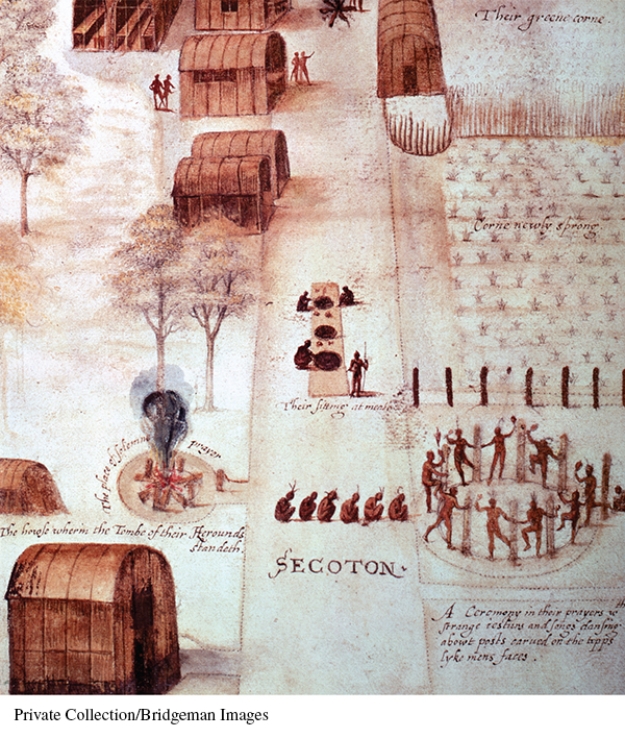 As a primary source, the image above is best understood as
 (Multiple Choice)
4.8/5 (98)
(98) How did Protestant religious doctrine differ from that of Roman Catholicism at the time of the Reformation in the sixteenth century?
(Essay)
4.9/5 (85)
(85) How did the Spanish conquistador Francisco Pizarro conquer the Incans by 1535?
(Multiple Choice)
4.8/5 (92)
(92) What factors led to the development of the transatlantic trade in African slaves in the 1600s?
(Essay)
4.7/5 (82)
(82) 
Filters
- Essay(0)
- Multiple Choice(0)
- Short Answer(0)
- True False(0)
- Matching(0)