



 Chat with AI
Exam 8: Economic Transformations, 1800-1848

Exam 1: Colliding Worlds, 1491-160084 Questions
Exam 2: American Experiments, 1521-170086 Questions
Exam 3: The British Atlantic World, 1607-175080 Questions
Exam 4: Growth, Diversity, and Conflict, 1720-176380 Questions
Exam 5: The Problem of Empire, 1754-177687 Questions
Exam 6: Making War and Republican Governments, 1776-178981 Questions
Exam 7: Hammering Out a Federal Republic, 1787-182088 Questions
Exam 8: Economic Transformations, 1800-184886 Questions
Exam 9: A Democratic Revolution, 1800-184884 Questions
Exam 10: Religion, Reform, and Culture, 1820-184888 Questions
Exam 11: Imperial Ambitions, 1820-184878 Questions
Exam 12: Sectional Conflict and Crisis, 1844-186081 Questions
Exam 13: Bloody Ground: the Civil War, 1861-186582 Questions
Exam 14: Reconstruction, 1865-187786 Questions
Exam 15: Conquering a Continent, 1860-189083 Questions
Exam 16: Industrial America: Corporations and Conflicts, 1877-191085 Questions
Exam 17: Making Modern American Culture, 1880-191785 Questions
Exam 18: Civilizations Inferno: the Rise and Reform of Industrial Cities, 1880-191784 Questions
Exam 19: Whose Government Politics, Populists, and Progressives, 1880-191784 Questions
Exam 20: An Emerging World Power, 1890-191883 Questions
Exam 21: Unsettled Prosperity: From War to Depression, 1919-193289 Questions
Exam 22: Managing the Great Depression, Forging the New Deal, 1929-193893 Questions
Exam 23: The World at War, 1937-194588 Questions
Exam 24: Cold War America, 1945-196385 Questions
Exam 25: Triumph of the Middle Class, 1945-196383 Questions
Exam 26: Walking Into Freedom Land: the Civil Rights Movement, 1941-197389 Questions
Exam 27: Uncivil Wars:liberal Crisis and Conservative Rebirth, 1961-197290 Questions
Exam 28: The Search for Order in an Era of Limits, 1973-198086 Questions
Exam 29: Conservative America in the Ascent, 1980-199185 Questions
Exam 30: Confronting Global and National Dilemmas, 1989 to the Present88 Questions
Select questions type


In the 1824 U.S.Supreme Court case Gibbons v.Ogden,the Marshall Court's decision

Free
(Multiple Choice)
4.8/5  (76)
(76) Correct Answer: Verified
D
Which of the following statements characterizes the emergence of the textile industry in the United States?
Free
(Multiple Choice)
4.8/5 (88)
(88) Correct Answer:Verified
VerifiedD
Answer the following questions :
-Panic of 1819
Free
(Multiple Choice)
4.8/5 (62)
(62) Correct Answer:Verified
VerifiedB
For this question,refer to the banner of the Society of Pewterers of New York City,carried in the Federal Procession,July 23,1788,celebrating the ratification of the U.S.Constitution. The ribbon at top right reads,"The Federal Plan Most Solid & Secure/Americans Their Freedom Will Endure/All Art Shall Flourish in Columbia's Land/And All her Sons Join as One Social Band."
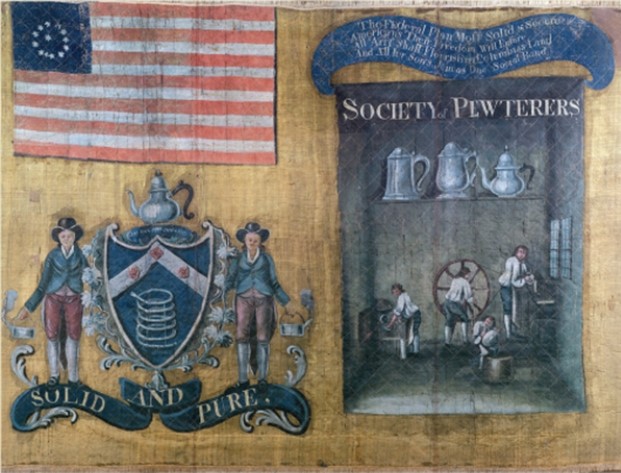 The ideas expressed in the image above most clearly show the influence of
 (Multiple Choice)
4.8/5 (85)
(85) Which of these did elite Americans embrace after the Industrial Revolution in order to set themselves apart from other groups of Americans?
(Multiple Choice)
4.9/5 (97)
(97) Explain the notion that the institution of slavery was a "positive good." Who made this argument and why?
(Essay)
4.9/5 (83)
(83) How did the Market Revolution alter labor patterns for American workers in the early nineteenth century from previous patterns? How did American laborers react to these changes?
(Essay)
4.8/5 (83)
(83) How did planters attempt to resolve a labor crisis in the Cotton South in the early nineteenth century?
(Multiple Choice)
4.8/5 (71)
(71) For this question,refer to the following excerpt. In all social systems there must be a class to do the menial duties,to perform the drudgery of life....Such a class you must have,or you would not have that other class which leads progress,civilization,and refinement.It constitutes the very mud-sill of society and of political government....Fortunately for the South,she found a race adapted to that purpose to her hand.A race inferior to her own,but eminently qualified in temper,in vigor,in docility,in capacity to stand the climate,to answer all her purposes.We use them for our purpose,and call them slaves....
The Senator from New York [William Seward] said yesterday that the whole world had abolished slavery.Aye,the name,but not the thing;...for the man who lives by daily labor,and scarcely lives at that,and who has to put out his labor in the market,and take the best he can get for it;in short,your whole hireling class of manual laborers and "operatives," as you call them,are essentially slaves.The difference between us is,that our slaves are hired for life and well compensated;there is no starvation,no begging,no want of employment among our people,and not too much employment either.Yours are hired by the day,not cared for,and scantily compensated,which may be proved in the most painful manner,at any hour in any street in any of your large towns....
South Carolina Senator James Henry Hammond,Speech to the Senate,March 4,1858
The excerpt above was most likely written as a result of
(Multiple Choice)
4.9/5 (74)
(74) For this question,refer to the following excerpt. In all social systems there must be a class to do the menial duties,to perform the drudgery of life....Such a class you must have,or you would not have that other class which leads progress,civilization,and refinement.It constitutes the very mud-sill of society and of political government....Fortunately for the South,she found a race adapted to that purpose to her hand.A race inferior to her own,but eminently qualified in temper,in vigor,in docility,in capacity to stand the climate,to answer all her purposes.We use them for our purpose,and call them slaves....
The Senator from New York [William Seward] said yesterday that the whole world had abolished slavery.Aye,the name,but not the thing;...for the man who lives by daily labor,and scarcely lives at that,and who has to put out his labor in the market,and take the best he can get for it;in short,your whole hireling class of manual laborers and "operatives," as you call them,are essentially slaves.The difference between us is,that our slaves are hired for life and well compensated;there is no starvation,no begging,no want of employment among our people,and not too much employment either.Yours are hired by the day,not cared for,and scantily compensated,which may be proved in the most painful manner,at any hour in any street in any of your large towns....
South Carolina Senator James Henry Hammond,Speech to the Senate,March 4,1858
The excerpt above best serves as evidence of which of the following?
(Multiple Choice)
4.8/5 (87)
(87) Which of the following statements characterizes the operations of the Bank of the United States in the twenty years after its 1791 chartering?
(Multiple Choice)
4.8/5 (79)
(79) On what basis did the U.S.government base its claim that the commonwealth system was consistent with republican ideology?
(Multiple Choice)
4.8/5 (87)
(87) How did the spread of industrialization in the United States during the 1820s and 1830s affect skilled artisans?
(Multiple Choice)
4.8/5 (78)
(78) John Jacob Astor,a prominent New York merchant of the late eighteenth and early nineteenth centuries,made his fortune in which trade?
(Multiple Choice)
5.0/5 (76)
(76) 
Filters
- Essay(0)
- Multiple Choice(0)
- Short Answer(0)
- True False(0)
- Matching(0)