



 Chat with AI
Exam 5: Governments Role and Government Failure

Exam 1: Limits, Alternatives, and Choices212 Questions
Exam 2: The Market System and the Circular Flow141 Questions
Exam 3: Demand, Supply, and Market Equilibrium202 Questions
Exam 4: Market Failures: Public Goods and Externalities155 Questions
Exam 5: Governments Role and Government Failure148 Questions
Exam 6: An Introduction to Macroeconomics123 Questions
Exam 7: Measuring Domestic Output and National Income157 Questions
Exam 8: Economic Growth114 Questions
Exam 9: Business Cycles, Unemployment, and Inflation143 Questions
Exam 10: Basic Macroeconomic Relationships142 Questions
Exam 11: The Aggregate Expenditures Model143 Questions
Exam 12: Aggregate Demand and Aggregate Supply152 Questions
Exam 13: Fiscal Policy, Deficits, and Debt164 Questions
Exam 14: Money, Banking, and Financial Institutions130 Questions
Exam 15: Money Creation127 Questions
Exam 16: Interest Rates and Monetary Policy174 Questions
Exam 17: Financial Economics136 Questions
Exam 18: Extending the Analysis of Aggregate Supply135 Questions
Exam 19: Current Issues in Macro Theory and Policy134 Questions
Exam 20: International Trade151 Questions
Exam 21: The Balance of Payments, Exchange Rates, and Trade Deficits152 Questions
Exam 22: The Economics of Developing Countries135 Questions
Select questions type


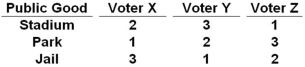 Refer to the above table, which shows the ranked preferences of voters for three alternative projects, with "1" being the top preference. In a paired-choice vote between a jail and a stadium:
 (Multiple Choice)
4.9/5  (67)
(67) Unfunded liabilities occur when the government considers long-term benefits and costs of projects, and approves only those with positive long-term net benefits.
(True/False)
4.8/5 (82)
(82) Government laws and policies need to be uniformly enforced. But this leads to all of the following problems, except:
(Multiple Choice)
4.8/5 (82)
(82) Critics of government contend that the market system creates incentives and pressures for internal efficiency which are absent in the public sector.
(True/False)
4.9/5 (89)
(89) Majority voting may produce economically inefficient outcomes because it:
(Multiple Choice)
4.9/5 (75)
(75) Fiscal policy refers to the government's attempt at regulating the economy through the use of changes in:
(Multiple Choice)
4.9/5 (73)
(73) Some economists contend that government agencies are generally less efficient than private businesses due to the following reasons, except:
(Multiple Choice)
4.8/5 (85)
(85) Many governments end up with chronic budget deficits because:
(Multiple Choice)
4.9/5 (78)
(78) If a public good provides social benefits that are greater than its costs, then majority of voters would always vote in favor of producing the good.
(True/False)
4.8/5 (70)
(70) The provision of loan guarantees can improve economic efficiency when:
(Multiple Choice)
4.9/5 (88)
(88) It is generally believed that, because of the election process, the incentives and pressures for internal efficiency are stronger in the public sector than in the private sector.
(True/False)
4.9/5 (78)
(78) If choice A wins over choice B in a majority vote, while choice B wins over choice C in a majority vote, then we can conclude that choice A would win over choice
C.
(True/False)
4.9/5 (79)
(79) Government's ability to reduce private-sector economic risks through laws and regulations would encourage all of the following, except:
(Multiple Choice)
4.9/5 (67)
(67) The so-called collective action problem is the reason why:
(Multiple Choice)
4.9/5 (84)
(84) 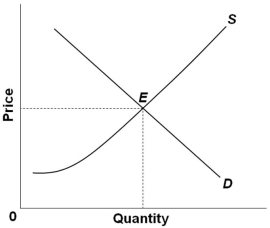 Refer to the graph above. Suppose that its shows the S and D graphs in a market where production entails a significant amount of pollution. In this case, the government should use its coercive power to make:
 (Multiple Choice)
4.9/5 (68)
(68) 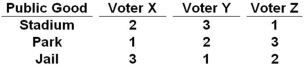 Refer to the above table, which shows the ranked preferences of voters for three alternative projects, with "1" being the top preference. In a paired-choice vote between a park and a jail:
 (Multiple Choice)
4.8/5 (76)
(76) In the median-voter model, the median voter refers to the voter who makes her choice at the midpoint of the voting period.
(True/False)
4.7/5 (78)
(78) Loan guarantees provided by government will reduce the willingness of investors to take on the risk in a project.
(True/False)
4.7/5 (78)
(78) 
Filters
- Essay(0)
- Multiple Choice(0)
- Short Answer(0)
- True False(0)
- Matching(0)