



 Chat with AI
Exam 5: Governments Role and Government Failure

Exam 1: Limits, Alternatives, and Choices212 Questions
Exam 2: The Market System and the Circular Flow141 Questions
Exam 3: Demand, Supply, and Market Equilibrium202 Questions
Exam 4: Market Failures: Public Goods and Externalities155 Questions
Exam 5: Governments Role and Government Failure148 Questions
Exam 6: An Introduction to Macroeconomics123 Questions
Exam 7: Measuring Domestic Output and National Income157 Questions
Exam 8: Economic Growth114 Questions
Exam 9: Business Cycles, Unemployment, and Inflation143 Questions
Exam 10: Basic Macroeconomic Relationships142 Questions
Exam 11: The Aggregate Expenditures Model143 Questions
Exam 12: Aggregate Demand and Aggregate Supply152 Questions
Exam 13: Fiscal Policy, Deficits, and Debt164 Questions
Exam 14: Money, Banking, and Financial Institutions130 Questions
Exam 15: Money Creation127 Questions
Exam 16: Interest Rates and Monetary Policy174 Questions
Exam 17: Financial Economics136 Questions
Exam 18: Extending the Analysis of Aggregate Supply135 Questions
Exam 19: Current Issues in Macro Theory and Policy134 Questions
Exam 20: International Trade151 Questions
Exam 21: The Balance of Payments, Exchange Rates, and Trade Deficits152 Questions
Exam 22: The Economics of Developing Countries135 Questions
Select questions type


Government in a market system can increase economic efficiency by collecting taxes in order to subsidize the production of:
(Multiple Choice)
4.9/5  (99)
(99) Governments try to smooth business cycles by using these policies, except:
(Multiple Choice)
4.9/5 (83)
(83) In the corporate world of business, the principal-agent problem arises between:
(Multiple Choice)
4.8/5 (76)
(76) When voters have different opinions about an issue, the position that is most likely to be adopted is that of the:
(Multiple Choice)
4.9/5 (77)
(77) During a period when output and employment is falling, the government will try to:
(Multiple Choice)
4.8/5 (83)
(83) Political corruption occurs in the following instances, except when:
(Multiple Choice)
4.7/5 (80)
(80) The government adds to its overall public debt whenever it:
(Multiple Choice)
4.7/5 (81)
(81) The collective action problem is the reason why there are no lobbyists representing the interest of general taxpayers or consumers in Washington, DC.
(True/False)
4.9/5 (72)
(72) The median-voter model indicates that political parties will:
(Multiple Choice)
4.8/5 (70)
(70) As long as government officials have to be elected, they are always held accounted for their policy decisions and choices.
(True/False)
4.7/5 (81)
(81) Unintended consequences can result from the government's desire to enforce laws uniformly.
(True/False)
4.8/5 (80)
(80) When the government provides loan guarantees and in effect "socializes losses and privatizes gains" of a project or firm, it can lead to a:
(Multiple Choice)
4.9/5 (80)
(80) One implication of the median-voter model as applied to a vote regarding how much government involvement to have in the economy is that most voters would find the resulting government involvement either too large or too small.
(True/False)
4.9/5 (76)
(76) Political logrolling, or vote-trading, can turn a potentially inefficient voting outcome into an efficient one.
(True/False)
4.8/5 (75)
(75) When monetary policy becomes highly politicized, the policy tends to:
(Multiple Choice)
5.0/5 (80)
(80) When the special-interest effect is the major reason for the passage of a government policy or project, then economic efficiency will always improve.
(True/False)
4.9/5 (69)
(69) A budget deficit will require the government to issue bonds to fill in the gap in the budget.
(True/False)
4.8/5 (78)
(78) Because of the so-called "bundled choice" problem, voters often vote for candidates that they are not entirely happy with.
(True/False)
4.9/5 (76)
(76) 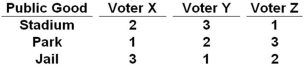 Refer to the above table, which shows the ranked preferences of voters for three alternative projects, with "1" being the top preference. In a paired-choice vote between a stadium and a park:
 (Multiple Choice)
4.9/5 (92)
(92) A situation in which society may not be able to rank its preferences consistently through paired-choice majority voting is:
(Multiple Choice)
4.9/5 (78)
(78) 
Filters
- Essay(0)
- Multiple Choice(0)
- Short Answer(0)
- True False(0)
- Matching(0)