



 Chat with AI
Exam 6: An Introduction to Macroeconomics

Exam 1: Limits, Alternatives, and Choices212 Questions
Exam 2: The Market System and the Circular Flow141 Questions
Exam 3: Demand, Supply, and Market Equilibrium202 Questions
Exam 4: Market Failures: Public Goods and Externalities155 Questions
Exam 5: Governments Role and Government Failure148 Questions
Exam 6: An Introduction to Macroeconomics123 Questions
Exam 7: Measuring Domestic Output and National Income157 Questions
Exam 8: Economic Growth114 Questions
Exam 9: Business Cycles, Unemployment, and Inflation143 Questions
Exam 10: Basic Macroeconomic Relationships142 Questions
Exam 11: The Aggregate Expenditures Model143 Questions
Exam 12: Aggregate Demand and Aggregate Supply152 Questions
Exam 13: Fiscal Policy, Deficits, and Debt164 Questions
Exam 14: Money, Banking, and Financial Institutions130 Questions
Exam 15: Money Creation127 Questions
Exam 16: Interest Rates and Monetary Policy174 Questions
Exam 17: Financial Economics136 Questions
Exam 18: Extending the Analysis of Aggregate Supply135 Questions
Exam 19: Current Issues in Macro Theory and Policy134 Questions
Exam 20: International Trade151 Questions
Exam 21: The Balance of Payments, Exchange Rates, and Trade Deficits152 Questions
Exam 22: The Economics of Developing Countries135 Questions
Select questions type


The major statistics that provide macroeconomists a picture of the health of an economy include the following, except:
(Multiple Choice)
4.9/5  (80)
(80) Suppose that inventories are falling. We could expect that, in the future:
(Multiple Choice)
4.9/5 (69)
(69) Citizens living in the richest nations today have material standards of living that are on average more than 50 times higher than people living in the poorest countries.
(True/False)
4.8/5 (67)
(67) One major reason for sticky prices could be that firms selling final goods and services do not want to annoy customers with frequently changing prices.
(True/False)
4.8/5 (95)
(95) 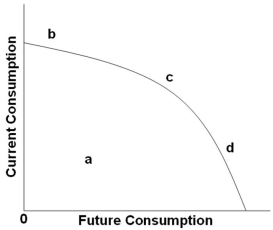 One principle of economic growth is the notion that, to raise living standards over time, an economy must:
 (Multiple Choice)
4.8/5 (73)
(73) Situations in which firms expect one thing to happen but then something else happens are called:
(Multiple Choice)
4.9/5 (74)
(74) 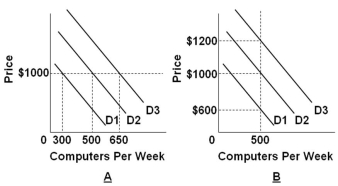 Refer to the graphs above. Suppose a firm is currently producing 500 computers per week and charging a price of $1000. What happens to the firm's inventory of computers if there is a negative demand shock and prices are flexible?
 (Multiple Choice)
4.8/5 (85)
(85) If a family's income increases by 5% at the same time that inflation is 3.5%, then the:
(Multiple Choice)
4.7/5 (72)
(72) Economists use different models of the economy because the economy behaves differently depending on how much time has passed after a demand shock.
(True/False)
4.8/5 (70)
(70) 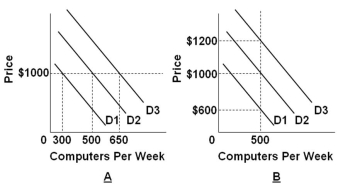 Refer to the graphs above. Suppose a firm is currently producing 500 computers per week and charging a price of $1000. How will the firm respond to a positive demand shock if prices are inflexible?
 (Multiple Choice)
4.7/5 (70)
(70) Which of the following markets is most likely to exhibit extremely flexible prices?
(Multiple Choice)
4.9/5 (97)
(97) Which among the following countries had the highest GDP per person in 2011?
(Multiple Choice)
4.8/5 (85)
(85) 
Filters
- Essay(0)
- Multiple Choice(0)
- Short Answer(0)
- True False(0)
- Matching(0)