



 Chat with AI
Exam 8: Economic Growth

Exam 1: Limits, Alternatives, and Choices212 Questions
Exam 2: The Market System and the Circular Flow141 Questions
Exam 3: Demand, Supply, and Market Equilibrium202 Questions
Exam 4: Market Failures: Public Goods and Externalities155 Questions
Exam 5: Governments Role and Government Failure148 Questions
Exam 6: An Introduction to Macroeconomics123 Questions
Exam 7: Measuring Domestic Output and National Income157 Questions
Exam 8: Economic Growth114 Questions
Exam 9: Business Cycles, Unemployment, and Inflation143 Questions
Exam 10: Basic Macroeconomic Relationships142 Questions
Exam 11: The Aggregate Expenditures Model143 Questions
Exam 12: Aggregate Demand and Aggregate Supply152 Questions
Exam 13: Fiscal Policy, Deficits, and Debt164 Questions
Exam 14: Money, Banking, and Financial Institutions130 Questions
Exam 15: Money Creation127 Questions
Exam 16: Interest Rates and Monetary Policy174 Questions
Exam 17: Financial Economics136 Questions
Exam 18: Extending the Analysis of Aggregate Supply135 Questions
Exam 19: Current Issues in Macro Theory and Policy134 Questions
Exam 20: International Trade151 Questions
Exam 21: The Balance of Payments, Exchange Rates, and Trade Deficits152 Questions
Exam 22: The Economics of Developing Countries135 Questions
Select questions type


The rate of growth of labor productivity in the U.S. has declined from the period 1973-1995 to the period 1995-2012.
(True/False)
4.7/5  (87)
(87) Increasing returns would be a situation where a firm increases its workforce and other inputs by:
(Multiple Choice)
4.9/5 (79)
(79) Compared with the period from 1973-1995, the annual rate of productivity growth from 1995-2012 was about:
(Multiple Choice)
4.9/5 (82)
(82) From 2010 to 2050, the "inverse dependency ratio" in the U.S. is expected to:
(Multiple Choice)
4.8/5 (78)
(78) If an economy has 800,000 work-hours employed, and its labor productivity is $16/hour, then its real GDP must be $50,000.
(True/False)
4.7/5 (92)
(92) There is unanimous agreement that economic growth is both desirable and sustainable.
(True/False)
4.8/5 (71)
(71) Human capital refers to the amount of capital available for the economy's human resources to work with.
(True/False)
4.7/5 (73)
(73) Increased labor productivity has been less important as a source of growth than the increased labor inputs in the U.S. economy since the 1950's.
(True/False)
4.9/5 (72)
(72) Rising real wages for women in the U.S. workforce since the 1960s have:
(Multiple Choice)
4.9/5 (78)
(78) Suppose that an economy is initially operating at a point on its PPC. If it then experiences an expansion in its production capacity, but its total spending does not rise as fast as its capacity, the economy will end up:
(Multiple Choice)
4.8/5 (87)
(87) 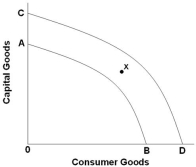 Refer to the above graph. If the production possibilities curve of an economy shifts from AB to CD, it is most likely caused by which of the following factors?
 (Multiple Choice)
4.8/5 (78)
(78) If a country has a larger real GDP than another country, then it should also have a higher real GDP per capita that the other country.
(True/False)
4.7/5 (92)
(92) Growth-promoting institutional structures include the following, except:
(Multiple Choice)
4.8/5 (83)
(83) Which of the following is best considered a demand factor in economic growth?
(Multiple Choice)
4.9/5 (81)
(81) 
Filters
- Essay(0)
- Multiple Choice(0)
- Short Answer(0)
- True False(0)
- Matching(0)