



 Chat with AI
Exam 8: Economic Growth

Exam 1: Limits, Alternatives, and Choices212 Questions
Exam 2: The Market System and the Circular Flow141 Questions
Exam 3: Demand, Supply, and Market Equilibrium202 Questions
Exam 4: Market Failures: Public Goods and Externalities155 Questions
Exam 5: Governments Role and Government Failure148 Questions
Exam 6: An Introduction to Macroeconomics123 Questions
Exam 7: Measuring Domestic Output and National Income157 Questions
Exam 8: Economic Growth114 Questions
Exam 9: Business Cycles, Unemployment, and Inflation143 Questions
Exam 10: Basic Macroeconomic Relationships142 Questions
Exam 11: The Aggregate Expenditures Model143 Questions
Exam 12: Aggregate Demand and Aggregate Supply152 Questions
Exam 13: Fiscal Policy, Deficits, and Debt164 Questions
Exam 14: Money, Banking, and Financial Institutions130 Questions
Exam 15: Money Creation127 Questions
Exam 16: Interest Rates and Monetary Policy174 Questions
Exam 17: Financial Economics136 Questions
Exam 18: Extending the Analysis of Aggregate Supply135 Questions
Exam 19: Current Issues in Macro Theory and Policy134 Questions
Exam 20: International Trade151 Questions
Exam 21: The Balance of Payments, Exchange Rates, and Trade Deficits152 Questions
Exam 22: The Economics of Developing Countries135 Questions
Select questions type


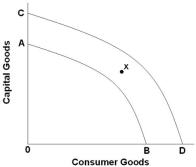 Refer to the above graph. If the production possibilities curve for an economy is at CD but the economy is operating at point X, the reasons are most likely to be because of:
 (Multiple Choice)
4.7/5  (92)
(92) Global competition has tended to slow down the rate of productivity growth in the United States.
(True/False)
4.9/5 (73)
(73) Which of the following is the single most important source of U.S. economic growth?
(Multiple Choice)
4.8/5 (66)
(66) One of the basic economic defenses of economic growth rests on the conclusion that:
(Multiple Choice)
4.9/5 (81)
(81) Factors that have contributed to the increase in women's labor-force participation rate in the U.S. include the following, except:
(Multiple Choice)
4.9/5 (90)
(90) The largest factor that raised labor productivity in the U.S. economy since the 1950's has been the increased amount of capital available.
(True/False)
4.9/5 (87)
(87) The table below shows the quantity of labor (measured in hours) and the productivity of labor (measured in real GDP per hour) in a hypothetical economy in three different years. 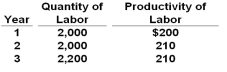 Refer to the above table. Between Year 2 and Year 3, real GDP increased by:
 (Multiple Choice)
4.8/5 (74)
(74) The following factors tend to make the real GDP growth rate understate the growth of economic well-being, except:
(Multiple Choice)
5.0/5 (76)
(76) Supply factors in economic growth include the following, except:
(Multiple Choice)
4.9/5 (81)
(81) Total output for an economy is basically equal to total work-hours multiplied by labor productivity.
(True/False)
4.8/5 (76)
(76) The entry of women into the workforce since the 1960s resulted in:
(Multiple Choice)
4.9/5 (86)
(86) Leader countries that experience modern economic growth early on will always grow faster than follower countries.
(True/False)
4.9/5 (82)
(82) In the growth debate, defenders of economic growth believe that it is the primary path to raising living standards.
(True/False)
4.8/5 (87)
(87) The "rule of 70" is a formula for determining the approximate number of:
(Multiple Choice)
4.8/5 (84)
(84) Economic historians identify which invention as a major factor that started the Industrial Revolution in Britain?
(Multiple Choice)
4.9/5 (89)
(89) Which of the following factors has been the dominant source of economic growth in the U.S. (except in 1973-1995)?
(Multiple Choice)
4.9/5 (70)
(70) Simultaneous consumption and network effects are sources of increasing returns and economies of scale that promote productivity growth.
(True/False)
4.8/5 (77)
(77) Society can increase its output and income by increasing basically one or both of two factors:
(Multiple Choice)
4.8/5 (74)
(74) 
Filters
- Essay(0)
- Multiple Choice(0)
- Short Answer(0)
- True False(0)
- Matching(0)