



 Chat with AI
Exam 12: Competition and the Invisible Hand

Exam 1: The Big Ideas253 Questions
Exam 2: The Power of Trade and Comparative239 Questions
Exam 3: Supply and Demand249 Questions
Exam 4: Equilibrium256 Questions
Exam 5: Elasticity and Its Applications271 Questions
Exam 6: Taxes and Subsidies225 Questions
Exam 7: The Price System275 Questions
Exam 8: Price Ceilings and Floors327 Questions
Exam 9: International Trade195 Questions
Exam 10: Externalities- When the Price Is Not Right273 Questions
Exam 11: Costs and Profit Maximization Under Competition217 Questions
Exam 12: Competition and the Invisible Hand144 Questions
Exam 13: Monopoly233 Questions
Exam 14: Price Discrimination262 Questions
Exam 15: Oligopoly and Game Theory218 Questions
Exam 16: Competing for Monopoly160 Questions
Exam 17: Monopolistic Competition and Advertising113 Questions
Exam 18: Labor Markets262 Questions
Exam 19: Public Goods and the Tragedy of the Commons244 Questions
Exam 20: Political Economy and Public Choice306 Questions
Exam 21: Economics, Ethics, and Public Policy241 Questions
Exam 22: Managing Incentives263 Questions
Exam 23: Stock Markets and Personal Finance271 Questions
Exam 24: Price Discrimination151 Questions
Exam 25: Consumer Choice145 Questions
Select questions type


Table: Profit Margins 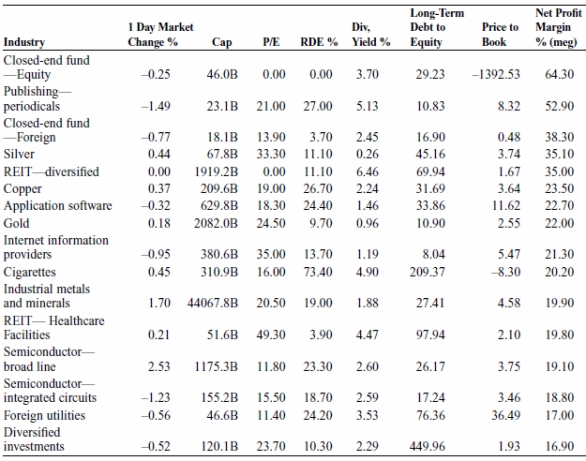 This table shows that silver, copper, and gold were some of the most profitable industries in July 2011. (For each dollar of sales, profit for these industries is 35.1, 23.5, and 22.0 cents, respectively.) According to the elimination principle, what do you expect to happen to these profit margins in the long run?
 (Multiple Choice)
4.8/5  (80)
(80) The invisible hand works well, even if markets are not competitive.
(True/False)
4.8/5 (82)
(82) In markets with externalities, the invisible hand concept does not work in society's best interest.
(True/False)
4.8/5 (79)
(79) Since all competitive firms produce wherever marginal cost equals the market price for the product, we can conclude that:
I. all competitive firms produce at the same marginal cost level.
II. all competitive firms produce the same quantity.
III. all competitive firms make normal profit.
(Multiple Choice)
4.7/5 (90)
(90) The invisible hand dictates that all companies will make the same profit margins in the short run.
(True/False)
4.9/5 (82)
(82) In a competitive market, the incentives that entrepreneurs have to seek profit and avoid losses align with the social incentive to move labor and capital out of low-value industries and into high-value industries.
(True/False)
4.8/5 (77)
(77) If every firm knows its marginal cost but a central planner cannot know every firm's marginal cost, then:
(Multiple Choice)
4.7/5 (79)
(79) In a competitive market with four firms (indicated as Firm 1, Firm 2, Firm 3, and Firm 4), which of the following is the condition that enables all sellers to maximize profit?
(Multiple Choice)
4.8/5 (91)
(91) A free market can allocate production across two farms to minimize total costs even when an ideal central planner could not.
(True/False)
4.9/5 (82)
(82) Which of the following best illustrates a market in which the invisible hand may not automatically minimize costs?
(Multiple Choice)
4.8/5 (80)
(80) According to Adam Smith and other economists, the minimization of total costs in a competitive industry:
(Multiple Choice)
4.7/5 (84)
(84) The elimination principle states that ______ normal profits are eliminated by ______, and ______ normal profits are eliminated by ______.
(Multiple Choice)
4.8/5 (73)
(73) If a competitive market has three firms with marginal costs of MC1 = Q1, MC2 = 0.50Q2, and MC3 = 2Q3 and faces a market price of $10, the total quantity supplied by all three firms is:
(Multiple Choice)
4.8/5 (81)
(81) 
Filters
- Essay(0)
- Multiple Choice(0)
- Short Answer(0)
- True False(0)
- Matching(0)