



 Chat with AI
Exam 7: The Price System

Exam 1: The Big Ideas253 Questions
Exam 2: The Power of Trade and Comparative239 Questions
Exam 3: Supply and Demand249 Questions
Exam 4: Equilibrium256 Questions
Exam 5: Elasticity and Its Applications271 Questions
Exam 6: Taxes and Subsidies225 Questions
Exam 7: The Price System275 Questions
Exam 8: Price Ceilings and Floors327 Questions
Exam 9: International Trade195 Questions
Exam 10: Externalities- When the Price Is Not Right273 Questions
Exam 11: Costs and Profit Maximization Under Competition217 Questions
Exam 12: Competition and the Invisible Hand144 Questions
Exam 13: Monopoly233 Questions
Exam 14: Price Discrimination262 Questions
Exam 15: Oligopoly and Game Theory218 Questions
Exam 16: Competing for Monopoly160 Questions
Exam 17: Monopolistic Competition and Advertising113 Questions
Exam 18: Labor Markets262 Questions
Exam 19: Public Goods and the Tragedy of the Commons244 Questions
Exam 20: Political Economy and Public Choice306 Questions
Exam 21: Economics, Ethics, and Public Policy241 Questions
Exam 22: Managing Incentives263 Questions
Exam 23: Stock Markets and Personal Finance271 Questions
Exam 24: Price Discrimination151 Questions
Exam 25: Consumer Choice145 Questions
Select questions type


Factors other than war in the Middle East-e.g., OPEC decisions, oil discoveries, and the demand for oil-also impact oil futures, so the future price of oil is a:
(Multiple Choice)
5.0/5  (80)
(80) Imagine the existence of prediction markets for grades in Ray's economics class. The weekend before a test, Ray observes a classmate at a party who has had too much to drink. He does not think that she will recover enough to study for the test on Monday. None of Ray's other classmates observes this. How could Ray profit from this information?
(Multiple Choice)
4.8/5 (78)
(78) Suppose that war in the Middle East reduces the supply of oil, forcing the country to economize on oil. How would a central planner optimize the economic problem under this situation?
(Multiple Choice)
5.0/5 (83)
(83) Use the following to answer questions:
Figure: Demand Curve 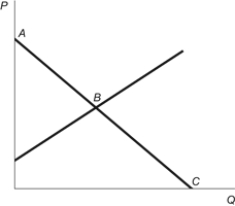 -(Figure: Demand Curve) Refer to the figure. Which part of the demand curve represents the satisfied wants?
 (Multiple Choice)
4.8/5 (81)
(81) Futures markets are often good predictors of what will happen to the price of goods in the future because:
(Multiple Choice)
4.8/5 (74)
(74) Suppose you have been hired by the Hollywood Stock Exchange to make predictions on how much a movie will make during its first four weekends at the box office. What kind of information would you use to make your forecast?
(Essay)
4.8/5 (78)
(78) As the price of oil increases, Brazilians will shift sugar cane from sugar production to ethanol production, thereby holding down fuel costs and reducing the price of sugar.
(True/False)
4.7/5 (75)
(75) Ignoring any third-party commissions, the profit one party earns in a futures contract equals the loss the other party suffers.
(True/False)
4.8/5 (71)
(71) Millions of producers working across the world cooperate to ensure that many more millions of consumers can have the goods and services they desire. These producers do not know each other and are not coordinated by a central agency. Their actions are directed simply by:
(Multiple Choice)
4.9/5 (89)
(89) Markets work well because of the information delivered by:
(Multiple Choice)
4.8/5 (84)
(84) One advantage of prediction markets is that they create incentives for traders to relay:
(Multiple Choice)
4.9/5 (82)
(82) John and Tom enter into a futures contract in which John agrees to deliver 500 crates of coffee to Tom one year from now. Tom agrees to pay a price of $200 per crate. A year from now, John and Tom find that the market price of coffee is $210 per crate. How might they make a cash settlement on the contract?
(Multiple Choice)
4.7/5 (88)
(88) 
Filters
- Essay(0)
- Multiple Choice(0)
- Short Answer(0)
- True False(0)
- Matching(0)