



 Chat with AI
Exam 7: The Price System

Exam 1: The Big Ideas253 Questions
Exam 2: The Power of Trade and Comparative239 Questions
Exam 3: Supply and Demand249 Questions
Exam 4: Equilibrium256 Questions
Exam 5: Elasticity and Its Applications271 Questions
Exam 6: Taxes and Subsidies225 Questions
Exam 7: The Price System275 Questions
Exam 8: Price Ceilings and Floors327 Questions
Exam 9: International Trade195 Questions
Exam 10: Externalities- When the Price Is Not Right273 Questions
Exam 11: Costs and Profit Maximization Under Competition217 Questions
Exam 12: Competition and the Invisible Hand144 Questions
Exam 13: Monopoly233 Questions
Exam 14: Price Discrimination262 Questions
Exam 15: Oligopoly and Game Theory218 Questions
Exam 16: Competing for Monopoly160 Questions
Exam 17: Monopolistic Competition and Advertising113 Questions
Exam 18: Labor Markets262 Questions
Exam 19: Public Goods and the Tragedy of the Commons244 Questions
Exam 20: Political Economy and Public Choice306 Questions
Exam 21: Economics, Ethics, and Public Policy241 Questions
Exam 22: Managing Incentives263 Questions
Exam 23: Stock Markets and Personal Finance271 Questions
Exam 24: Price Discrimination151 Questions
Exam 25: Consumer Choice145 Questions
Select questions type


A spot market allows for the exchange of commodities in the ______ at prices that are settled upon in the ______.
(Multiple Choice)
5.0/5  (79)
(79) How can selling a futures contract mitigate agricultural risk for farmers?
(Multiple Choice)
4.9/5 (93)
(93) Speculators reduce price swings for goods, increasing society's welfare.
(True/False)
4.8/5 (84)
(84) Use the following to answer questions:
Figure: Demand Curve 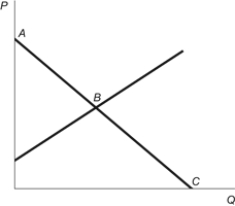 -(Figure: Demand Curve) Refer to the figure. Which point on the graph represents an unsatisfied want?
 (Multiple Choice)
4.7/5 (81)
(81) It is difficult for a central planner to determine optimal allocations of resources because:
(Multiple Choice)
4.8/5 (89)
(89) All relevant information about the use of a good is captured:
(Multiple Choice)
4.8/5 (84)
(84) In a competitive free market, consumers decide not only whether their use of a good is worth more than the market price, but also whether their use of a good is worth more than:
(Multiple Choice)
4.9/5 (95)
(95) The Strike King Lure Co. ordered $100,000 worth of stainless steel to use in the production of fishing lures. The $100,000 expenditure represents the:
(Multiple Choice)
4.8/5 (64)
(64) Rising oil prices during the 1970s shifted flower production from California to Kenya. Which of the following answers explains this shift?
(Multiple Choice)
5.0/5 (72)
(72) Suppose resources are directed by means of a central planner who receives information on all the different uses of these resources. Why might sellers have an incentive to not provide truthful information to the central planner?
(Multiple Choice)
4.9/5 (83)
(83) Markets have the advantage over central planning as the method of resource allocation because:
(Multiple Choice)
4.8/5 (78)
(78) If a central planner had the power to solve the great economic problem:
(Multiple Choice)
4.8/5 (81)
(81) Suppose that war in the Middle East disrupts oil production, reducing the supply of oil by 20%. The central planner of a government decides to economize on oil.
a. What should a central planner do to economize on oil?
b. What information does a central planner have to collect in order to economize on oil?
c. What may cause a central planner to fail to economize on oil?
(Essay)
4.9/5 (78)
(78) The text states: "The great economic problem is to arrange our limited resources to satisfy as many of our wants as possible." How does a market achieve this goal?
(Multiple Choice)
4.9/5 (78)
(78) The market is effectively able to allocate goods to their highest-valued uses because:
(Multiple Choice)
4.8/5 (83)
(83) 
Filters
- Essay(0)
- Multiple Choice(0)
- Short Answer(0)
- True False(0)
- Matching(0)