



 Chat with AI
Exam 7: The Price System

Exam 1: The Big Ideas253 Questions
Exam 2: The Power of Trade and Comparative239 Questions
Exam 3: Supply and Demand249 Questions
Exam 4: Equilibrium256 Questions
Exam 5: Elasticity and Its Applications271 Questions
Exam 6: Taxes and Subsidies225 Questions
Exam 7: The Price System275 Questions
Exam 8: Price Ceilings and Floors327 Questions
Exam 9: International Trade195 Questions
Exam 10: Externalities- When the Price Is Not Right273 Questions
Exam 11: Costs and Profit Maximization Under Competition217 Questions
Exam 12: Competition and the Invisible Hand144 Questions
Exam 13: Monopoly233 Questions
Exam 14: Price Discrimination262 Questions
Exam 15: Oligopoly and Game Theory218 Questions
Exam 16: Competing for Monopoly160 Questions
Exam 17: Monopolistic Competition and Advertising113 Questions
Exam 18: Labor Markets262 Questions
Exam 19: Public Goods and the Tragedy of the Commons244 Questions
Exam 20: Political Economy and Public Choice306 Questions
Exam 21: Economics, Ethics, and Public Policy241 Questions
Exam 22: Managing Incentives263 Questions
Exam 23: Stock Markets and Personal Finance271 Questions
Exam 24: Price Discrimination151 Questions
Exam 25: Consumer Choice145 Questions
Select questions type


A wheat farmer plans to retire at the end of the growing season, or about three months from now, and take up the leisure activity of fishing. The farmer would like to purchase a $20,000 fishing boat from selling his last crop of wheat. It's possible that when the wheat is harvested in three months that its price will be lower than it is today and the farmer would be unable to afford the boat. How can the farmer hedge his risk against a drop in wheat prices?
(Essay)
4.9/5  (83)
(83) The central planning approach failed to optimally allocate oil during the 1973-1974 oil crisis because of problems of:
(Multiple Choice)
4.9/5 (88)
(88) Around 1730, Samurai (warriors) in Japan were paid in rice. There were sometimes bad harvests, which, surprisingly, caused the price of rice to fall. Around this time, through the Dojima Rice Exchange in Japan, the Samurai were able to enter into futures contracts in rice. Rice and currency were both acceptable forms of payment in Japan at this time. Discuss a likely reason why the Samurai might have wanted to enter such contracts.
(Essay)
4.9/5 (81)
(81) Use the following to answer questions
Table: The HP Stock Exchange
 -(Table: The HP Stock Exchange) The HP Stock Exchange lets members of HP's sales team buy and sell shares that pay off when sales fall within a certain range. A typical security would pay out $1, if and only if future sales fell within the specific range of that share. Accordingly, the trading price given in the table between 15,000 and 20,000 units implies that:
 (Multiple Choice)
4.9/5 (85)
(85) Hewlett-Packard uses an internal prediction market to predict future hardware sales.
(True/False)
4.8/5 (67)
(67) Speculators who think that a war in the Middle East is likely will ______ oil futures, pushing ______ the futures price.
(Multiple Choice)
4.8/5 (81)
(81) The Kenyan flower industry sprang up primarily because of increases in the price of oil.
(True/False)
4.9/5 (68)
(68) Dairy farmers use sawdust for milk cow bedding. What happened to the price of milk because of the housing slowdown in 2007?
(Multiple Choice)
4.8/5 (79)
(79) Markets coordinate in a way that links buyers and sellers who rely primarily on:
(Multiple Choice)
5.0/5 (76)
(76) In a competitive market, what does it mean when a company goes out of business?
(Multiple Choice)
4.8/5 (81)
(81) Speculators who think that a war in the Middle East is likely will:
(Multiple Choice)
4.7/5 (88)
(88) A soybean farmer plants his crop today but he doesn't harvest it until next year when the soybean price could be quite different from today's spot price. To avoid the price risk, the farmer can:
(Multiple Choice)
4.7/5 (72)
(72) An increase in the price of oil is also a signal to oil suppliers to invest more in exploration, to search for alternatives, and to increase recycling.
(True/False)
5.0/5 (77)
(77) In prediction markets, the probability of an event is given as 1 minus the price.
(True/False)
4.8/5 (92)
(92) Use the following to answer questions:
Figure: Demand Curve Sections 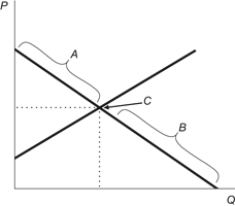 -(Figure: Demand Curve Sections) Refer to the figure. The section of the demand curve labeled B represents:
 (Multiple Choice)
5.0/5 (80)
(80) 
Filters
- Essay(0)
- Multiple Choice(0)
- Short Answer(0)
- True False(0)
- Matching(0)