



 Chat with AI
Exam 7: The Price System

Exam 1: The Big Ideas253 Questions
Exam 2: The Power of Trade and Comparative239 Questions
Exam 3: Supply and Demand249 Questions
Exam 4: Equilibrium256 Questions
Exam 5: Elasticity and Its Applications271 Questions
Exam 6: Taxes and Subsidies225 Questions
Exam 7: The Price System275 Questions
Exam 8: Price Ceilings and Floors327 Questions
Exam 9: International Trade195 Questions
Exam 10: Externalities- When the Price Is Not Right273 Questions
Exam 11: Costs and Profit Maximization Under Competition217 Questions
Exam 12: Competition and the Invisible Hand144 Questions
Exam 13: Monopoly233 Questions
Exam 14: Price Discrimination262 Questions
Exam 15: Oligopoly and Game Theory218 Questions
Exam 16: Competing for Monopoly160 Questions
Exam 17: Monopolistic Competition and Advertising113 Questions
Exam 18: Labor Markets262 Questions
Exam 19: Public Goods and the Tragedy of the Commons244 Questions
Exam 20: Political Economy and Public Choice306 Questions
Exam 21: Economics, Ethics, and Public Policy241 Questions
Exam 22: Managing Incentives263 Questions
Exam 23: Stock Markets and Personal Finance271 Questions
Exam 24: Price Discrimination151 Questions
Exam 25: Consumer Choice145 Questions
Select questions type


When oil prices increased in the 1970s, sellers began to grow roses in ________ countries and sell them in ________ countries.
(Multiple Choice)
4.7/5  (82)
(82) Figure: Price Changes 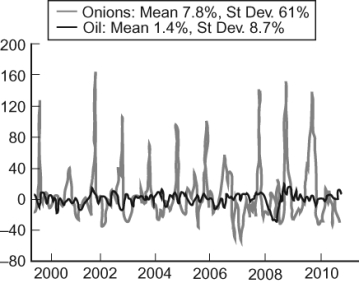 The figure (from Global Financial Data, EIA) illustrates in percentage terms how the price of onions (in gray) and crude oil (in black) fluctuate over time. The price of onions clearly fluctuates more than oil. In 1958, the United States Congress banned future markets on onions. How does this historical fact explain the difference in deviation between oil and onions?
 (Multiple Choice)
4.8/5 (75)
(75) If an increase in oil prices made it profitable to use corn-based ethanol for fuel and corncobs are a waste product of ethanol production, what will happen in the market for corncob pipes?
(Multiple Choice)
4.8/5 (87)
(87) Failing to understand the signaling role of prices, consumers would complain of ________ and politicians would call for ________.
(Multiple Choice)
4.8/5 (71)
(71) Which factor(s) contribute to the increased speed of trade across countries?
I. profit opportunities for sellers
II. better transportation networks
III. increased cooperation among countries
(Multiple Choice)
4.9/5 (84)
(84) Suppose that everyone believes war is about to break out in the Middle East, decreasing the supply of oil. One should:
(Multiple Choice)
4.8/5 (60)
(60) Use the following to answer questions:
Figure: Supply and Demand 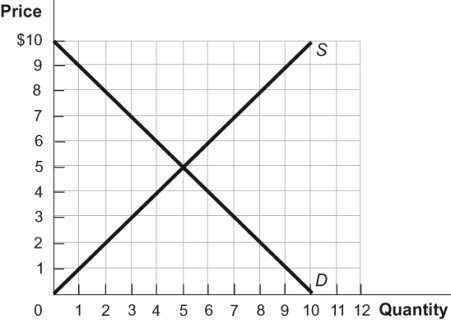 -(Figure: Supply and Demand) At the equilibrium price in the figure, the unsatisfied demanders are represented by the section of the demand curve between:
 (Multiple Choice)
4.7/5 (81)
(81) In a free market, the price of a good is equal to the value of the good:
(Multiple Choice)
4.9/5 (81)
(81) On average, the gain in value from speculation is less than the loss in value.
(True/False)
4.9/5 (87)
(87) If more sugar cane is demanded for ethanol production, ceteris paribus, the price of sugar is expected to increase.
(True/False)
4.8/5 (74)
(74) Which scenario would cause a speculator to "buy low and sell high"?
(Multiple Choice)
4.8/5 (74)
(74) Imagine the existence of prediction markets for political claims about the future. How might politics change?
(Multiple Choice)
4.8/5 (77)
(77) Prices are important in a market economy because they allocate goods into their highest-valued uses.
(True/False)
4.9/5 (75)
(75) Goods with uses valued higher than the market price represent satisfied wants.
(True/False)
4.8/5 (69)
(69) 
Filters
- Essay(0)
- Multiple Choice(0)
- Short Answer(0)
- True False(0)
- Matching(0)