



 Chat with AI
Exam 22: Protein Synthesis, posttranslational Modification, and Transport

Exam 1: Principles of Biochemistry98 Questions
Exam 2: Physical Biochemistry: Energy Conversion,water,and Membranes99 Questions
Exam 3: Nucleic Acid Structure and Function100 Questions
Exam 4: Protein Structure100 Questions
Exam 5: Methods in Protein Biochemistry98 Questions
Exam 6: Protein Function113 Questions
Exam 7: Enzyme Mechanisms105 Questions
Exam 8: Cell Signaling Systems102 Questions
Exam 9: Glycolysis: a Paradigm of Metabolic Regulation100 Questions
Exam 10: The Citrate Cycle100 Questions
Exam 11: Oxidative Phosphorylation98 Questions
Exam 12: Photosynthesis100 Questions
Exam 13: Carbohydrate Structure and Function100 Questions
Exam 14: Carbohydrate Metabolism100 Questions
Exam 15: Lipid Structure and Function98 Questions
Exam 16: Lipid Metabolism100 Questions
Exam 17: Amino Acid Metabolism100 Questions
Exam 18: Nucleotide Metabolism98 Questions
Exam 19: Metabolic Integration101 Questions
Exam 20: Dna Replication, repair, and Recombination99 Questions
Exam 21: Rna Synthesis, processing, and Gene Silencing100 Questions
Exam 22: Protein Synthesis, posttranslational Modification, and Transport100 Questions
Exam 23: Gene Regulation99 Questions
Select questions type


How many potential codons does the following mRNA sequence contain? CUCUCUCUCUCUC
(Multiple Choice)
4.8/5  (72)
(72) A common feature of translation in both eukaryotes and prokaryotes is
(Multiple Choice)
4.8/5 (76)
(76) Consider an in vitro experiment in which all components needed for protein synthesis are present.If tRNAs charged with radioactively labeled amino acids are added,over time the radioactivity would be located in which of the following components?
(Multiple Choice)
4.9/5 (73)
(73) Which of the following sequences is most likely a nuclear localization signal?
(Multiple Choice)
4.9/5 (72)
(72) tRNA interacts with ribosomes at one of three sites: the E site,the P site,and the __________ site.
(Multiple Choice)
4.7/5 (75)
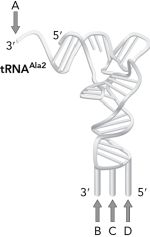
(75) 
If a protein is covalently modified by ubiquitin,it will be
(Multiple Choice)
4.9/5 (89)
(89) Identify the antibiotic shown below and illustrate how it functions to inhibit bacterial cell growth. 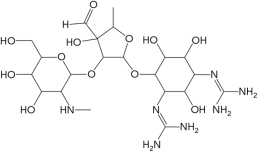
(Essay)
4.7/5 (90)
(90) Which antibiotic functions by inhibiting cell wall synthesis?
(Multiple Choice)
4.8/5 (87)
(87) How many GTP are hydrolyzed during a single round of translation elongation in a eukaryote?
(Multiple Choice)
4.8/5 (78)
(78) Where might the molecule shown below be located in both the prokaryotic and eukaryotic ribosome? 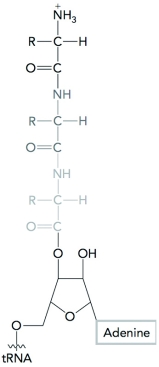
(Multiple Choice)
4.9/5 (86)
(86) If the following mRNA was added to a cell-free translation system,how many unique protein sequences would be generated? ACCACCACCACCACCACCACCACCACCACCACCACCACCACC
(Multiple Choice)
4.9/5 (82)
(82) An experiment with bacteria that has been exposed to an antibiotic reveals that the translocation step has been inhibited.Which antibiotic was likely used?
(Multiple Choice)
4.9/5 (87)
(87) Noncanonical base pairings of A and I would contain __________ hydrogen bonds.The base pairing of C and I would contain __________ hydrogen bonds.
(Multiple Choice)
4.8/5 (73)
(73) At any time during nuclear import and export,Ran can be found associated with all EXCEPT
(Multiple Choice)
4.9/5 (87)
(87) How does the wobble hypothesis allow for fewer than 63 tRNAs to effectively recognize 63 codons?
(Essay)
4.8/5 (82)
(82) Place the following steps in the elongation phase of translation in their proper order.
A.Peptide bond formation occurs.
B.GTP is hydrolyzed,and the ribosome moves one codon in the  direction.
C.GTP is hydrolyzed,and EF-Tu•GDP is released.
D.tRNA is released from the E site.
direction.
C.GTP is hydrolyzed,and EF-Tu•GDP is released.
D.tRNA is released from the E site. (Multiple Choice)
4.7/5 (90)
(90) A __________ is NOT a characteristic of the ER signal peptide sequence.
(Multiple Choice)
4.9/5 (78)
(78) Differentiate between type I and type II aminoacyl-tRNA synthetases in how they interact with the tRNA and acceptor stem.
(Essay)
4.8/5 (73)
(73) 
Filters
- Essay(0)
- Multiple Choice(0)
- Short Answer(0)
- True False(0)
- Matching(0)