



 Chat with AI
Exam 11: Enzyme Catalysis

Exam 1: Introduction to the Chemistry of Life56 Questions
Exam 2: Water59 Questions
Exam 3: Nucleotides, nucleic Acids, and Genetic Information67 Questions
Exam 4: Amino Acids68 Questions
Exam 5: Proteins: Primary Structure68 Questions
Exam 6: Proteins: Three-Dimensional Structure60 Questions
Exam 7: Protein Function Part I: Myoglobin and Hemoglobin74 Questions
Exam 8: Carbohydrates66 Questions
Exam 9: Lipids and Biological Membranes58 Questions
Exam 10: Membrane Transport49 Questions
Exam 11: Enzyme Catalysis53 Questions
Exam 12: Enzyme Kinetics, inhibition and Control54 Questions
Exam 13: Biochemical Signaling50 Questions
Exam 14: Introduction to Metabolism52 Questions
Exam 15: Glucose Catabolism50 Questions
Exam 16: Glycogen Metabolism and Gluconeogenesis50 Questions
Exam 17: Citric Acid Cycle50 Questions
Exam 18: Electron Transport and Oxidative Phosphorylation50 Questions
Exam 19: Photosynthesis50 Questions
Exam 20: Lipid Metabolism51 Questions
Exam 21: Amino Acid Metabolism50 Questions
Exam 22: Mammalian Fuel Metabolism: Integration and Regulation50 Questions
Exam 23: Nucleotide Metabolism50 Questions
Exam 24: Nucleic Acid Structure50 Questions
Exam 25: DNA Replication, repair and Recombination50 Questions
Exam 26: Transcription and Rna Processing50 Questions
Exam 27: Protein Synthesis49 Questions
Exam 28: Regulation of Gene Expression50 Questions
Select questions type


Enzyme X catalyzes the addition of a hydroxyl group to substrate Y.In the process a metal cofactor is reduced and then reoxidized.What class of enzyme is X?
(Multiple Choice)
4.8/5  (73)
(73) Simultaneous stimulation of a reaction by general acid and general base catalysis is defined as
(Multiple Choice)
4.7/5 (72)
(72) An uncatalyzed reaction has a rate of 4.2 × 10⁻⁷ sec-1.When an enzyme is added the rate is 3.2 × 10⁴ sec-1.Calculate the rate enhancement caused by the enzyme.
(Multiple Choice)
4.9/5 (86)
(86) Which type of catalysis may be carried out using redistribution of electron density to facilitate the transfer of a proton?
(I)proximity
(II)acid-base
(III)covalent
(IV)strain
(Multiple Choice)
4.8/5 (81)
(81) During the course of a catalytic reaction the following occurs: 1)Substrate is covalently bound and oriented with proximity to the active site residues.2)Negative charge builds up on the substrate and is stabilized.3)Oxidation of the enzyme followed by reduction to complete the catalytic cycle.What type of chemical species can facilitate these reactions?
(Multiple Choice)
4.7/5 (81)
(81) A recent discovery has suggested that a gene mutation results in several amino acid substitutions within an active site.The following substitutions have been identified and are each expected to form the active site:
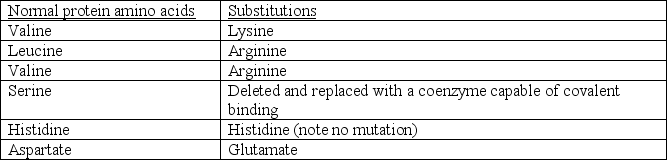 It was also noticed that a coenzyme molecule containing a hydroxyl (-OH)group binds to the mutated protein in approximately the same location as the original serine but does not alter the structure of the protein in anyway.Based on your knowledge of amino acids,enzymes,and catalysis,which of the following is a REASONABLE conclusion?
 (Multiple Choice)
4.9/5 (86)
(86) Why can histidine NOT act as a base in the lysosome (an organelle where the pH is close to 4.5)?
(Multiple Choice)
4.9/5 (63)
(63) ______ metals are the most common metallic enzyme cofactors.
(Multiple Choice)
4.8/5 (73)
(73) In affinity labeling,a technique used to study enzyme mechanisms,
(Multiple Choice)
4.7/5 (77)
(77) 
Filters
- Essay(0)
- Multiple Choice(0)
- Short Answer(0)
- True False(0)
- Matching(0)