



 Chat with AI
Exam 16: Glycogen Metabolism and Gluconeogenesis

Exam 1: Introduction to the Chemistry of Life56 Questions
Exam 2: Water59 Questions
Exam 3: Nucleotides, nucleic Acids, and Genetic Information67 Questions
Exam 4: Amino Acids68 Questions
Exam 5: Proteins: Primary Structure68 Questions
Exam 6: Proteins: Three-Dimensional Structure60 Questions
Exam 7: Protein Function Part I: Myoglobin and Hemoglobin74 Questions
Exam 8: Carbohydrates66 Questions
Exam 9: Lipids and Biological Membranes58 Questions
Exam 10: Membrane Transport49 Questions
Exam 11: Enzyme Catalysis53 Questions
Exam 12: Enzyme Kinetics, inhibition and Control54 Questions
Exam 13: Biochemical Signaling50 Questions
Exam 14: Introduction to Metabolism52 Questions
Exam 15: Glucose Catabolism50 Questions
Exam 16: Glycogen Metabolism and Gluconeogenesis50 Questions
Exam 17: Citric Acid Cycle50 Questions
Exam 18: Electron Transport and Oxidative Phosphorylation50 Questions
Exam 19: Photosynthesis50 Questions
Exam 20: Lipid Metabolism51 Questions
Exam 21: Amino Acid Metabolism50 Questions
Exam 22: Mammalian Fuel Metabolism: Integration and Regulation50 Questions
Exam 23: Nucleotide Metabolism50 Questions
Exam 24: Nucleic Acid Structure50 Questions
Exam 25: DNA Replication, repair and Recombination50 Questions
Exam 26: Transcription and Rna Processing50 Questions
Exam 27: Protein Synthesis49 Questions
Exam 28: Regulation of Gene Expression50 Questions
Select questions type


The glycogen debranching enzyme is required for

Free
(Multiple Choice)
4.9/5  (82)
(82) Correct Answer: Verified
D
Matching
Choose the correct answer from the list.Not all the answers will be used.
-Carboxylation of pyruvate in humans requires ______ as an essential dietary nutrient.
Free
(Multiple Choice)
4.8/5 (71)
(71) Correct Answer:Verified
VerifiedF
Phosphoprotein phosphatase -1 (PP1)
Free
(Multiple Choice)
4.8/5 (74)
(74) Correct Answer:Verified
VerifiedE
The diagram represents a "substrate cycle" in glucose metabolism.Which of the following statements about the cycle is true? 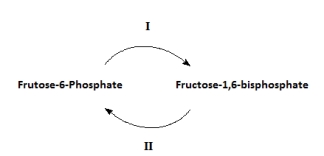
(Multiple Choice)
4.8/5 (79)
(79) Which of the following aides in formation of a primer for glycogen synthesis ?
(Multiple Choice)
4.8/5 (76)
(76) Which statement is true regarding the activation of pyruvate carboxylase by acetyl-CoA?
(Multiple Choice)
4.7/5 (74)
(74) Which enzyme below is NOT required for the synthesis of branched glycogen?
(Multiple Choice)
4.8/5 (80)
(80) Which of the following overall sequences is correct with regard to gluconeogenesis?
(Multiple Choice)
4.8/5 (66)
(66) Matching
Choose the correct answer from the list.Not all the answers will be used.
-The breakdown of glycogen is referred to as ______.
(Multiple Choice)
4.8/5 (74)
(74) Which of the following statements about glycogen is true?
(I)Glycogen is a polymer of glucose in (1 6)linkages with (1 4)linked branches every 8-14 residues.
(II)UDP-glucose is produced from glycogen by the action of the enzyme phosphorylase.
(III)In glycogen breakdown,glucose residues are sequentially removed from the nonreducing ends.
(IV)The breakdown of glycogen in skeletal muscle ultimately supplies glucose-6-phosphate,which can enter glycolysis to generate ATP.
(Multiple Choice)
4.7/5 (72)
(72) Matching
Choose the correct answer from the list.Not all the answers will be used.
-The membrane-bound polyisoprenol involved in the synthesis of N-linked glycoproteins is called ______.
(Multiple Choice)
4.9/5 (71)
(71) Patient "G" has a glycogen storage disease which results in decreased muscle glycogen levels.Muscle biopsies indicate poor glycogen structure in the muscle.Which of the following enzymes might be related to the cause?
(Multiple Choice)
4.8/5 (79)
(79) Matching
Choose the correct answer from the list.Not all the answers will be used.
-______ cells lack receptors for the hormone glucagon.
(Multiple Choice)
4.7/5 (86)
(86) Which of the following metabolic conversions involved in glucose synthesis requires the direct expenditure of ATP?
(I)3-Phosphoglycerate 1,3-bisphosphoglycerate
(II)Glyceraldehyde-3-phosphate + dihydroxyacetone phosphate fructose-1,6-bisphosphate
(III)Fructose-1,6-bisphosphate fructose-6-phosphate
(IV)1,3-Bisphosphoglycerate glyceraldehyde-3-phosphate
(Multiple Choice)
4.9/5 (81)
(81) Which of the following metabolic conversions does not occur in gluconeogenesis?
(Multiple Choice)
5.0/5 (63)
(63) Matching
Choose the correct answer from the list.Not all the answers will be used.
-The first step in the breakdown of glycogen is catalyzed by ______.
(Multiple Choice)
4.9/5 (79)
(79) Which of the following serves as the free energy source for the metabolic conversion of oxaloacetate to phosphoenolpyruvate,which is catalyzed by PEP carboxykinase?
(Multiple Choice)
4.7/5 (97)
(97) Which of the following best describes the role of fructose-2,6-bisphosphate (FBP)in liver cells?
(Multiple Choice)
4.9/5 (79)
(79) What is the net ATP yield for a muscle cell that stores one dietary glucose molecule as glycogen and then releases it and sends it through glycolysis?
(Multiple Choice)
4.8/5 (89)
(89) Which of the following best describes the function of the glycogen debranching enzyme in glycogenolysis?
(Multiple Choice)
4.8/5 (71)
(71) 
Filters
- Essay(0)
- Multiple Choice(0)
- Short Answer(0)
- True False(0)
- Matching(0)