



 Chat with AI
Exam 22: Mammalian Fuel Metabolism: Integration and Regulation

Exam 1: Introduction to the Chemistry of Life56 Questions
Exam 2: Water59 Questions
Exam 3: Nucleotides, nucleic Acids, and Genetic Information67 Questions
Exam 4: Amino Acids68 Questions
Exam 5: Proteins: Primary Structure68 Questions
Exam 6: Proteins: Three-Dimensional Structure60 Questions
Exam 7: Protein Function Part I: Myoglobin and Hemoglobin74 Questions
Exam 8: Carbohydrates66 Questions
Exam 9: Lipids and Biological Membranes58 Questions
Exam 10: Membrane Transport49 Questions
Exam 11: Enzyme Catalysis53 Questions
Exam 12: Enzyme Kinetics, inhibition and Control54 Questions
Exam 13: Biochemical Signaling50 Questions
Exam 14: Introduction to Metabolism52 Questions
Exam 15: Glucose Catabolism50 Questions
Exam 16: Glycogen Metabolism and Gluconeogenesis50 Questions
Exam 17: Citric Acid Cycle50 Questions
Exam 18: Electron Transport and Oxidative Phosphorylation50 Questions
Exam 19: Photosynthesis50 Questions
Exam 20: Lipid Metabolism51 Questions
Exam 21: Amino Acid Metabolism50 Questions
Exam 22: Mammalian Fuel Metabolism: Integration and Regulation50 Questions
Exam 23: Nucleotide Metabolism50 Questions
Exam 24: Nucleic Acid Structure50 Questions
Exam 25: DNA Replication, repair and Recombination50 Questions
Exam 26: Transcription and Rna Processing50 Questions
Exam 27: Protein Synthesis49 Questions
Exam 28: Regulation of Gene Expression50 Questions
Select questions type


Which of the following proteins stimulates the appetite?

Free
(Multiple Choice)
5.0/5  (78)
(78) Correct Answer: Verified
B
Insulin-dependent (type 1)diabetes
Free
(Multiple Choice)
4.9/5 (82)
(82) Correct Answer:Verified
VerifiedA
Matching
Choose the correct answer from the list.Not all the answers will be used.
-The endocrine glands secrete ______ which result in numerous cellular responses.
Free
(Multiple Choice)
4.9/5 (74)
(74) Correct Answer:Verified
VerifiedH
The metabolic fate(s)of glucose-6-phosphate include
(I)glycogen and glucose.
(II)ribose-5-phosphate
(III)acetyl-CoA.
(IV)DNA and RNA.
(Multiple Choice)
4.7/5 (76)
(76) Based on the information given in the chapter complete the following statement about the graph shown below: The curve labeled ___ corresponds to activity of glucokinase under conditions with no inhibition.The binding of ____ to the regulating protein would result in kinetic behavior represented by curve ____. 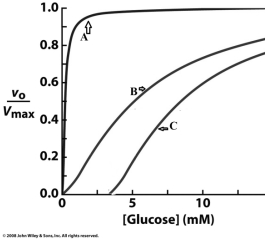
(Multiple Choice)
4.8/5 (86)
(86) Matching
Choose the correct answer from the list.Not all the answers will be used.
-The ______ stores very little glycogen and therefore requires a steady supply of glucose from the blood.
(Multiple Choice)
4.9/5 (89)
(89) Which of the following metabolizes ketone bodies?
(I)brain
(II)liver
(III)muscle
(IV)adipose tissue
(Multiple Choice)
4.8/5 (90)
(90) Which of the following best describes the function of AMP-dependent protein kinase (AMPK)?
(Multiple Choice)
4.7/5 (75)
(75) At low glucose concentrations (≤5mM),the majority of glucose produced by liver cells is due to the action of
(Multiple Choice)
4.8/5 (76)
(76) Aerobic activity in response to stress results in which of the following?
(I)Glycolysis occurs in the muscle.
(II)Glycolysis occurs in the liver.
(III)Glycogenolysis occurs in the muscle.
(IV)Glycogenolysis occurs in the liver.
(Multiple Choice)
4.8/5 (88)
(88) Evidence suggests that the lifespan of a rodent may be extended
(Multiple Choice)
4.8/5 (85)
(85) Metformin and thiazolidinediones (TZDs)are used to treat ____ and produce a(an)______ in AMPK activity.
(Multiple Choice)
4.9/5 (78)
(78) Which of the following reactions is catalyzed by adenylate cyclase?
(Multiple Choice)
4.9/5 (74)
(74) The interorgan pathway that allows transport of nitrogen from muscle to the liver utilizes ____ as an amino group acceptor in the transamination reaction generating _____.
(Multiple Choice)
4.8/5 (71)
(71) 
Filters
- Essay(0)
- Multiple Choice(0)
- Short Answer(0)
- True False(0)
- Matching(0)