



 Chat with AI
Exam 15: Glucose Catabolism

Exam 1: Introduction to the Chemistry of Life56 Questions
Exam 2: Water59 Questions
Exam 3: Nucleotides, nucleic Acids, and Genetic Information67 Questions
Exam 4: Amino Acids68 Questions
Exam 5: Proteins: Primary Structure68 Questions
Exam 6: Proteins: Three-Dimensional Structure60 Questions
Exam 7: Protein Function Part I: Myoglobin and Hemoglobin74 Questions
Exam 8: Carbohydrates66 Questions
Exam 9: Lipids and Biological Membranes58 Questions
Exam 10: Membrane Transport49 Questions
Exam 11: Enzyme Catalysis53 Questions
Exam 12: Enzyme Kinetics, inhibition and Control54 Questions
Exam 13: Biochemical Signaling50 Questions
Exam 14: Introduction to Metabolism52 Questions
Exam 15: Glucose Catabolism50 Questions
Exam 16: Glycogen Metabolism and Gluconeogenesis50 Questions
Exam 17: Citric Acid Cycle50 Questions
Exam 18: Electron Transport and Oxidative Phosphorylation50 Questions
Exam 19: Photosynthesis50 Questions
Exam 20: Lipid Metabolism51 Questions
Exam 21: Amino Acid Metabolism50 Questions
Exam 22: Mammalian Fuel Metabolism: Integration and Regulation50 Questions
Exam 23: Nucleotide Metabolism50 Questions
Exam 24: Nucleic Acid Structure50 Questions
Exam 25: DNA Replication, repair and Recombination50 Questions
Exam 26: Transcription and Rna Processing50 Questions
Exam 27: Protein Synthesis49 Questions
Exam 28: Regulation of Gene Expression50 Questions
Select questions type


Matching
Choose the correct answer from the list.Not all the answers will be used.
-______ is an inhibitor of enolase which was useful in elucidating the glycolytic pathway.

Free
(Multiple Choice)
5.0/5  (78)
(78) Correct Answer: Verified
K
Which of the following compounds contains a "high-energy" bond and is used to produce ATP by substrate-level phosphorylation in glycolysis?
Free
(Multiple Choice)
4.8/5 (89)
(89) Correct Answer:Verified
VerifiedC
Which of the following reactions does not occur in mammals?
Free
(Multiple Choice)
4.7/5 (92)
(92) Correct Answer:Verified
VerifiedE
Matching
Choose the correct answer from the list.Not all the answers will be used.
-NADPH used in lipid biosynthesis is produced by the ______ pathway.
(Multiple Choice)
4.7/5 (78)
(78) In which of the following metabolic conversions is ATP required during glycolysis?
(I)fructose-6-phosphate SYMBOL 174 \f "Symbol" fructose-1,6-bisphosphate
(II)glucose SYMBOL 174 \f "Symbol" glucose-6-phosphate
(III)fructose-1,6-bisphosphate SYMBOL 174 \f "Symbol" dihydroxyacetone phosphate + glyceraldehyde-3-phosphate
(IV)glucose-6-phosphate SYMBOL 174 \f "Symbol" fructose-6-phosphate
(Multiple Choice)
4.8/5 (76)
(76) The reaction catalyzed by the enzyme aldolase has a G˚' ≈ +23 kJ/mol.In muscle cells,the reaction proceeds in this same,forward direction.How can this occur?
(Multiple Choice)
4.8/5 (85)
(85) Phosphofructokinase is allosterically _____ by high concentrations of _____.
(I)activated;ATP
(II)inhibited;ATP
(III)inhibited;fructose-2,6-bisphosphate
(IV)activated;fructose -2,6-bisphosphate
(Multiple Choice)
4.9/5 (90)
(90) Glucose is converted to ______ in skeletal muscle under anaerobic conditions.
(Multiple Choice)
4.8/5 (86)
(86) Which of the following is correct regarding the hexose monophosphate shunt?
(I)NADH is generated by the oxidation of glucose-6-phosphate.
(II)Glyceraldehyde-3-phosphate is generated in the reaction.
(III)The pathway requires a transaldolase.
(IV)The pathway generates 3 ATP per 1 glucose-6-phosphate.
(Multiple Choice)
4.9/5 (95)
(95) Matching
Choose the correct answer from the list.Not all the answers will be used.
-The products of glycolysis include: ATP,NADH,and ______.
(Multiple Choice)
4.8/5 (85)
(85) Conversion of galactose to glucose
(I)requires an epimerase.
(II)requires uridine diphosphate.
(III)requires a transferase
(IV)requires an isomerase.
(Multiple Choice)
4.9/5 (78)
(78) Methanol is highly toxic,not because of its own activity,but because it is converted metabolically into formaldehyde,which is the actual poison.What enzyme catalyzes this conversion?
(Multiple Choice)
4.7/5 (62)
(62) Which of the following best explains why an enzyme hasn't evolved to catalyze the following reaction as the first step of glycolysis?
Glucose + Pi -> glucose-6-phosphate
(I)The use of ATP is required for this step to serve as a regulatory control point.
(II)The use of ATP is important because it helps keep its concentration low.Otherwise the high [ATP] would slow glycolysis too much through feedback inhibition.
(III)The large positive G˚' of this reaction would need to be overcome by an exceedingly high [Pi].
(IV)Inorganic phosphate cannot be specifically placed on the carbon in the 6th position.
(Multiple Choice)
4.9/5 (68)
(68) Matching
Choose the correct answer from the list.Not all the answers will be used.
-A genetic deficiency of a single transferase enzyme required for sugar group exchange causes the medical condition known as _____ which results in failure to thrive,mental retardation,and potential liver damage.
(Multiple Choice)
4.8/5 (71)
(71) Which of the following is true regarding glycolysis?
(I)There is a net oxidation of substrate carbon atoms.
(II)There is no net release of free energy.
(III)Pyruvate is generated only during aerobic glycolysis.
(IV)There is 2 ATP formed for every 2 glucose molecules.
)
(Multiple Choice)
4.9/5 (90)
(90) Consider the following portion of the glycolytic sequence catalyzed by the enzymes above the arrows.Which products(s)will produce ATP?

(Multiple Choice)
4.7/5 (86)
(86) Select the enzyme from the list which would catalyze the reaction shown below. 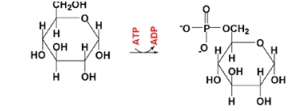
(Multiple Choice)
4.8/5 (104)
(104) 
Filters
- Essay(0)
- Multiple Choice(0)
- Short Answer(0)
- True False(0)
- Matching(0)