



 Chat with AI
Exam 16: Glycogen Metabolism and Gluconeogenesis

Exam 1: Introduction to the Chemistry of Life56 Questions
Exam 2: Water59 Questions
Exam 3: Nucleotides, nucleic Acids, and Genetic Information67 Questions
Exam 4: Amino Acids68 Questions
Exam 5: Proteins: Primary Structure68 Questions
Exam 6: Proteins: Three-Dimensional Structure60 Questions
Exam 7: Protein Function Part I: Myoglobin and Hemoglobin74 Questions
Exam 8: Carbohydrates66 Questions
Exam 9: Lipids and Biological Membranes58 Questions
Exam 10: Membrane Transport49 Questions
Exam 11: Enzyme Catalysis53 Questions
Exam 12: Enzyme Kinetics, inhibition and Control54 Questions
Exam 13: Biochemical Signaling50 Questions
Exam 14: Introduction to Metabolism52 Questions
Exam 15: Glucose Catabolism50 Questions
Exam 16: Glycogen Metabolism and Gluconeogenesis50 Questions
Exam 17: Citric Acid Cycle50 Questions
Exam 18: Electron Transport and Oxidative Phosphorylation50 Questions
Exam 19: Photosynthesis50 Questions
Exam 20: Lipid Metabolism51 Questions
Exam 21: Amino Acid Metabolism50 Questions
Exam 22: Mammalian Fuel Metabolism: Integration and Regulation50 Questions
Exam 23: Nucleotide Metabolism50 Questions
Exam 24: Nucleic Acid Structure50 Questions
Exam 25: DNA Replication, repair and Recombination50 Questions
Exam 26: Transcription and Rna Processing50 Questions
Exam 27: Protein Synthesis49 Questions
Exam 28: Regulation of Gene Expression50 Questions
Select questions type


Matching
Choose the correct answer from the list.Not all the answers will be used.
-______ activates glycogen breakdown.
(Multiple Choice)
4.8/5  (78)
(78) Which of the following enzymes directly converts phosphorylase b into the more active form,phosphorylase a?
(Multiple Choice)
4.9/5 (81)
(81) Increased levels of epinephrine in the blood will
(I)activate adenylate cyclase in liver and muscle cells.
(II)stimulate glycogen synthesis.
(III)inhibit glycolysis in the muscle cell.
(IV)stimulate gluconeogenesis in the muscle cell.
(Multiple Choice)
4.8/5 (86)
(86) Which of the following is true regarding the reaction shown below?
Pyruvate + HCO3− + ATP oxaloacetate + ADP + Pi
(I)It requires the direct transport of oxaloacetate across the membrane.
(II)It utilizes the malate-aspartate shuttle in some species.
(III)It is essential for gluconeogenesis.
(IV)Its reactants require the function of enzymes which are only found in the cytosol.
(Multiple Choice)
4.9/5 (79)
(79) Which statement is TRUE concerning the metabolic reaction shown below? 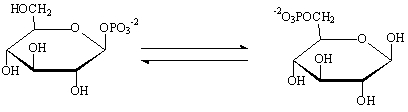
(Multiple Choice)
4.8/5 (74)
(74) Which of the following is correct concerning the metabolic reaction shown below?
Pyruvate + CO2 + ATP SYMBOL 174 \f "Symbol" oxaloacetate + ADP + Pi
(I)This metabolic reaction is catalyzed by pyruvate carboxykinase.
(II)The enzyme that catalyzes this reaction is activated by high concentrations of acetyl-CoA .
(III)The enzyme that catalyzes this reaction is covalently bonded to the coenzyme pyridoxal-5ꞌ-phosphate.
(IV)The enzyme that catalyzes this reaction is located in the endoplasmic reticulum of the cell .
(Multiple Choice)
4.9/5 (88)
(88) Individuals with McArdle's disease lack the ____ in the ____,
(Multiple Choice)
4.8/5 (67)
(67) What molecules correspond to correspond to X and Y in the following gluconeogenic reaction?
Fructose-1,6-bisphosphotase + X Fructose-6-phosphate + Y
(Multiple Choice)
4.9/5 (77)
(77) The synthesis of N-linked oligosaccharides occur in the _____ while O-linked oligosaccharides are synthesized in the ______.
(Multiple Choice)
4.9/5 (76)
(76) The biotin prosthetic group of pyruvate carboxylase is covalently attached to a ______ residue of the enzyme?
(Multiple Choice)
4.9/5 (84)
(84) 
Filters
- Essay(0)
- Multiple Choice(0)
- Short Answer(0)
- True False(0)
- Matching(0)