



 Chat with AI
Exam 11: Enzyme Catalysis

Exam 1: Introduction to the Chemistry of Life56 Questions
Exam 2: Water59 Questions
Exam 3: Nucleotides, nucleic Acids, and Genetic Information67 Questions
Exam 4: Amino Acids68 Questions
Exam 5: Proteins: Primary Structure68 Questions
Exam 6: Proteins: Three-Dimensional Structure60 Questions
Exam 7: Protein Function Part I: Myoglobin and Hemoglobin74 Questions
Exam 8: Carbohydrates66 Questions
Exam 9: Lipids and Biological Membranes58 Questions
Exam 10: Membrane Transport49 Questions
Exam 11: Enzyme Catalysis53 Questions
Exam 12: Enzyme Kinetics, inhibition and Control54 Questions
Exam 13: Biochemical Signaling50 Questions
Exam 14: Introduction to Metabolism52 Questions
Exam 15: Glucose Catabolism50 Questions
Exam 16: Glycogen Metabolism and Gluconeogenesis50 Questions
Exam 17: Citric Acid Cycle50 Questions
Exam 18: Electron Transport and Oxidative Phosphorylation50 Questions
Exam 19: Photosynthesis50 Questions
Exam 20: Lipid Metabolism51 Questions
Exam 21: Amino Acid Metabolism50 Questions
Exam 22: Mammalian Fuel Metabolism: Integration and Regulation50 Questions
Exam 23: Nucleotide Metabolism50 Questions
Exam 24: Nucleic Acid Structure50 Questions
Exam 25: DNA Replication, repair and Recombination50 Questions
Exam 26: Transcription and Rna Processing50 Questions
Exam 27: Protein Synthesis49 Questions
Exam 28: Regulation of Gene Expression50 Questions
Select questions type


The enzyme pictured below is shown in two configurations,A (open)and B (closed).Upon binding substrate in the active site,the enzyme converts the structure shown in B.Which of the following is true based on the given information? 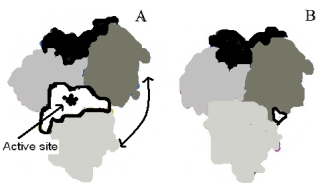
(Multiple Choice)
4.7/5  (59)
(59) Alcohol dehydrogenase catalyzes the conversion of methanol to _________ and is,therefore,classified as a(an)________.
(Multiple Choice)
4.9/5 (80)
(80) Matching
-Metal ion cofactors offer various ______ states that allow enzymes to accomplished oxidation reduction reactions.
(Multiple Choice)
4.7/5 (79)
(79) Curved arrows are conventionally used to illustrate the movement of
(Multiple Choice)
4.8/5 (78)
(78) Consider the Schiff base formation reaction discussed in the catalytic mechanisms section of the chapter.What would probably happen if the carboxylate group was stabilized by a nearby positive charge?
(Multiple Choice)
4.8/5 (82)
(82) A new serine protease was discovered that preferentially cleaves a peptide bond adjoining a negatively charged side chain.Which of the following is true?
(Multiple Choice)
4.8/5 (83)
(83) The catalytic mechanism of bovine pancreatic RNase A relies upon acid-base catalysis involving the amino acid __________.
(Multiple Choice)
5.0/5 (75)
(75) Matching
-Clustering several amino acid residues with appropriate pK values at an active site can promote a(n)_________ catalytic mechanism.
(Multiple Choice)
4.9/5 (72)
(72) Matching
-On a transition state diagram for a one-step very spontaneous reaction a large peak (high G‡)would imply a ______ rate for the reaction.
(Multiple Choice)
4.8/5 (78)
(78) Proton transfer from an acid,lowering the free energy of a reaction's transition state,is characteristic of
(Multiple Choice)
4.8/5 (83)
(83) In the serine protease trypsin,the specificity for one substrate over another describes what type of catalysis?
(Multiple Choice)
4.9/5 (80)
(80) Which one of the following is correct?
(I)All enzymes are highly specific for the reactions they catalyze.
(II)Prosthetic groups are loosely associated with the polypeptide chain of an enzyme.
(III)If an enzyme-catalyzed reaction requires a group with a low pK to be deprotonated and a group with a higher pK to be protonated,the pH vs.rate curve will have a peak in the middle of the two pK values.
(IV)When comparing types of catalysis,the proximity effect provides the largest rate enhancement.
(Multiple Choice)
4.7/5 (80)
(80) The following diagram shows a portion of a reaction sequence of an enzyme.What type(s)of catalysis is (are)occurring in this first step? 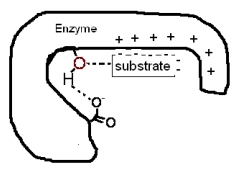
(Multiple Choice)
4.8/5 (84)
(84) A peptide with the sequence "Glu-Ser-Val-Asp-Lys" will likely be cut next to "Val" rapidly by _______ and very slowly by ____.
(I)chymotrypsin
(II)trypsin
(III)trypsinogen
(IV)elastase
(Multiple Choice)
4.7/5 (74)
(74) Matching
-On a transition state diagram for a multistep reaction,the step with the greatest G is the ______.
(Multiple Choice)
4.7/5 (73)
(73) Which of the following is TRUE about enzymes?
(I)Enzymes typically catalyze reactions at much higher rates than chemical catalyst.
(II)Enzymes are often very specific for their substrates.
(III)Enzyme activities can often be regulated.
(IV)Enzymes typically act under milder conditions of temperature and pH than chemical catalysts.
(Multiple Choice)
4.9/5 (79)
(79) Lysozyme requires _____ for effective catalysis.
(I)an Asp in a nonpolar environment
(II)a negatively charged Asp
(III)a Glu that functions as an acid catalyst
(IV)a Glu that is deprotonated
(Multiple Choice)
4.7/5 (60)
(60) Which of the following processes would yield and increase in rate?
(Multiple Choice)
4.8/5 (86)
(86) Matching
-If an enzyme-catalyzed reaction has a low rate at low pH and high rate at higher pH,this implies that a group on either the enzyme or the substrate must be ______ for an efficient reaction.
(Multiple Choice)
4.9/5 (83)
(83) 
Filters
- Essay(0)
- Multiple Choice(0)
- Short Answer(0)
- True False(0)
- Matching(0)