



 Chat with AI
Exam 10: Consumer Choice and Behavioral Economics

Exam 1: Economics: Foundations and Models444 Questions
Exam 2: Trade-Offs, Comparative Advantage, and the Market System498 Questions
Exam 3: Where Prices Come From: the Interaction of Demand and Supply475 Questions
Exam 4: Economic Efficiency, Government Price Setting, and Taxes419 Questions
Exam 5: Externalities, Environmental Policy, and Public Goods266 Questions
Exam 6: Elasticity: the Responsiveness of Demand and Supply295 Questions
Exam 7: The Economics of Health Care334 Questions
Exam 8: Firms, the Stock Market, and Corporate Governance278 Questions
Exam 9: Comparative Advantage and the Gains From International Trade379 Questions
Exam 10: Consumer Choice and Behavioral Economics302 Questions
Exam 11: Technology, Production, and Costs330 Questions
Exam 12: Firms in Perfectly Competitive Markets298 Questions
Exam 13: Monopolistic Competition: the Competitive Model in a More Realistic Setting276 Questions
Exam 14: Oligopoly: Firms in Less Competitive Markets262 Questions
Exam 15: Monopoly and Antitrust Policy271 Questions
Exam 16: Pricing Strategy263 Questions
Exam 17: The Markets for Labor and Other Factors of Production286 Questions
Exam 18: Public Choice, Taxes, and the Distribution of Income258 Questions
Exam 19: GDP: Measuring Total Production and Income266 Questions
Exam 20: Unemployment and Inflation292 Questions
Exam 21: Economic Growth, the Financial System, and Business Cycles257 Questions
Exam 22: Long-Run Economic Growth: Sources and Policies268 Questions
Exam 23: Aggregate Expenditure and Output in the Short Run306 Questions
Exam 24: Aggregate Demand and Aggregate Supply Analysis284 Questions
Exam 25: Money, Banks, and the Federal Reserve System280 Questions
Exam 26: Monetary Policy277 Questions
Exam 27: Fiscal Policy303 Questions
Exam 28: Inflation, Unemployment, and Federal Reserve Policy257 Questions
Exam 29: Macroeconomics in an Open Economy278 Questions
Exam 30: The International Financial System262 Questions
Select questions type


The word "util" has been used by economists in the past as an objective measure of utility. Today economists believe that
(Multiple Choice)
4.9/5  (77)
(77) Suppose your marginal utility from consuming the 3rd slice of cake is zero, then your total utility from consuming cake is
(Multiple Choice)
4.9/5 (60)
(60) The highest-valued alternative that must be given up to engage in an activity is the definition of
(Multiple Choice)
4.8/5 (79)
(79) The Wong family consumes 3 pounds of fish and 5 pounds of chicken per month. The price of fish is $8 per pound and chicken is $4 per pound.
a. What is the amount of income allocated to fish and chicken consumption?
b. What is the price ratio (the price of fish relative to the price of chicken)?
c. Explain the meaning of the price ratio you computed.
d. If the Wongs maximize utility, what is the ratio of the marginal utility of fish to the marginal utility of chicken?
e. If the price of chicken rises, will the Wong family consume more chicken, less chicken or the same amount of chicken? Explain your answer using the rule of equal marginal utility per dollar.
(Essay)
4.9/5 (77)
(77) Which of the following is a common mistake made by consumers?
(Multiple Choice)
4.7/5 (86)
(86) Identify the one statement that does not demonstrate how social effects influence consumer choice.
(Multiple Choice)
4.8/5 (72)
(72) Vinny consumes tacos and chicken wings. To keep his utility constant, he must consume more tacos if he consumes fewer chicken wings. This means that
(Multiple Choice)
4.9/5 (88)
(88) Lilly Davis has $5 per week to spend on any combination of ice cream and candy. The price of an ice cream cone is $2 and the price of a candy bar is $1. The table below shows Lilly's utility values. Use the table to answer the questions that follow the table.
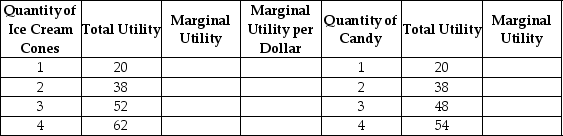 a. Complete the table by filling in the blank spaces.
b. Suppose Lilly purchases 2 ice cream cones and 1 candy bar. Is she consuming the optimal consumption bundle? If so, explain why. If not, what combination should she buy and why?
a. Complete the table by filling in the blank spaces.
b. Suppose Lilly purchases 2 ice cream cones and 1 candy bar. Is she consuming the optimal consumption bundle? If so, explain why. If not, what combination should she buy and why? (Essay)
4.7/5 (87)
(87) Figure 10-9  -Refer to Figure 10-9. The change in the budget constraint from BC1 to BC2 implies
 (Multiple Choice)
4.7/5 (80)
(80) What is an indifference curve? Why can indifference curves never cross?
(Essay)
4.8/5 (82)
(82) Consumers maximize total utility within their budget constraint by
(Multiple Choice)
4.8/5 (73)
(73) The demand curve for an inferior good can never be downward sloping.
(True/False)
4.9/5 (66)
(66) Table 10-2
 Table 10-2 above shows Keira's utility from soup and sandwiches. The price of soup is $2 per cup and the price of a sandwich is $3. Keira has $18 to spend on these two goods.
-Refer to Table 10-2. What is Keira's marginal utility per dollar spent on the third cup of soup?
Table 10-2 above shows Keira's utility from soup and sandwiches. The price of soup is $2 per cup and the price of a sandwich is $3. Keira has $18 to spend on these two goods.
-Refer to Table 10-2. What is Keira's marginal utility per dollar spent on the third cup of soup? (Multiple Choice)
4.9/5 (77)
(77) One possible reason as to why consumers respond to sales is that by displaying a "high" regular price and a "low" sale price, sales provide consumers with a reference point to interpret the prices being offered.
(True/False)
5.0/5 (84)
(84) What must be true in terms of the income effect, the substitution effect, and the type of good for the good's demand curve to be upward sloping?
(Essay)
4.8/5 (84)
(84) Figure 10-2  Figure 10-2 represents the demand for ice cream cones.
-Goods with upward sloping demand curves are referred to as
Figure 10-2 represents the demand for ice cream cones.
-Goods with upward sloping demand curves are referred to as (Multiple Choice)
4.8/5 (78)
(78) 
Filters
- Essay(0)
- Multiple Choice(0)
- Short Answer(0)
- True False(0)
- Matching(0)