



 Chat with AI
Exam 10: Consumer Choice and Behavioral Economics

Exam 1: Economics: Foundations and Models444 Questions
Exam 2: Trade-Offs, Comparative Advantage, and the Market System498 Questions
Exam 3: Where Prices Come From: the Interaction of Demand and Supply475 Questions
Exam 4: Economic Efficiency, Government Price Setting, and Taxes419 Questions
Exam 5: Externalities, Environmental Policy, and Public Goods266 Questions
Exam 6: Elasticity: the Responsiveness of Demand and Supply295 Questions
Exam 7: The Economics of Health Care334 Questions
Exam 8: Firms, the Stock Market, and Corporate Governance278 Questions
Exam 9: Comparative Advantage and the Gains From International Trade379 Questions
Exam 10: Consumer Choice and Behavioral Economics302 Questions
Exam 11: Technology, Production, and Costs330 Questions
Exam 12: Firms in Perfectly Competitive Markets298 Questions
Exam 13: Monopolistic Competition: the Competitive Model in a More Realistic Setting276 Questions
Exam 14: Oligopoly: Firms in Less Competitive Markets262 Questions
Exam 15: Monopoly and Antitrust Policy271 Questions
Exam 16: Pricing Strategy263 Questions
Exam 17: The Markets for Labor and Other Factors of Production286 Questions
Exam 18: Public Choice, Taxes, and the Distribution of Income258 Questions
Exam 19: GDP: Measuring Total Production and Income266 Questions
Exam 20: Unemployment and Inflation292 Questions
Exam 21: Economic Growth, the Financial System, and Business Cycles257 Questions
Exam 22: Long-Run Economic Growth: Sources and Policies268 Questions
Exam 23: Aggregate Expenditure and Output in the Short Run306 Questions
Exam 24: Aggregate Demand and Aggregate Supply Analysis284 Questions
Exam 25: Money, Banks, and the Federal Reserve System280 Questions
Exam 26: Monetary Policy277 Questions
Exam 27: Fiscal Policy303 Questions
Exam 28: Inflation, Unemployment, and Federal Reserve Policy257 Questions
Exam 29: Macroeconomics in an Open Economy278 Questions
Exam 30: The International Financial System262 Questions
Select questions type


The substitution effect of a price increase causes a decrease in the quantity demanded of an inferior good.
(True/False)
4.7/5  (76)
(76) The increase in consumption of a good when its price falls is caused by two effects. What are these two effects? Explain the difference between these effects.
(Essay)
4.9/5 (85)
(85) Which of the following is held constant along an indifference curve?
(Multiple Choice)
4.8/5 (68)
(68) The income effect of a price increase for a Giffen good outweighs the substitution effect.
(True/False)
4.8/5 (75)
(75) Economists have used ________ and ________ in experiments designed to determine whether consumers care about fairness when they make decisions.
(Multiple Choice)
5.0/5 (96)
(96) Arnold Kim began blogging about Apple products during his fourth year of medical school. Kim's website, MacRumors.com, became so successful that he decided to give up his medical career and work full time on his website, despite the nearly $200,000 he had invested in his education. In making his decision, the $200,000 he spent on his education
(Multiple Choice)
4.8/5 (80)
(80) If marginal utility of apples is diminishing and is a positive amount, consuming one more apple will cause
(Multiple Choice)
4.7/5 (76)
(76) The income effect of a decrease in the price of legal services, a normal good, results in
(Multiple Choice)
4.7/5 (81)
(81) If you received negative marginal utility from consuming the 4th slice of pizza, then your total utility from 4 slices of pizza must be less than your total utility from 3 slices of pizza.
(True/False)
4.9/5 (83)
(83) Consider a downward-sloping demand curve. When the price of a normal good increases, the income and substitution effects
(Multiple Choice)
4.8/5 (86)
(86) Figure 10-7  Manuri has $300 to spend on Pilates classes and Yoga classes. The price of a group Pilates class is $20 and the price of a group Yoga class is $10. Manuri's optimal bundle is given by "A" in Figure 10-7.
-Refer to Figure 10-7. Suppose the price of Pilates sessions rises to $30 while income and the price of Yoga sessions remain unchanged. What is her new optimal bundle?
Manuri has $300 to spend on Pilates classes and Yoga classes. The price of a group Pilates class is $20 and the price of a group Yoga class is $10. Manuri's optimal bundle is given by "A" in Figure 10-7.
-Refer to Figure 10-7. Suppose the price of Pilates sessions rises to $30 while income and the price of Yoga sessions remain unchanged. What is her new optimal bundle? (Multiple Choice)
4.9/5 (77)
(77) You participate in a taste test for a new protein supplement called "Boost." You are given five consecutive one ounce vials of the supplement and after consuming each vial you are asked to note your reaction. You consume the first vial and your response is: "Hmmm, quite good!" After the second, you say, "Not bad at all." After the third, you note, "It's alright." and after the fourth you wince, "No more, the after-taste is getting to me. I need water." What economic principle does this scenario illustrate? Define the principle.
(Essay)
4.9/5 (71)
(71) In making decisions about what to consume, a person's goal is to
(Multiple Choice)
4.9/5 (71)
(71) A standard which came to the market first, such as the QWERTY letter layout in typewriters, can become entrenched (this layout is still used in computer keyboards today). What is this phenomenon called?
(Multiple Choice)
4.8/5 (80)
(80) Avner is maximizing total utility by buying sports magazines and protein supplements. For him to buy more sports magazines,
(Multiple Choice)
4.7/5 (80)
(80) An advantage of Microsoft windows is its compatibility with the widest range of hardware and software. The dominance of Windows is self-reinforcing: hardware and software manufacturers ensure that their products are compatible with Windows in order to have access to the large number of Windows users. Which principle best describes this scenario?
(Multiple Choice)
4.8/5 (84)
(84) Figure 10-8 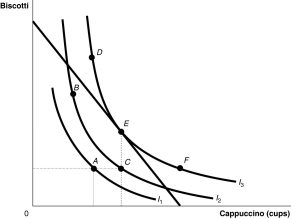 -Refer to Figure 10-8. Given the budget constraint in the diagram, which of the following statements is false?
 (Multiple Choice)
4.7/5 (86)
(86) 
Filters
- Essay(0)
- Multiple Choice(0)
- Short Answer(0)
- True False(0)
- Matching(0)