



 Chat with AI
Exam 10: Consumer Choice and Behavioral Economics

Exam 1: Economics: Foundations and Models444 Questions
Exam 2: Trade-Offs, Comparative Advantage, and the Market System498 Questions
Exam 3: Where Prices Come From: the Interaction of Demand and Supply475 Questions
Exam 4: Economic Efficiency, Government Price Setting, and Taxes419 Questions
Exam 5: Externalities, Environmental Policy, and Public Goods266 Questions
Exam 6: Elasticity: the Responsiveness of Demand and Supply295 Questions
Exam 7: The Economics of Health Care334 Questions
Exam 8: Firms, the Stock Market, and Corporate Governance278 Questions
Exam 9: Comparative Advantage and the Gains From International Trade379 Questions
Exam 10: Consumer Choice and Behavioral Economics302 Questions
Exam 11: Technology, Production, and Costs330 Questions
Exam 12: Firms in Perfectly Competitive Markets298 Questions
Exam 13: Monopolistic Competition: the Competitive Model in a More Realistic Setting276 Questions
Exam 14: Oligopoly: Firms in Less Competitive Markets262 Questions
Exam 15: Monopoly and Antitrust Policy271 Questions
Exam 16: Pricing Strategy263 Questions
Exam 17: The Markets for Labor and Other Factors of Production286 Questions
Exam 18: Public Choice, Taxes, and the Distribution of Income258 Questions
Exam 19: GDP: Measuring Total Production and Income266 Questions
Exam 20: Unemployment and Inflation292 Questions
Exam 21: Economic Growth, the Financial System, and Business Cycles257 Questions
Exam 22: Long-Run Economic Growth: Sources and Policies268 Questions
Exam 23: Aggregate Expenditure and Output in the Short Run306 Questions
Exam 24: Aggregate Demand and Aggregate Supply Analysis284 Questions
Exam 25: Money, Banks, and the Federal Reserve System280 Questions
Exam 26: Monetary Policy277 Questions
Exam 27: Fiscal Policy303 Questions
Exam 28: Inflation, Unemployment, and Federal Reserve Policy257 Questions
Exam 29: Macroeconomics in an Open Economy278 Questions
Exam 30: The International Financial System262 Questions
Select questions type


Jamal, Lawson and Kyle have been standing in line for almost an hour waiting to be served at Kirala, a popular new Japanese restaurant. It is possible that some of the people in line won't be served at all before the restaurant closes. Which of the following could explain why the restaurant does not simply raise prices high enough to eliminate the lines? a. In situations where consumption takes place publicly, demand for the product is also influenced by how many other people are buying the product. Consequently, a popular restaurant that increased its prices enough to eliminate lines might find that it had also eliminated its popularity.
B. Firms may sometimes not raise their prices for fear that it violates people's sense of fairness and might alienate customers.
C. The demand for restaurant meals is relatively elastic and if the firm raise prices it will lower its profits.
(Multiple Choice)
4.8/5  (73)
(73) Economists have shown that when the ultimatum game experiment is carried out, both allocators and recipients act as if fairness is important.
(True/False)
5.0/5 (76)
(76) If the marginal utility Ida Mae receives from eating chicken wings is negative, then
(Multiple Choice)
4.9/5 (90)
(90) Why do many film processing companies have a policy of printing every picture on a roll of film or a memory card, even if the picture is very fuzzy and customers are allowed to ask for refunds on any pictures they do not like?
(Essay)
4.9/5 (85)
(85) Suppose the consumer's income increases while the prices of the goods remain constant. Then the
(Multiple Choice)
5.0/5 (86)
(86) A network externality refers to a situation in which the usefulness of a product decreases with the number of consumers who use it.
(True/False)
4.8/5 (67)
(67) Which of the following is explained by the law of diminishing marginal utility?
(Multiple Choice)
4.8/5 (79)
(79) When the price of audio books, a normal good, falls, causing your purchasing power to rise, you buy more of them due to
(Multiple Choice)
4.9/5 (68)
(68) Arnold Kim began blogging about Apple products during his fourth year of medical school. Kim's Website, MacRumors.com, became so successful that he decided to give up his medical career and work full time on his Website, despite the nearly $200,000 he had invested in his education. In making his decision, Kim decided to ignore the money and time he spent on his education. Economists would say that Kim made a
(Multiple Choice)
4.7/5 (77)
(77) Grace Makutsi finally bought a pair of blue shoes that she had been coveting for a long time. In less than a week she discovered that the shoes were uncomfortable. Grace went back to wearing her old pair and stashed away the new pair. When asked by her boss, Mme. Ramotswe why does she not simply give away the new pair, she said: "But I paid so much for them." Grace's behavior
(Multiple Choice)
4.8/5 (68)
(68) Table 10-3
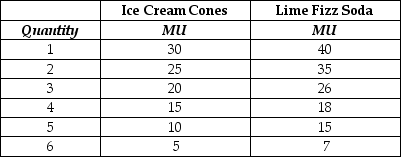 -Refer to Table 10-3. The table above shows Lee's marginal utility per dollar from consuming ice cream cones and cans of Lime Fizz Soda. The price of an ice cream cone is $2 and the price of Lime Fizz Soda is $1. Use this information to select the correct statement.
 (Multiple Choice)
4.8/5 (76)
(76) Why might network externalities result in products that contain inferior technologies?
(Essay)
4.8/5 (82)
(82) Table 10-2
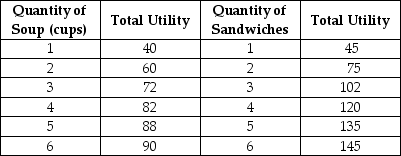 Table 10-2 above shows Keira's utility from soup and sandwiches. The price of soup is $2 per cup and the price of a sandwich is $3. Keira has $18 to spend on these two goods.
-Refer to Table 10-2. If Keira maximizes her utility, how many units of each good should she buy?
Table 10-2 above shows Keira's utility from soup and sandwiches. The price of soup is $2 per cup and the price of a sandwich is $3. Keira has $18 to spend on these two goods.
-Refer to Table 10-2. If Keira maximizes her utility, how many units of each good should she buy? (Multiple Choice)
4.9/5 (70)
(70) If Lisa spends her income on veggie burgers and pints of soy milk and the price of veggie burgers is three times the price of a pint of soy milk, then when Lisa maximizes her utility she will buy
(Multiple Choice)
4.9/5 (62)
(62) 
Filters
- Essay(0)
- Multiple Choice(0)
- Short Answer(0)
- True False(0)
- Matching(0)