



 Chat with AI
Exam 10: Consumer Choice and Behavioral Economics

Exam 1: Economics: Foundations and Models444 Questions
Exam 2: Trade-Offs, Comparative Advantage, and the Market System498 Questions
Exam 3: Where Prices Come From: the Interaction of Demand and Supply475 Questions
Exam 4: Economic Efficiency, Government Price Setting, and Taxes419 Questions
Exam 5: Externalities, Environmental Policy, and Public Goods266 Questions
Exam 6: Elasticity: the Responsiveness of Demand and Supply295 Questions
Exam 7: The Economics of Health Care334 Questions
Exam 8: Firms, the Stock Market, and Corporate Governance278 Questions
Exam 9: Comparative Advantage and the Gains From International Trade379 Questions
Exam 10: Consumer Choice and Behavioral Economics302 Questions
Exam 11: Technology, Production, and Costs330 Questions
Exam 12: Firms in Perfectly Competitive Markets298 Questions
Exam 13: Monopolistic Competition: the Competitive Model in a More Realistic Setting276 Questions
Exam 14: Oligopoly: Firms in Less Competitive Markets262 Questions
Exam 15: Monopoly and Antitrust Policy271 Questions
Exam 16: Pricing Strategy263 Questions
Exam 17: The Markets for Labor and Other Factors of Production286 Questions
Exam 18: Public Choice, Taxes, and the Distribution of Income258 Questions
Exam 19: GDP: Measuring Total Production and Income266 Questions
Exam 20: Unemployment and Inflation292 Questions
Exam 21: Economic Growth, the Financial System, and Business Cycles257 Questions
Exam 22: Long-Run Economic Growth: Sources and Policies268 Questions
Exam 23: Aggregate Expenditure and Output in the Short Run306 Questions
Exam 24: Aggregate Demand and Aggregate Supply Analysis284 Questions
Exam 25: Money, Banks, and the Federal Reserve System280 Questions
Exam 26: Monetary Policy277 Questions
Exam 27: Fiscal Policy303 Questions
Exam 28: Inflation, Unemployment, and Federal Reserve Policy257 Questions
Exam 29: Macroeconomics in an Open Economy278 Questions
Exam 30: The International Financial System262 Questions
Select questions type


Figure 10-2  Figure 10-2 represents the demand for ice cream cones.
-Refer to Figure 10-2. When the price of ice cream cones increases from $2 to $3, quantity demanded decreases from 4 ice cream cones to 3 ice cream cones. This change in quantity demanded is due to
Figure 10-2 represents the demand for ice cream cones.
-Refer to Figure 10-2. When the price of ice cream cones increases from $2 to $3, quantity demanded decreases from 4 ice cream cones to 3 ice cream cones. This change in quantity demanded is due to (Multiple Choice)
4.8/5  (86)
(86) Economists have used the ultimatum game and the dictator game in experiments designed to determine
(Multiple Choice)
4.8/5 (74)
(74) Consumers have to make tradeoffs in deciding what to consume because
(Multiple Choice)
4.8/5 (81)
(81) Figure 10-5  -Refer to Figure 10-5. The consumer can afford consumption bundles
 (Multiple Choice)
4.8/5 (78)
(78) Health Clubs typically experience an increase in one-year memberships in January, but many new customers cancel their memberships before the end of the year. Which of the following is the best explanation for this behavior?
(Multiple Choice)
4.8/5 (72)
(72) If Dawson prefers pizza to hamburgers and hamburgers to hot dogs, then if preferences are transitive,
(Multiple Choice)
4.7/5 (76)
(76) An increase in income results in an outward shift of an indifference curve.
(True/False)
4.8/5 (62)
(62) Table 10-2
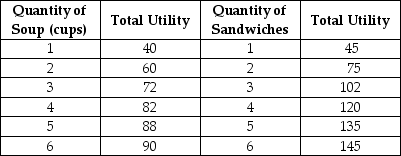 Table 10-2 above shows Keira's utility from soup and sandwiches. The price of soup is $2 per cup and the price of a sandwich is $3. Keira has $18 to spend on these two goods.
-Refer to Table 10-2. Holding prices constant, when Keira's income changed from $18 to $23, her utility maximizing bundle changed. Based on your answers to her optimal choices at the two income levels, what type of goods are soup and sandwiches?
Table 10-2 above shows Keira's utility from soup and sandwiches. The price of soup is $2 per cup and the price of a sandwich is $3. Keira has $18 to spend on these two goods.
-Refer to Table 10-2. Holding prices constant, when Keira's income changed from $18 to $23, her utility maximizing bundle changed. Based on your answers to her optimal choices at the two income levels, what type of goods are soup and sandwiches? (Multiple Choice)
4.9/5 (93)
(93) In an experiment that employed the dictator game, economists at Cornell University gave student "allocators" the option of dividing $20 in only two ways (a) $18 for themselves and $2 to another student, or (b) $10 for themselves and $10 to another student. What was one result from this experiment?
(Multiple Choice)
4.8/5 (84)
(84) For which of the following products is social influence likely to have the greatest impact?
(Multiple Choice)
4.9/5 (76)
(76) Figure 10-9  -Refer to Figure 10-9. If the consumer has $240 to spend on DVDs and CDs, what is the price of a CD if the budget constraint is BC2?
 (Multiple Choice)
4.8/5 (69)
(69) Consider a downward-sloping demand curve. When the price of a normal good decreases, the income and substitution effects
(Multiple Choice)
4.7/5 (83)
(83) Behavioral economics is the study of situations in which people make rational choices.
(True/False)
4.8/5 (92)
(92) A common mistake made by consumers is the failure to take into account the sunk costs of their actions.
(True/False)
4.8/5 (77)
(77) Standard economic theory asserts that sunk costs are irrelevant in making economic decisions, yet studies conducted by behavioral economists reveal that sunk costs often affect economic decisions. Which of the following could explain this observation?
(Multiple Choice)
4.8/5 (73)
(73) In a survey of consumers, Daniel Kaheman, Jack Knetsch and Richard Thaler asked their opinion of a hardware store's decision to
(Multiple Choice)
4.9/5 (69)
(69) Table 10-1
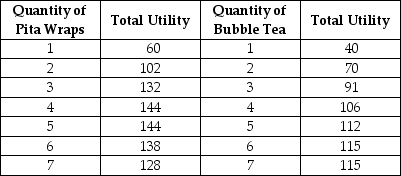 Keegan has $30 to spend on Pita Wraps and Bubble Tea. The price of a Pita Wrap is $6 and the price of a glass of Bubble Tea is $3. Table 10-1 shows his total utility from different quantities of the two items.
-Refer to Table 10-1. If Keegan can drink all the bubble tea he wants for free, how many glasses will he consume?
Keegan has $30 to spend on Pita Wraps and Bubble Tea. The price of a Pita Wrap is $6 and the price of a glass of Bubble Tea is $3. Table 10-1 shows his total utility from different quantities of the two items.
-Refer to Table 10-1. If Keegan can drink all the bubble tea he wants for free, how many glasses will he consume? (Multiple Choice)
4.7/5 (94)
(94) The marginal rate of substitution is determined by the slope of an indifference curve.
(True/False)
4.7/5 (81)
(81) The substitution effect of a change in the price of cauliflower is the portion of the change in the quantity of cauliflower demanded that can be attributed to the change in the price of a substitute vegetable such as asparagus.
(True/False)
4.7/5 (78)
(78) 
Filters
- Essay(0)
- Multiple Choice(0)
- Short Answer(0)
- True False(0)
- Matching(0)