



 Chat with AI
Exam 10: Consumer Choice and Behavioral Economics

Exam 1: Economics: Foundations and Models444 Questions
Exam 2: Trade-Offs, Comparative Advantage, and the Market System498 Questions
Exam 3: Where Prices Come From: the Interaction of Demand and Supply475 Questions
Exam 4: Economic Efficiency, Government Price Setting, and Taxes419 Questions
Exam 5: Externalities, Environmental Policy, and Public Goods266 Questions
Exam 6: Elasticity: the Responsiveness of Demand and Supply295 Questions
Exam 7: The Economics of Health Care334 Questions
Exam 8: Firms, the Stock Market, and Corporate Governance278 Questions
Exam 9: Comparative Advantage and the Gains From International Trade379 Questions
Exam 10: Consumer Choice and Behavioral Economics302 Questions
Exam 11: Technology, Production, and Costs330 Questions
Exam 12: Firms in Perfectly Competitive Markets298 Questions
Exam 13: Monopolistic Competition: the Competitive Model in a More Realistic Setting276 Questions
Exam 14: Oligopoly: Firms in Less Competitive Markets262 Questions
Exam 15: Monopoly and Antitrust Policy271 Questions
Exam 16: Pricing Strategy263 Questions
Exam 17: The Markets for Labor and Other Factors of Production286 Questions
Exam 18: Public Choice, Taxes, and the Distribution of Income258 Questions
Exam 19: GDP: Measuring Total Production and Income266 Questions
Exam 20: Unemployment and Inflation292 Questions
Exam 21: Economic Growth, the Financial System, and Business Cycles257 Questions
Exam 22: Long-Run Economic Growth: Sources and Policies268 Questions
Exam 23: Aggregate Expenditure and Output in the Short Run306 Questions
Exam 24: Aggregate Demand and Aggregate Supply Analysis284 Questions
Exam 25: Money, Banks, and the Federal Reserve System280 Questions
Exam 26: Monetary Policy277 Questions
Exam 27: Fiscal Policy303 Questions
Exam 28: Inflation, Unemployment, and Federal Reserve Policy257 Questions
Exam 29: Macroeconomics in an Open Economy278 Questions
Exam 30: The International Financial System262 Questions
Select questions type


The income effect of a price increase causes a decrease in the quantity demanded of a normal good.
(True/False)
4.8/5  (106)
(106) Economists do not think it is possible to compare the relative utility that two people get from consuming an additional unit of a particular good.
(True/False)
4.9/5 (61)
(61) After getting an A on your economics exam, you decide to go to your favorite Mexican restaurant to celebrate. You are having trouble deciding whether to order the chipotle chicken chimichanga or the cilantro seafood enchiladas. Use the rule of equal marginal utility per dollar to determine which one to purchase: (a) the chimichanga for $8 which gives you 120 units of utility, or (b) the enchiladas for $15 which gives you 195 units of utility?
(Essay)
4.8/5 (65)
(65) Music writer Anthony Kuzminski praised rock star Tom Petty in a 2007 article in the online Unrated Magazine. Kuzminski wrote: "Something Petty never can get enough credit for is his fan-friendly attitude. He kept ticket prices for [his concerts] at $50 when other acts this summer are charging upwards of $100 for stadium gigs. Petty could charge more, but he doesn't see the point. He has stated time and time again he still makes millions when he's on the road, regardless of his ticket prices. He is the last of the fan friendly rock stars out there." Use economic reasoning to write a rationale for Tom Petty's decision to charge prices for his band's ("Tom Petty and the Heartbreakers") concerts that are less than market clearing prices.
Source: Anthony Kuzminski, "Tom Petty & The Heartbreakers at the Vic Theater" http://www.unratedmagazine.com/
(Essay)
4.8/5 (76)
(76) Figure 10-2  Figure 10-2 represents the demand for ice cream cones.
-For a demand curve to be upward sloping, the good would have to be an inferior good, and
Figure 10-2 represents the demand for ice cream cones.
-For a demand curve to be upward sloping, the good would have to be an inferior good, and (Multiple Choice)
4.9/5 (69)
(69) Costs that have already been incurred, and which cannot be recovered, are known as
(Multiple Choice)
4.7/5 (82)
(82) Figure 10-9  -Refer to Figure 10-9. If the consumer has $240 to spend on DVDs and CDs, what is the price of a DVD if the budget constraint is BC1?
 (Multiple Choice)
4.8/5 (72)
(72) The French Bakery ran a special which decreased the price of its croissants from $1.50 to $1.00. Although her money income had not changed, Toni decided to buy 2 croissants instead of her usual 1 bagel and 1 croissant. Toni's actions are explained by which of the following?
(Multiple Choice)
4.8/5 (86)
(86) Which of the following describes the substitution effect of a price change?
(Multiple Choice)
4.8/5 (82)
(82) A consumer maximizes her total utility from a bundle of goods when her marginal utility from each good is equal.
(True/False)
4.9/5 (78)
(78) Table 10-2
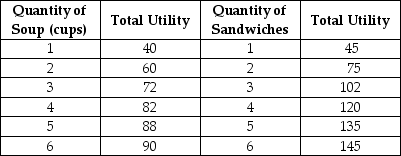 Table 10-2 above shows Keira's utility from soup and sandwiches. The price of soup is $2 per cup and the price of a sandwich is $3. Keira has $18 to spend on these two goods.
-Refer to Table 10-2. Holding prices constant, when Keira's income changes from $18 to $23, what happens to her total utility and to the marginal utilities of the last cup of soup and the last sandwich purchased?
Table 10-2 above shows Keira's utility from soup and sandwiches. The price of soup is $2 per cup and the price of a sandwich is $3. Keira has $18 to spend on these two goods.
-Refer to Table 10-2. Holding prices constant, when Keira's income changes from $18 to $23, what happens to her total utility and to the marginal utilities of the last cup of soup and the last sandwich purchased? (Multiple Choice)
4.9/5 (86)
(86) A Giffen good could be either a normal good or an inferior good.
(True/False)
4.9/5 (82)
(82) Figure 10-6  -Refer to Figure 10-6. A change in the price of candy only is shown in
 (Multiple Choice)
4.7/5 (73)
(73) All but one of the following economists were awarded a Nobel prize for their contributions to experimental economics and their explorations of the influence fairness has on consumer decision-making. Which economist did not receive a Nobel Prize for this work?
(Multiple Choice)
4.8/5 (87)
(87) When diminishing marginal utility sets in, total utility must be negative.
(True/False)
4.9/5 (87)
(87) Figure 10-3  -Refer to Figure 10-3. Best friends Laurel and Hardy both enjoy watching romantic comedies and science fiction movies. Based on the diagrams above what can you conclude about their movie preferences?
 (Multiple Choice)
4.8/5 (80)
(80) Assume that you had a ticket for a basketball playoff game that you bought for $50, the maximum price you were willing to pay. If a friend of yours offers to buy the ticket for $100 but you decide not to sell it, how can your decision be explained?
(Multiple Choice)
4.7/5 (76)
(76) 
Filters
- Essay(0)
- Multiple Choice(0)
- Short Answer(0)
- True False(0)
- Matching(0)