



 Chat with AI
Exam 10: Consumer Choice and Behavioral Economics

Exam 1: Economics: Foundations and Models444 Questions
Exam 2: Trade-Offs, Comparative Advantage, and the Market System498 Questions
Exam 3: Where Prices Come From: the Interaction of Demand and Supply475 Questions
Exam 4: Economic Efficiency, Government Price Setting, and Taxes419 Questions
Exam 5: Externalities, Environmental Policy, and Public Goods266 Questions
Exam 6: Elasticity: the Responsiveness of Demand and Supply295 Questions
Exam 7: The Economics of Health Care334 Questions
Exam 8: Firms, the Stock Market, and Corporate Governance278 Questions
Exam 9: Comparative Advantage and the Gains From International Trade379 Questions
Exam 10: Consumer Choice and Behavioral Economics302 Questions
Exam 11: Technology, Production, and Costs330 Questions
Exam 12: Firms in Perfectly Competitive Markets298 Questions
Exam 13: Monopolistic Competition: the Competitive Model in a More Realistic Setting276 Questions
Exam 14: Oligopoly: Firms in Less Competitive Markets262 Questions
Exam 15: Monopoly and Antitrust Policy271 Questions
Exam 16: Pricing Strategy263 Questions
Exam 17: The Markets for Labor and Other Factors of Production286 Questions
Exam 18: Public Choice, Taxes, and the Distribution of Income258 Questions
Exam 19: GDP: Measuring Total Production and Income266 Questions
Exam 20: Unemployment and Inflation292 Questions
Exam 21: Economic Growth, the Financial System, and Business Cycles257 Questions
Exam 22: Long-Run Economic Growth: Sources and Policies268 Questions
Exam 23: Aggregate Expenditure and Output in the Short Run306 Questions
Exam 24: Aggregate Demand and Aggregate Supply Analysis284 Questions
Exam 25: Money, Banks, and the Federal Reserve System280 Questions
Exam 26: Monetary Policy277 Questions
Exam 27: Fiscal Policy303 Questions
Exam 28: Inflation, Unemployment, and Federal Reserve Policy257 Questions
Exam 29: Macroeconomics in an Open Economy278 Questions
Exam 30: The International Financial System262 Questions
Select questions type


If Marlowe obtains 9 units of utility per dollar spent on apples and 6 units of utility per dollar spent on oranges, then Marlowe
(Multiple Choice)
4.7/5  (88)
(88) Aisha and Debbie both purchase milk and bread at the same Quik Mart. They have different tastes for milk and bread and different incomes. They both buy some milk and some bread, but they buy considerably different quantities of the two goods. Which of the following statements is true, given that Aisha and Debbie are utility-maximizers?
(Multiple Choice)
4.9/5 (84)
(84) Table 10-1
 Keegan has $30 to spend on Pita Wraps and Bubble Tea. The price of a Pita Wrap is $6 and the price of a glass of Bubble Tea is $3. Table 10-1 shows his total utility from different quantities of the two items.
-Refer to Table 10-1. What is Keegan's optimal consumption bundle?
Keegan has $30 to spend on Pita Wraps and Bubble Tea. The price of a Pita Wrap is $6 and the price of a glass of Bubble Tea is $3. Table 10-1 shows his total utility from different quantities of the two items.
-Refer to Table 10-1. What is Keegan's optimal consumption bundle? (Multiple Choice)
4.8/5 (84)
(84) Figure 10-1  -Refer to Figure 10-1. Which of the following statements is true?
 (Multiple Choice)
4.9/5 (87)
(87) Suppose Barry is maximizing his utility from consuming used paperback novels and audio books. The price of a used novel = $4 and the price of an audio book = $8. If the marginal utility of the last novel was 32 units of utility (utils) what was the marginal utility of the last audio book purchased?
(Multiple Choice)
4.8/5 (86)
(86) The restriction that a consumer's total expenditure on goods and services purchased cannot exceed the income available is referred to as
(Multiple Choice)
4.8/5 (83)
(83) The ultimatum game and the dictator game are used in economic experiments to test whether fairness is an important influence on consumer decision-making.
(True/False)
5.0/5 (74)
(74) Figure 10-1
-Refer to Figure 10-1. When the price of hoagies increases from $5.00 to $5.75, quantity demanded decreases from Q1 to Q0. This change in quantity demanded is due to
-Refer to Figure 10-1. When the price of hoagies increases from $5.00 to $5.75, quantity demanded decreases from Q1 to Q0. This change in quantity demanded is due to (Multiple Choice)
4.8/5 (80)
(80) As a consumer consumes more and more of a product in a particular time period, eventually marginal utility
(Multiple Choice)
4.9/5 (72)
(72) Table 10-5
 -Marge buys 5 CDs and 7 DVDs. The marginal utility of the 5th CD and the marginal utility of the 7th DVD are both equal to 30 utils. Can we say that this is the optimal combination of CDs and DVDs for Marge?
 (Multiple Choice)
4.9/5 (85)
(85) A network externality causes firms to sacrifice profits in the short run in order to satisfy their customers and increase their long-run profits.
(True/False)
4.9/5 (80)
(80) A sunk cost is a cost that has already been paid and cannot be recovered.
(True/False)
4.9/5 (78)
(78) ________ is an experiment that tests the significance of fairness in consumer decision making.
(Multiple Choice)
4.8/5 (79)
(79) Figure 10-8 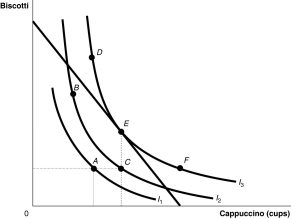 -Refer to Figure 10-8. If the price of biscotti is $1.50 and the price of a cappuccino is $3.00, what is the slope of the budget constraint?
 (Multiple Choice)
4.9/5 (86)
(86) Arnie Ziffel has $20 per week to spend on any combination of pineapples and green tea. The price of a pineapple is $4 and the price of a bottle of green tea is $2. The table below shows Arnie's utility values. Use the table to answer the questions that follow the table.
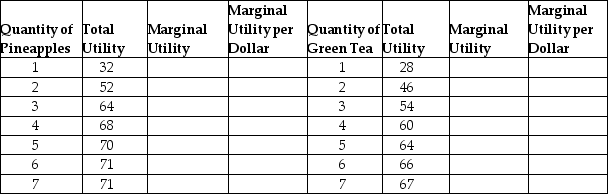 a. Complete the table by filling in the blank spaces.
b. Suppose Arnold purchases 4 pineapples and 2 bottles of green tea. Is he consuming the optimal consumption bundle? If so, explain why. If not, what combination should he buy and why?
a. Complete the table by filling in the blank spaces.
b. Suppose Arnold purchases 4 pineapples and 2 bottles of green tea. Is he consuming the optimal consumption bundle? If so, explain why. If not, what combination should he buy and why? (Essay)
4.8/5 (82)
(82) The income effect due to a price decrease will result in an increase in the quantity demanded for
(Multiple Choice)
4.8/5 (87)
(87) Table 10-7
 Table 10-7 shows Antonio's utility from beer and pizza.
-Refer to Table 10-7. What is Antonio's marginal utility from consuming the fifth beer?
Table 10-7 shows Antonio's utility from beer and pizza.
-Refer to Table 10-7. What is Antonio's marginal utility from consuming the fifth beer? (Multiple Choice)
5.0/5 (84)
(84) If Callum is consuming his utility maximizing bundle and the price of one good rises, what happens to the marginal utility per dollar spent on this good (MU/P), and what should Callum do?
(Multiple Choice)
4.8/5 (82)
(82) 
Filters
- Essay(0)
- Multiple Choice(0)
- Short Answer(0)
- True False(0)
- Matching(0)