



 Chat with AI
Exam 10: Consumer Choice and Behavioral Economics

Exam 1: Economics: Foundations and Models444 Questions
Exam 2: Trade-Offs, Comparative Advantage, and the Market System498 Questions
Exam 3: Where Prices Come From: the Interaction of Demand and Supply475 Questions
Exam 4: Economic Efficiency, Government Price Setting, and Taxes419 Questions
Exam 5: Externalities, Environmental Policy, and Public Goods266 Questions
Exam 6: Elasticity: the Responsiveness of Demand and Supply295 Questions
Exam 7: The Economics of Health Care334 Questions
Exam 8: Firms, the Stock Market, and Corporate Governance278 Questions
Exam 9: Comparative Advantage and the Gains From International Trade379 Questions
Exam 10: Consumer Choice and Behavioral Economics302 Questions
Exam 11: Technology, Production, and Costs330 Questions
Exam 12: Firms in Perfectly Competitive Markets298 Questions
Exam 13: Monopolistic Competition: the Competitive Model in a More Realistic Setting276 Questions
Exam 14: Oligopoly: Firms in Less Competitive Markets262 Questions
Exam 15: Monopoly and Antitrust Policy271 Questions
Exam 16: Pricing Strategy263 Questions
Exam 17: The Markets for Labor and Other Factors of Production286 Questions
Exam 18: Public Choice, Taxes, and the Distribution of Income258 Questions
Exam 19: GDP: Measuring Total Production and Income266 Questions
Exam 20: Unemployment and Inflation292 Questions
Exam 21: Economic Growth, the Financial System, and Business Cycles257 Questions
Exam 22: Long-Run Economic Growth: Sources and Policies268 Questions
Exam 23: Aggregate Expenditure and Output in the Short Run306 Questions
Exam 24: Aggregate Demand and Aggregate Supply Analysis284 Questions
Exam 25: Money, Banks, and the Federal Reserve System280 Questions
Exam 26: Monetary Policy277 Questions
Exam 27: Fiscal Policy303 Questions
Exam 28: Inflation, Unemployment, and Federal Reserve Policy257 Questions
Exam 29: Macroeconomics in an Open Economy278 Questions
Exam 30: The International Financial System262 Questions
Select questions type


The additional utility that George receives from consuming one more slice of pizza is called
(Multiple Choice)
4.7/5  (85)
(85) Which of the following is likely to occur as the result of the law of diminishing marginal utility?
(Multiple Choice)
4.9/5 (71)
(71) Gowri has $6 per day to purchase lunch. She spends all of her lunch money on pizza and iced-tea. The price of pizza is $2.00 per slice and iced-tea costs $1 per bottle.
a. Draw Gowri's budget constraint and label it BC0. Put pizza on the horizontal axis and iced-tea on the vertical axis. Be sure to identify the intercept values.
b. If the price of iced-tea rises to $1.20 per bottle, show what will happen to her budget constraint in your diagram. Be sure to indicate any new intercept values.
(Essay)
4.9/5 (92)
(92) Suppose Renee can increase her total utility from consuming video rentals and books by buying one more book and renting one fewer video. Which of the following is true?
(Multiple Choice)
4.9/5 (84)
(84) Table 10-4
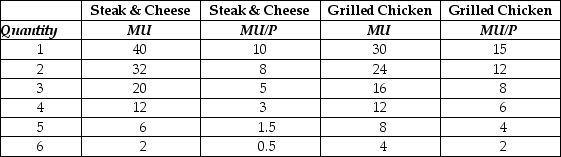 -Refer to Table 10-4. For steak and cheese and grilled chicken sandwiches, the table contains the values of the marginal utility (MU) and marginal utility per dollar (MU/P) for Mabel Jarvis. Mabel has $14 to spend on steak and cheese and grilled chicken sandwiches. Which of the following statements is false?
 (Multiple Choice)
5.0/5 (77)
(77) During a study session for an economics exam with three other students, Peter Daltry commented on an example of a consumer who had to decide the on number of slices of pizza and cups of Coca-Cola he would consume. Peter explained that "To maximize his utility this consumer must equate the marginal utility per dollar for pizza and Coca-Cola." Was Peter's analysis correct?
(Multiple Choice)
4.9/5 (91)
(91) Consider a downward-sloping demand curve. When the price of an inferior good increases, the income and substitution effects
(Multiple Choice)
4.9/5 (84)
(84) If by purchasing more apples and fewer oranges you increase your total utility, then apples must be cheaper than oranges.
(True/False)
4.8/5 (75)
(75) If you exhibit the endowment effect as a decision maker, then you are
(Multiple Choice)
4.7/5 (83)
(83) Suppose you pre-ordered a non-refundable movie ticket to X-Men: Days of Future Past. On the day of the movie you decide that you would rather not go to the movie. According to economists, what is the rational thing to do?
(Multiple Choice)
5.0/5 (92)
(92) In order to derive an individual's demand curve for salmon, we would observe what happens to the utility-maximizing bundle when we change
(Multiple Choice)
4.8/5 (72)
(72) The only Giffen goods that have been identified so far in the real world are luxury goods.
(True/False)
4.9/5 (80)
(80) In the utility maximizing model, consumer preferences are assumed to be transitive. What does this mean?
(Multiple Choice)
4.7/5 (89)
(89) The observation that people tend to value something more highly when they own it than when they don't is called the
(Multiple Choice)
4.8/5 (76)
(76) Consider a downward-sloping demand curve. When the price of an inferior good decreases, the income and substitution effects
(Multiple Choice)
4.7/5 (76)
(76) Figure 10-6  -Refer to Figure 10-6. Which diagram demonstrates a decrease in total utility following an increase in the price of candy?
 (Multiple Choice)
4.9/5 (77)
(77) Alan Krueger conducted a survey of fans at the 2001 Super Bowl who purchased tickets to the game for $325 or $400. Krueger found that (a) 94 percent of those surveyed would not have paid $3,000 for their tickets, and (b) 92 percent of those surveyed would not have sold their tickets for $3,000. These results are an example of
(Multiple Choice)
4.7/5 (78)
(78) 
Filters
- Essay(0)
- Multiple Choice(0)
- Short Answer(0)
- True False(0)
- Matching(0)