



 Chat with AI
Exam 26: Monetary Policy

Exam 1: Economics: Foundations and Models444 Questions
Exam 2: Trade-Offs, Comparative Advantage, and the Market System498 Questions
Exam 3: Where Prices Come From: the Interaction of Demand and Supply475 Questions
Exam 4: Economic Efficiency, Government Price Setting, and Taxes419 Questions
Exam 5: Externalities, Environmental Policy, and Public Goods266 Questions
Exam 6: Elasticity: the Responsiveness of Demand and Supply295 Questions
Exam 7: The Economics of Health Care334 Questions
Exam 8: Firms, the Stock Market, and Corporate Governance278 Questions
Exam 9: Comparative Advantage and the Gains From International Trade379 Questions
Exam 10: Consumer Choice and Behavioral Economics302 Questions
Exam 11: Technology, Production, and Costs330 Questions
Exam 12: Firms in Perfectly Competitive Markets298 Questions
Exam 13: Monopolistic Competition: the Competitive Model in a More Realistic Setting276 Questions
Exam 14: Oligopoly: Firms in Less Competitive Markets262 Questions
Exam 15: Monopoly and Antitrust Policy271 Questions
Exam 16: Pricing Strategy263 Questions
Exam 17: The Markets for Labor and Other Factors of Production286 Questions
Exam 18: Public Choice, Taxes, and the Distribution of Income258 Questions
Exam 19: GDP: Measuring Total Production and Income266 Questions
Exam 20: Unemployment and Inflation292 Questions
Exam 21: Economic Growth, the Financial System, and Business Cycles257 Questions
Exam 22: Long-Run Economic Growth: Sources and Policies268 Questions
Exam 23: Aggregate Expenditure and Output in the Short Run306 Questions
Exam 24: Aggregate Demand and Aggregate Supply Analysis284 Questions
Exam 25: Money, Banks, and the Federal Reserve System280 Questions
Exam 26: Monetary Policy277 Questions
Exam 27: Fiscal Policy303 Questions
Exam 28: Inflation, Unemployment, and Federal Reserve Policy257 Questions
Exam 29: Macroeconomics in an Open Economy278 Questions
Exam 30: The International Financial System262 Questions
Select questions type


Table 26-8
 -With a monetary growth rule as proposed by the monetarists, during a recession the rate of growth of the money supply would
 (Multiple Choice)
4.7/5  (68)
(68) An advantage of the personal consumption expenditures price index (PCE) over the Consumer Price Index (CPI) as a measure of inflation is that the PCE
(Multiple Choice)
4.9/5 (81)
(81) From an initial long-run macroeconomic equilibrium, if the Federal Reserve anticipated that next year aggregate demand would grow significantly slower than long-run aggregate supply, then the Federal Reserve would most likely
(Multiple Choice)
4.7/5 (89)
(89) Beginning in 2008, The Federal Reserve and the U.S. Treasury Department responded to the financial crisis by intervening in financial markets in unprecedented ways. Briefly summarize the actions of the Fed and Treasury.
(Essay)
4.7/5 (67)
(67) Figure 26-8 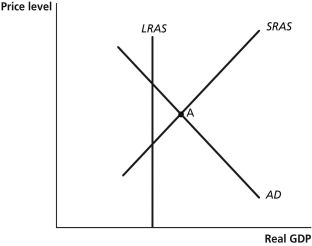 -Refer to Figure 26-8. In the figure above, if the economy is at point A, the appropriate monetary policy by the Federal Reserve would be to
 (Multiple Choice)
5.0/5 (89)
(89) In 2008, the Treasury and Federal Reserve took several actions in response to the deepening financial crisis. One action was the Treasury's move to have the federal government take control of
(Multiple Choice)
4.9/5 (82)
(82) The core personal consumption expenditures price index excludes
(Multiple Choice)
4.9/5 (74)
(74) If the Fed orders an expansionary monetary policy, describe what will happen to the following variables relative to what would have happened without the policy:
a. The money supply
b. Interest rates
c. Investment
d. Consumption
e. Net Exports
f. The aggregate demand curve
g. Real GDP
h. The price level
(Essay)
4.9/5 (70)
(70) A borrower defaults on a loan when he stops making payments on the loan.
(True/False)
4.8/5 (76)
(76) The Fed can use contractionary monetary policy in an attempt to keep inflation from increasing.
(True/False)
4.7/5 (87)
(87) Expansionary monetary policy enacted during a recession will cause the inflation rate to increase.
(True/False)
4.9/5 (76)
(76) Changes in interest rates affect all four components of aggregate demand.
(True/False)
4.8/5 (68)
(68) The money demand curve, against possible levels of interest rates, has a
(Multiple Choice)
4.7/5 (83)
(83) A financial asset is considered ________ if it can be sold in a secondary market.
(Multiple Choice)
4.8/5 (82)
(82) If the amount you owe on your house is less than the price of the house, you have
(Multiple Choice)
4.9/5 (80)
(80) Using the Taylor rule, if the current inflation rate exceeds the target inflation rate and real GDP exceeds potential GDP, then the federal funds target rate ________ the sum of the current inflation rate plus the real equilibrium federal funds rate.
(Multiple Choice)
4.8/5 (82)
(82) To reassure investors who were unwilling to buy mortgages in the secondary market, the U.S. Congress used two government sponsored enterprises, Fannie Mae and Freddie Mac, to stand between investors and banks that grant mortgages. Fannie Mae and Freddie Mac
(Multiple Choice)
4.9/5 (76)
(76) The Taylor rule links the Federal Reserve's target for the
(Multiple Choice)
4.9/5 (82)
(82) Suppose that the economy is producing below potential GDP and the Fed implements the correct change in monetary policy, but not until after the economy has passed the trough of the recession. Then
(Multiple Choice)
4.8/5 (76)
(76) 
Filters
- Essay(0)
- Multiple Choice(0)
- Short Answer(0)
- True False(0)
- Matching(0)