



 Chat with AI
Exam 26: Monetary Policy

Exam 1: Economics: Foundations and Models444 Questions
Exam 2: Trade-Offs, Comparative Advantage, and the Market System498 Questions
Exam 3: Where Prices Come From: the Interaction of Demand and Supply475 Questions
Exam 4: Economic Efficiency, Government Price Setting, and Taxes419 Questions
Exam 5: Externalities, Environmental Policy, and Public Goods266 Questions
Exam 6: Elasticity: the Responsiveness of Demand and Supply295 Questions
Exam 7: The Economics of Health Care334 Questions
Exam 8: Firms, the Stock Market, and Corporate Governance278 Questions
Exam 9: Comparative Advantage and the Gains From International Trade379 Questions
Exam 10: Consumer Choice and Behavioral Economics302 Questions
Exam 11: Technology, Production, and Costs330 Questions
Exam 12: Firms in Perfectly Competitive Markets298 Questions
Exam 13: Monopolistic Competition: the Competitive Model in a More Realistic Setting276 Questions
Exam 14: Oligopoly: Firms in Less Competitive Markets262 Questions
Exam 15: Monopoly and Antitrust Policy271 Questions
Exam 16: Pricing Strategy263 Questions
Exam 17: The Markets for Labor and Other Factors of Production286 Questions
Exam 18: Public Choice, Taxes, and the Distribution of Income258 Questions
Exam 19: GDP: Measuring Total Production and Income266 Questions
Exam 20: Unemployment and Inflation292 Questions
Exam 21: Economic Growth, the Financial System, and Business Cycles257 Questions
Exam 22: Long-Run Economic Growth: Sources and Policies268 Questions
Exam 23: Aggregate Expenditure and Output in the Short Run306 Questions
Exam 24: Aggregate Demand and Aggregate Supply Analysis284 Questions
Exam 25: Money, Banks, and the Federal Reserve System280 Questions
Exam 26: Monetary Policy277 Questions
Exam 27: Fiscal Policy303 Questions
Exam 28: Inflation, Unemployment, and Federal Reserve Policy257 Questions
Exam 29: Macroeconomics in an Open Economy278 Questions
Exam 30: The International Financial System262 Questions
Select questions type


An increase in the domestic interest rate relative to other interest rates should
(Multiple Choice)
4.7/5  (72)
(72) Mortgage lenders often resell mortgages in secondary markets. How might this make lenders act differently than if they intended to hold the mortgages themselves?
(Essay)
4.9/5 (84)
(84) When the price of a financial asset ________ its interest rate will ________.
(Multiple Choice)
4.7/5 (99)
(99) Figure 26-7 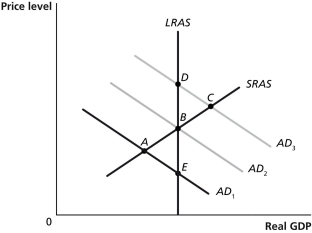 -Refer to Figure 26-7. Suppose the Fed sells Treasury Bills in pursuit of contractionary monetary policy. Using the static AD-AS model in the figure above, this situation would be depicted as a movement from
 (Multiple Choice)
4.8/5 (94)
(94) The Federal Reserve could target both the money supply and the interest rate at the same time if it controlled money demand along with money supply.
(True/False)
4.7/5 (74)
(74) Which of the following characterizes the Fed's ability to prevent recessions?
(Multiple Choice)
4.8/5 (83)
(83) Hovnanain Enterprises, a residential home builder based in New Jersey, did well during the mid-2000s but did not do so well in during and immediately after the recession of 2007-2009. The reason for this is
(Multiple Choice)
4.8/5 (75)
(75) Suppose the Fed decreases the money supply. In response households and firms will ________ short term assets and this will drive ________ interest rates.
(Multiple Choice)
4.7/5 (80)
(80) If the Fed lowers its target for the federal funds rate, this indicates that
(Multiple Choice)
4.8/5 (69)
(69) Figure 26-12  -Refer to Figure 26-12. In the dynamic AD-AS model, the economy is at point A in year 1 and is expected to go to point B in year 2, and the Federal Reserve pursues policy. This will result in
 (Multiple Choice)
4.9/5 (79)
(79) The argument advanced by Milton Friedman for adopting a monetary growth rule is that
(Multiple Choice)
4.9/5 (70)
(70) Table 26-8
 -Refer to Table 26-8. The hypothetical information in the table shows what the values for real GDP and the price level will be in 2014 if the Federal Reserve does not use monetary policy:
a. If the Fed wants to keep real GDP at its potential level in 2014, should it use an expansionary policy or a contractionary policy? Should the trading desk buy T-bills or sell them?
b. Suppose the Fed's policy is successful in keeping real GDP at its potential level in 2014. State whether each of the following will be higher or lower than if the Fed had taken no action:
(i) Real GDP
(ii) Full-employment real GDP
(iii) The inflation rate
(iv) The unemployment rate
c. Draw an aggregate demand and aggregate supply graph to illustrate your answer. Be sure that your graph contains LRAS curves for 2013 and 2014; SRAS curves 2013 and 2014; AD curve for 2013 and 2014, with and without monetary policy actions; and equilibrium real GDP and the price level in 2014 with and without policy.
-Refer to Table 26-8. The hypothetical information in the table shows what the values for real GDP and the price level will be in 2014 if the Federal Reserve does not use monetary policy:
a. If the Fed wants to keep real GDP at its potential level in 2014, should it use an expansionary policy or a contractionary policy? Should the trading desk buy T-bills or sell them?
b. Suppose the Fed's policy is successful in keeping real GDP at its potential level in 2014. State whether each of the following will be higher or lower than if the Fed had taken no action:
(i) Real GDP
(ii) Full-employment real GDP
(iii) The inflation rate
(iv) The unemployment rate
c. Draw an aggregate demand and aggregate supply graph to illustrate your answer. Be sure that your graph contains LRAS curves for 2013 and 2014; SRAS curves 2013 and 2014; AD curve for 2013 and 2014, with and without monetary policy actions; and equilibrium real GDP and the price level in 2014 with and without policy. (Essay)
4.9/5 (86)
(86) Table 26-3
 -Refer to Table 26-3. Consider the hypothetical information in the table above for potential real GDP, real GDP and the price level in 2014 and in 2015 if the Federal Reserve does not use monetary policy. If the Fed uses monetary policy successfully to keep real GDP at its potential level in 2015, which of the following will be lower than if the Fed had taken no action?
 (Multiple Choice)
4.8/5 (63)
(63) Use a graph to show the effects of an expansionary monetary policy moving an economy out of recession and to potential real GDP. Explain what happens to aggregate demand, real GDP, and the price level.
(Essay)
4.9/5 (88)
(88) When housing prices ________ as they did beginning in 2006 following the housing market bubble, most banks and other lenders tightened the requirement for borrowers, making it ________ for potential home buyers to obtain mortgages.
(Multiple Choice)
4.8/5 (79)
(79) When the Federal Reserve System was established in 1913, its main policy goal was
(Multiple Choice)
4.8/5 (76)
(76) 
Filters
- Essay(0)
- Multiple Choice(0)
- Short Answer(0)
- True False(0)
- Matching(0)