



 Chat with AI
Exam 26: Monetary Policy

Exam 1: Economics: Foundations and Models444 Questions
Exam 2: Trade-Offs, Comparative Advantage, and the Market System498 Questions
Exam 3: Where Prices Come From: the Interaction of Demand and Supply475 Questions
Exam 4: Economic Efficiency, Government Price Setting, and Taxes419 Questions
Exam 5: Externalities, Environmental Policy, and Public Goods266 Questions
Exam 6: Elasticity: the Responsiveness of Demand and Supply295 Questions
Exam 7: The Economics of Health Care334 Questions
Exam 8: Firms, the Stock Market, and Corporate Governance278 Questions
Exam 9: Comparative Advantage and the Gains From International Trade379 Questions
Exam 10: Consumer Choice and Behavioral Economics302 Questions
Exam 11: Technology, Production, and Costs330 Questions
Exam 12: Firms in Perfectly Competitive Markets298 Questions
Exam 13: Monopolistic Competition: the Competitive Model in a More Realistic Setting276 Questions
Exam 14: Oligopoly: Firms in Less Competitive Markets262 Questions
Exam 15: Monopoly and Antitrust Policy271 Questions
Exam 16: Pricing Strategy263 Questions
Exam 17: The Markets for Labor and Other Factors of Production286 Questions
Exam 18: Public Choice, Taxes, and the Distribution of Income258 Questions
Exam 19: GDP: Measuring Total Production and Income266 Questions
Exam 20: Unemployment and Inflation292 Questions
Exam 21: Economic Growth, the Financial System, and Business Cycles257 Questions
Exam 22: Long-Run Economic Growth: Sources and Policies268 Questions
Exam 23: Aggregate Expenditure and Output in the Short Run306 Questions
Exam 24: Aggregate Demand and Aggregate Supply Analysis284 Questions
Exam 25: Money, Banks, and the Federal Reserve System280 Questions
Exam 26: Monetary Policy277 Questions
Exam 27: Fiscal Policy303 Questions
Exam 28: Inflation, Unemployment, and Federal Reserve Policy257 Questions
Exam 29: Macroeconomics in an Open Economy278 Questions
Exam 30: The International Financial System262 Questions
Select questions type


The Taylor rule accurately predicted the changes in the federal funds target during the period
(Multiple Choice)
4.9/5  (77)
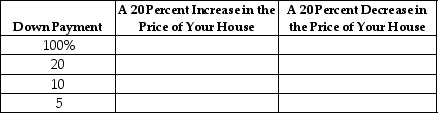
(77) In the following table, fill in the columns for your return on investment if the price of your house increased or decreased by 20 percent, based on the down payments specified in the first column.
Return on Your Investment From
(Essay)
4.8/5 (85)
(85) If the amount you owe on your house is greater than the price of the house, you have
(Multiple Choice)
4.9/5 (90)
(90) Monetary policy could be procyclical if the Federal Reserve
(Multiple Choice)
4.9/5 (79)
(79) Although the Federal Reserve had traditionally made discount loans only to ________, in response to the financial crisis in 2008 the Fed made primary dealers eligible for discount loans as well.
(Multiple Choice)
5.0/5 (87)
(87) Table 26-6
 -Refer to Table 26-6. Suppose the table above illustrates the values of real and potential GDP and the price level, if the Fed does not vote to change their current policy to be more contractionary or expansionary. If the Fed wants to keep real GDP at its potential level in 2015, should the Fed use a contractionary or expansionary policy? Should it raise or lower its interest rate target? How should it conduct open market operations to achieve its goal?
 (Essay)
4.8/5 (67)
(67) Figure 26-9 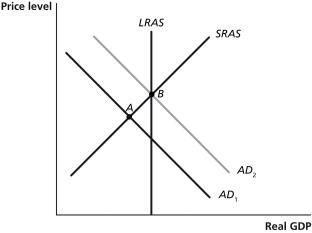 -Refer to Figure 26-9. In the figure above suppose the economy is initially at point A. The movement of the economy to point B as shown in the graph illustrates the effect of which of the following policy actions by the Federal Reserve?
 (Multiple Choice)
4.9/5 (72)
(72) Use the money demand and money supply model to show graphically and explain the effect on interest rates of the Federal Reserve's open market purchase of Treasury securities.
(Essay)
4.9/5 (66)
(66) Figure 26-3 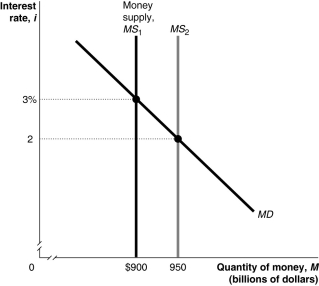 -Refer to Figure 26-3. In the figure above, when the money supply shifts from MS1 to MS2, at the interest rate of 3 percent households and firms will
 (Multiple Choice)
4.8/5 (86)
(86) Table 26-8
 -Monetarists think that the Fed should use ________ as a target when conducting monetary policy.
 (Multiple Choice)
4.7/5 (70)
(70) Suppose the equilibrium real federal funds rate is 5 percent, the target rate of inflation is 3 percent, the current inflation rate is 5 percent, and real GDP is 4 percent above potential real GDP. If the weights for the inflation gap and the output gap are both 1/2, then according to the Taylor rule the federal funds target rate equals
(Multiple Choice)
4.8/5 (77)
(77) Figure 26-1  -Refer to Figure 26-1. In the figure, the money demand curve would move from Money demand1 to Money demand2 if
 (Multiple Choice)
4.9/5 (85)
(85) Present two arguments as to why the Fed should adopt inflation targeting as a framework for monetary policy.
(Essay)
4.7/5 (79)
(79) The Fed can simultaneously reduce the inflation rate and stimulate growth through lowering interest rates.
(True/False)
4.7/5 (90)
(90) Use the money demand and money supply model to show the money market in equilibrium with an interest rate of 5 percent and the quantity of money of $800 billion. Suppose the Federal Reserve increases the money supply to $850 billion. At the previous equilibrium interest rate of 5 percent, will households and firms now be holding more money or less money than they want to hold, and will they be buying or selling short-term financial assets? At the new equilibrium interest rate, households and firms will desire to hold the entire $850 billion of the money supply. What causes households and firms to want to hold the additional $50 billion of the money supply?
(Essay)
4.8/5 (82)
(82) 
Filters
- Essay(0)
- Multiple Choice(0)
- Short Answer(0)
- True False(0)
- Matching(0)