



 Chat with AI
Exam 26: Monetary Policy

Exam 1: Economics: Foundations and Models444 Questions
Exam 2: Trade-Offs, Comparative Advantage, and the Market System498 Questions
Exam 3: Where Prices Come From: the Interaction of Demand and Supply475 Questions
Exam 4: Economic Efficiency, Government Price Setting, and Taxes419 Questions
Exam 5: Externalities, Environmental Policy, and Public Goods266 Questions
Exam 6: Elasticity: the Responsiveness of Demand and Supply295 Questions
Exam 7: The Economics of Health Care334 Questions
Exam 8: Firms, the Stock Market, and Corporate Governance278 Questions
Exam 9: Comparative Advantage and the Gains From International Trade379 Questions
Exam 10: Consumer Choice and Behavioral Economics302 Questions
Exam 11: Technology, Production, and Costs330 Questions
Exam 12: Firms in Perfectly Competitive Markets298 Questions
Exam 13: Monopolistic Competition: the Competitive Model in a More Realistic Setting276 Questions
Exam 14: Oligopoly: Firms in Less Competitive Markets262 Questions
Exam 15: Monopoly and Antitrust Policy271 Questions
Exam 16: Pricing Strategy263 Questions
Exam 17: The Markets for Labor and Other Factors of Production286 Questions
Exam 18: Public Choice, Taxes, and the Distribution of Income258 Questions
Exam 19: GDP: Measuring Total Production and Income266 Questions
Exam 20: Unemployment and Inflation292 Questions
Exam 21: Economic Growth, the Financial System, and Business Cycles257 Questions
Exam 22: Long-Run Economic Growth: Sources and Policies268 Questions
Exam 23: Aggregate Expenditure and Output in the Short Run306 Questions
Exam 24: Aggregate Demand and Aggregate Supply Analysis284 Questions
Exam 25: Money, Banks, and the Federal Reserve System280 Questions
Exam 26: Monetary Policy277 Questions
Exam 27: Fiscal Policy303 Questions
Exam 28: Inflation, Unemployment, and Federal Reserve Policy257 Questions
Exam 29: Macroeconomics in an Open Economy278 Questions
Exam 30: The International Financial System262 Questions
Select questions type


Using the money demand and money supply model, an increase in money demand would cause the equilibrium interest rate to
(Multiple Choice)
4.9/5  (80)
(80) In the countries that have adopted inflation targeting, the inflation rate has typically
(Multiple Choice)
4.8/5 (80)
(80) The larger the fraction of an investment financed by borrowing,
(Multiple Choice)
4.9/5 (77)
(77) Suppose the equilibrium real federal funds rate is 2 percent, the target rate of inflation is 2 percent, the current inflation rate is 4 percent, and real GDP is 2 percent above potential real GDP. If the weights for the inflation gap and the output gap are both 1/2, then according to the Taylor rule the federal funds target rate equals
(Multiple Choice)
4.9/5 (84)
(84) Using the money demand and money supply model, an open market purchase of Treasury securities by the Federal Reserve would cause the equilibrium interest rate to
(Multiple Choice)
4.9/5 (69)
(69) The body that is responsible for dating the beginning and ending dates for a recession is
(Multiple Choice)
4.9/5 (70)
(70) Firms that participate in regular open market transactions with ________ are called primary dealers.
(Multiple Choice)
4.9/5 (67)
(67) When Congress established the Federal Reserve in 1913, what was its main responsibility? When did Congress broaden the Fed's responsibilities?
(Essay)
4.9/5 (66)
(66) Inflation targeting is a framework for carrying out monetary policy whereby
(Multiple Choice)
4.8/5 (86)
(86) Figure 26-1  -Refer to Figure 26-1. In the figure above, the money demand curve would move from Money demand1 to Money demand2 if
 (Multiple Choice)
4.7/5 (82)
(82) The interest rate that banks charge other banks for overnight loans is the
(Multiple Choice)
5.0/5 (74)
(74) Why doesn't the Fed have both a money supply target and an interest rate target?
(Multiple Choice)
4.8/5 (87)
(87) Prior to 1970, mortgages were ________ resold in the secondary market.
(Multiple Choice)
4.8/5 (75)
(75) A monetary policy target is a variable that the Fed can affect directly, which then affects one or more of the Fed's policy goals.
(True/False)
4.7/5 (74)
(74) If the Federal Reserve targets the money supply, and the money demand curve shifts to the left, then the Fed
(Multiple Choice)
4.8/5 (83)
(83) Figure 26-11 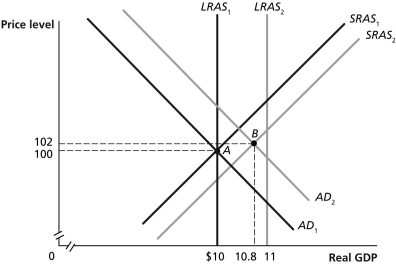 -Refer to Figure 26-11. In the dynamic model of AD-AS in the figure above, if the economy is at point A in year 1 and is expected to go to point B in year 2, and the Federal Reserve pursues no policy, then at point B
 (Multiple Choice)
4.7/5 (60)
(60) Describe how the Fed uses open market operations to change short-term and long-term interest rates.
(Essay)
4.8/5 (89)
(89) 
Filters
- Essay(0)
- Multiple Choice(0)
- Short Answer(0)
- True False(0)
- Matching(0)