



 Chat with AI
Exam 26: Monetary Policy

Exam 1: Economics: Foundations and Models444 Questions
Exam 2: Trade-Offs, Comparative Advantage, and the Market System498 Questions
Exam 3: Where Prices Come From: the Interaction of Demand and Supply475 Questions
Exam 4: Economic Efficiency, Government Price Setting, and Taxes419 Questions
Exam 5: Externalities, Environmental Policy, and Public Goods266 Questions
Exam 6: Elasticity: the Responsiveness of Demand and Supply295 Questions
Exam 7: The Economics of Health Care334 Questions
Exam 8: Firms, the Stock Market, and Corporate Governance278 Questions
Exam 9: Comparative Advantage and the Gains From International Trade379 Questions
Exam 10: Consumer Choice and Behavioral Economics302 Questions
Exam 11: Technology, Production, and Costs330 Questions
Exam 12: Firms in Perfectly Competitive Markets298 Questions
Exam 13: Monopolistic Competition: the Competitive Model in a More Realistic Setting276 Questions
Exam 14: Oligopoly: Firms in Less Competitive Markets262 Questions
Exam 15: Monopoly and Antitrust Policy271 Questions
Exam 16: Pricing Strategy263 Questions
Exam 17: The Markets for Labor and Other Factors of Production286 Questions
Exam 18: Public Choice, Taxes, and the Distribution of Income258 Questions
Exam 19: GDP: Measuring Total Production and Income266 Questions
Exam 20: Unemployment and Inflation292 Questions
Exam 21: Economic Growth, the Financial System, and Business Cycles257 Questions
Exam 22: Long-Run Economic Growth: Sources and Policies268 Questions
Exam 23: Aggregate Expenditure and Output in the Short Run306 Questions
Exam 24: Aggregate Demand and Aggregate Supply Analysis284 Questions
Exam 25: Money, Banks, and the Federal Reserve System280 Questions
Exam 26: Monetary Policy277 Questions
Exam 27: Fiscal Policy303 Questions
Exam 28: Inflation, Unemployment, and Federal Reserve Policy257 Questions
Exam 29: Macroeconomics in an Open Economy278 Questions
Exam 30: The International Financial System262 Questions
Select questions type


Which of the following correctly describes what the Fed used as monetary targets in the past?
(Multiple Choice)
4.8/5  (78)
(78) Inflation targeting has been adopted by the central banks of several countries including the European Central Bank.
(True/False)
4.8/5 (70)
(70) Expansionary monetary policy refers to the ________ to increase real GDP.
(Multiple Choice)
4.8/5 (78)
(78) In 2008, the Treasury and Federal Reserve took several actions in response to the deepening financial crisis. One action was the creation of the Term Securities Lending Facility, under which the Fed will loan up to $200 billion of treasury securities in exchange for
(Multiple Choice)
4.8/5 (81)
(81) The Federal Reserve does not target both the money supply and an interest rate because
(Multiple Choice)
4.9/5 (82)
(82) The Federal Reserve's performance in the mid-to-late 1980s, 1990s, and early 2000s has received high marks from economists, even without inflation targeting.
(True/False)
4.9/5 (82)
(82) If the Federal Reserve targets the interest rate and the money demand curve shifts to the left, then the Fed
(Multiple Choice)
5.0/5 (85)
(85) The Fed seeks to promote stability of financial markets because
(Multiple Choice)
4.8/5 (68)
(68) The consumer price index (CPI), the personal consumption expenditures price index (PCE), and the core PCE have over the last 10 years
(Multiple Choice)
4.9/5 (74)
(74) Rising nominal GDP will increase the demand for money and short-term interest rates.
(True/False)
4.9/5 (74)
(74) The Federal Reserve cut the federal funds rate seven times between September 2007 and March 2008. What event led the Fed to make these reductions in the federal funds rate?
(Multiple Choice)
4.7/5 (96)
(96) Article Summary
Concerned about slow economic growth, the Fed announced in September 2013 that it would postpone winding down its $85 billion a month bond purchasing program which has been a key component of its monetary stimulus package. Fed Chairman Ben Bernanke would not commit to a timeline for reducing the bond purchases, stating that the program was "not on a preset course." The Fed's forecasts of economic growth have been lowered for 2013 and 2014, and the Fed does not expect to raise interest rates until 2015. Since late 2008, the Fed has held its benchmark interest rate near zero, while its balance sheet has tripled to more than $3.6 trillion. The Fed also stated that so long as inflation did not become a threat, it would not raise interest rates until the unemployment rate dropped to 6.5 percent. At the time of the announcement, the unemployment rate was 7.3 percent.
Source: Pedro da Costa and Alister Bull, "Fed Surprises, sticks to stimulus as it cuts growth outlook," Reuters, September 18, 2013.
-Refer to the Article Summary. The Fed announced that it would postpone winding down its $85 billion per month bond purchasing program. The Fed's purchasing of long-term treasury bonds and other government-backed securities in an effort to keep long-term interest rates low is a strategy known as
(Multiple Choice)
4.8/5 (79)
(79) Figure 26-6 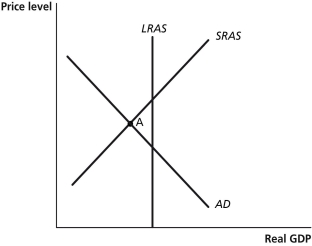 -Refer to Figure 26-6. In the figure above, if the economy is at point A, the appropriate monetary policy by the Federal Reserve would be to
 (Multiple Choice)
5.0/5 (73)
(73) Table 26-5
 -Refer to Table 26-5. Suppose the table above illustrates the values of real and potential GDP and the price level, if the Fed does not vote to change their current policy to be more contractionary or expansionary. Suppose that the Fed uses an appropriate policy and is successful in keeping real GDP at potential in 2015. State whether each of the following will be higher or lower than if the Fed had taken no action:
a. Real GDP
b. Potential real GDP
c. The price level
d. The unemployment rate
-Refer to Table 26-5. Suppose the table above illustrates the values of real and potential GDP and the price level, if the Fed does not vote to change their current policy to be more contractionary or expansionary. Suppose that the Fed uses an appropriate policy and is successful in keeping real GDP at potential in 2015. State whether each of the following will be higher or lower than if the Fed had taken no action:
a. Real GDP
b. Potential real GDP
c. The price level
d. The unemployment rate (Essay)
4.8/5 (79)
(79) Most of the pressure for a monetary growth rule has disappeared because since 1980,
(Multiple Choice)
4.9/5 (72)
(72) Suppose that the economy is producing above potential GDP and the Fed implements the correct change in monetary policy, but not until after the economy has passed the peak of the boom. Then
(Multiple Choice)
4.8/5 (79)
(79) In October 2008, Congress passed the Troubled Asset Relief Program (TARP), under which the Treasury provided ________ to banks in exchange for ________.
(Multiple Choice)
4.7/5 (86)
(86) If money demand is extremely sensitive to changes in the interest rate, the money demand curve becomes almost horizontal. If the Fed expands the money supply under these circumstances, then the interest rate will
(Multiple Choice)
4.7/5 (84)
(84) The Fed can use expansionary monetary policy to lower interest rates to stimulate aggregate demand.
(True/False)
4.9/5 (67)
(67) 
Filters
- Essay(0)
- Multiple Choice(0)
- Short Answer(0)
- True False(0)
- Matching(0)