



 Chat with AI
Exam 26: Monetary Policy

Exam 1: Economics: Foundations and Models444 Questions
Exam 2: Trade-Offs, Comparative Advantage, and the Market System498 Questions
Exam 3: Where Prices Come From: the Interaction of Demand and Supply475 Questions
Exam 4: Economic Efficiency, Government Price Setting, and Taxes419 Questions
Exam 5: Externalities, Environmental Policy, and Public Goods266 Questions
Exam 6: Elasticity: the Responsiveness of Demand and Supply295 Questions
Exam 7: The Economics of Health Care334 Questions
Exam 8: Firms, the Stock Market, and Corporate Governance278 Questions
Exam 9: Comparative Advantage and the Gains From International Trade379 Questions
Exam 10: Consumer Choice and Behavioral Economics302 Questions
Exam 11: Technology, Production, and Costs330 Questions
Exam 12: Firms in Perfectly Competitive Markets298 Questions
Exam 13: Monopolistic Competition: the Competitive Model in a More Realistic Setting276 Questions
Exam 14: Oligopoly: Firms in Less Competitive Markets262 Questions
Exam 15: Monopoly and Antitrust Policy271 Questions
Exam 16: Pricing Strategy263 Questions
Exam 17: The Markets for Labor and Other Factors of Production286 Questions
Exam 18: Public Choice, Taxes, and the Distribution of Income258 Questions
Exam 19: GDP: Measuring Total Production and Income266 Questions
Exam 20: Unemployment and Inflation292 Questions
Exam 21: Economic Growth, the Financial System, and Business Cycles257 Questions
Exam 22: Long-Run Economic Growth: Sources and Policies268 Questions
Exam 23: Aggregate Expenditure and Output in the Short Run306 Questions
Exam 24: Aggregate Demand and Aggregate Supply Analysis284 Questions
Exam 25: Money, Banks, and the Federal Reserve System280 Questions
Exam 26: Monetary Policy277 Questions
Exam 27: Fiscal Policy303 Questions
Exam 28: Inflation, Unemployment, and Federal Reserve Policy257 Questions
Exam 29: Macroeconomics in an Open Economy278 Questions
Exam 30: The International Financial System262 Questions
Select questions type


Figure 26-11 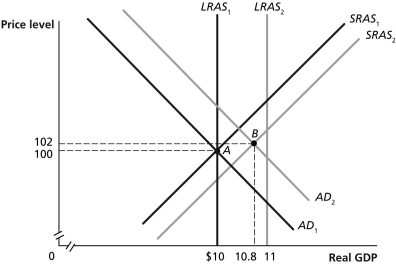 -Refer to Figure 26-11. In the dynamic model of AD-AS in the figure above, the economy is at point A in year 1 and is expected to go to point B in year 2, and the Federal Reserve pursues policy. This will result in
 (Multiple Choice)
4.8/5  (88)
(88) If the Fed raises its target for the federal fund rate, this indicates that
(Multiple Choice)
4.8/5 (66)
(66) Figure 26-12  -Refer to Figure 26-12. In the dynamic AD-AS model, if the economy is at point A in year 1 and is expected to go to point B in year 2, the Federal Reserve would most likely
 (Multiple Choice)
5.0/5 (88)
(88) Suppose that households became mistrustful of the banking system and decide to decrease their checking accounts and increase their holdings of currency. Using the money demand and money supply model and assuming everything else is held constant, the equilibrium interest rate should
(Multiple Choice)
4.9/5 (77)
(77) The Federal Reserve responded to the 2008 financial crisis in several ways. Which of the following is not one of the ways the Fed responded?
(Multiple Choice)
4.8/5 (80)
(80) In response to already low interest rates doing little to stimulate the economy, the Fed announced a new program in September 2011 under which it would purchase long-term Treasury securities while selling an equal amount of shorter-term Treasury securities. This policy was known as
(Multiple Choice)
4.8/5 (77)
(77) Buying a house during a recession may be a good idea if your job is secure because the Federal Reserve often
(Multiple Choice)
4.9/5 (89)
(89) Figure 26-15 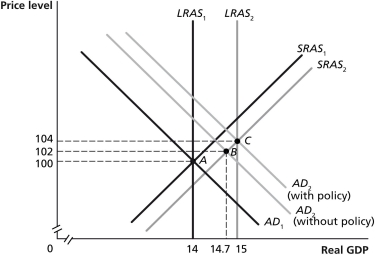 -Refer to Figure 26-15. In the figure above, suppose the economy in Year 1 is at point A and expected in Year 2 to be at point B. Which of the following policies could the Federal Reserve use to move the economy to point C?
 (Multiple Choice)
4.9/5 (77)
(77) The money market model is concerned with ________ and the loanable funds market model is concerned with ________.
(Multiple Choice)
4.7/5 (70)
(70) Table 26-8
 -Use the dynamic aggregate demand and aggregate supply model and start with Year 1 in long-run macroeconomic equilibrium. For Year 2, graph aggregate demand, long-run aggregate supply, and short-run aggregate supply such that the condition of the economy will induce the Federal Reserve to conduct a contractionary monetary policy. Briefly explain the condition of the economy and what the Federal Reserve is attempting to do.
 (Essay)
4.8/5 (81)
(81) If the Federal Reserve raises or lowers interest rates too late, it could result in a ________ policy that destabilizes the economy.
(Multiple Choice)
4.8/5 (90)
(90) Federal Reserve Board Chairmen Paul Volcker, Alan Greenspan, and Ben Bernanke all have focused on which of the following as their main goal of monetary policy?
(Multiple Choice)
4.8/5 (74)
(74) While many analysts defended the actions taken by the Fed and the Treasury to respond to the financial crisis in 2008, others were critical of these actions. The critics were concerned that by not allowing large firms to fail,
(Multiple Choice)
4.8/5 (81)
(81) Which of the following describes what the Fed would do to pursue an expansionary monetary policy?
(Multiple Choice)
4.9/5 (82)
(82) Using the money demand and money supply model, an open market sale of Treasury securities by the Federal Reserve would cause the equilibrium interest rate to
(Multiple Choice)
5.0/5 (70)
(70) When housing prices fall, as they did beginning in 2006 following the housing market bubble, consumption spending on furniture, appliances, and home improvements ________ as many households found it ________ to borrow against the value of their homes.
(Multiple Choice)
4.8/5 (81)
(81) When the Fed decided to buy long-term Treasury securities while selling an equal amount of shorter-term treasury securities to keep long-term interest rates low, it was following a strategy known as
(Multiple Choice)
4.8/5 (89)
(89) 
Filters
- Essay(0)
- Multiple Choice(0)
- Short Answer(0)
- True False(0)
- Matching(0)