



 Chat with AI
Exam 26: Monetary Policy

Exam 1: Economics: Foundations and Models444 Questions
Exam 2: Trade-Offs, Comparative Advantage, and the Market System498 Questions
Exam 3: Where Prices Come From: the Interaction of Demand and Supply475 Questions
Exam 4: Economic Efficiency, Government Price Setting, and Taxes419 Questions
Exam 5: Externalities, Environmental Policy, and Public Goods266 Questions
Exam 6: Elasticity: the Responsiveness of Demand and Supply295 Questions
Exam 7: The Economics of Health Care334 Questions
Exam 8: Firms, the Stock Market, and Corporate Governance278 Questions
Exam 9: Comparative Advantage and the Gains From International Trade379 Questions
Exam 10: Consumer Choice and Behavioral Economics302 Questions
Exam 11: Technology, Production, and Costs330 Questions
Exam 12: Firms in Perfectly Competitive Markets298 Questions
Exam 13: Monopolistic Competition: the Competitive Model in a More Realistic Setting276 Questions
Exam 14: Oligopoly: Firms in Less Competitive Markets262 Questions
Exam 15: Monopoly and Antitrust Policy271 Questions
Exam 16: Pricing Strategy263 Questions
Exam 17: The Markets for Labor and Other Factors of Production286 Questions
Exam 18: Public Choice, Taxes, and the Distribution of Income258 Questions
Exam 19: GDP: Measuring Total Production and Income266 Questions
Exam 20: Unemployment and Inflation292 Questions
Exam 21: Economic Growth, the Financial System, and Business Cycles257 Questions
Exam 22: Long-Run Economic Growth: Sources and Policies268 Questions
Exam 23: Aggregate Expenditure and Output in the Short Run306 Questions
Exam 24: Aggregate Demand and Aggregate Supply Analysis284 Questions
Exam 25: Money, Banks, and the Federal Reserve System280 Questions
Exam 26: Monetary Policy277 Questions
Exam 27: Fiscal Policy303 Questions
Exam 28: Inflation, Unemployment, and Federal Reserve Policy257 Questions
Exam 29: Macroeconomics in an Open Economy278 Questions
Exam 30: The International Financial System262 Questions
Select questions type


A decrease in interest rates can ________ the demand for stocks as stocks become relatively ________ attractive investments as compared to bonds.
(Multiple Choice)
4.7/5  (76)
(76) The ability of the Federal Reserve to use monetary policy to affect economic variables such as real GDP ultimately depends upon its ability to affect
(Multiple Choice)
4.8/5 (82)
(82) Contractionary monetary policy on the part of the Fed results in
(Multiple Choice)
4.9/5 (77)
(77) The leader of the monetarist school and major proponent of a monetary growth rule was
(Multiple Choice)
4.9/5 (94)
(94) By the 2000s, an important change in the mortgage market had occurred when ________ became significant participants in the secondary market for mortgages.
(Multiple Choice)
4.8/5 (82)
(82) When the Fed embarked on a policy known as quantitative easing, they
(Multiple Choice)
4.9/5 (83)
(83) If the Fed orders a contractionary monetary policy, describe what will happen to the following variables relative to what would have happened without the policy:
a. The money supply
b. Interest rates
c. Investment
d. Consumption
e. Net Exports
f. The aggregate demand curve
g. Real GDP
h. The price level
(Essay)
4.9/5 (87)
(87) During the turmoil in the market for subprime mortgages in 2007 and 2008, the Fed increased the volume of discount loans. The goal of the Fed was to
(Multiple Choice)
4.7/5 (70)
(70) Which of the following will lead to a decrease in the equilibrium interest rate in the economy?
(Multiple Choice)
4.9/5 (83)
(83) Figure 26-13 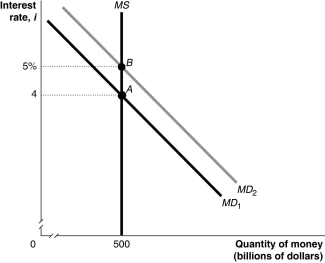 -Refer to Figure 26-13. In the figure above, if the economy in Year 1 is at point A and expected in Year 2 to be at point B, then the appropriate monetary policy by the Federal Reserve would be to
 (Multiple Choice)
4.7/5 (83)
(83) What is a mortgage? What were the important developments in the mortgage market during the years after 1970?
(Essay)
4.8/5 (79)
(79) Use a graph to show the effects of a contractionary monetary policy to reduce inflation and move an economy back to potential real GDP. Explain what happens to aggregate demand, real GDP, and the price level.
(Essay)
4.9/5 (58)
(58) The Federal Home Loan Mortgage Corporation and the Federal National Mortgage Association were established by Congress in order to regulate banks that buy and sell mortgage-backed securities.
(True/False)
4.9/5 (80)
(80) Firms that participate in regular open market transactions with the Federal Reserve are called
(Multiple Choice)
4.9/5 (84)
(84) Which of the following is not an argument against inflation targeting?
(Multiple Choice)
4.8/5 (71)
(71) By the 2000s, investment banks had become significant participants in the secondary market for mortgages.
(True/False)
4.8/5 (87)
(87) Figure 26-10  -Refer to Figure 26-10. In the figure above, suppose the economy is initially at point A. The movement of the economy to point B as shown in the graph illustrates the effect of which of the following policy actions by the Federal Reserve?
 (Multiple Choice)
4.8/5 (82)
(82) 
Filters
- Essay(0)
- Multiple Choice(0)
- Short Answer(0)
- True False(0)
- Matching(0)