



 Chat with AI
Exam 26: Monetary Policy

Exam 1: Economics: Foundations and Models444 Questions
Exam 2: Trade-Offs, Comparative Advantage, and the Market System498 Questions
Exam 3: Where Prices Come From: the Interaction of Demand and Supply475 Questions
Exam 4: Economic Efficiency, Government Price Setting, and Taxes419 Questions
Exam 5: Externalities, Environmental Policy, and Public Goods266 Questions
Exam 6: Elasticity: the Responsiveness of Demand and Supply295 Questions
Exam 7: The Economics of Health Care334 Questions
Exam 8: Firms, the Stock Market, and Corporate Governance278 Questions
Exam 9: Comparative Advantage and the Gains From International Trade379 Questions
Exam 10: Consumer Choice and Behavioral Economics302 Questions
Exam 11: Technology, Production, and Costs330 Questions
Exam 12: Firms in Perfectly Competitive Markets298 Questions
Exam 13: Monopolistic Competition: the Competitive Model in a More Realistic Setting276 Questions
Exam 14: Oligopoly: Firms in Less Competitive Markets262 Questions
Exam 15: Monopoly and Antitrust Policy271 Questions
Exam 16: Pricing Strategy263 Questions
Exam 17: The Markets for Labor and Other Factors of Production286 Questions
Exam 18: Public Choice, Taxes, and the Distribution of Income258 Questions
Exam 19: GDP: Measuring Total Production and Income266 Questions
Exam 20: Unemployment and Inflation292 Questions
Exam 21: Economic Growth, the Financial System, and Business Cycles257 Questions
Exam 22: Long-Run Economic Growth: Sources and Policies268 Questions
Exam 23: Aggregate Expenditure and Output in the Short Run306 Questions
Exam 24: Aggregate Demand and Aggregate Supply Analysis284 Questions
Exam 25: Money, Banks, and the Federal Reserve System280 Questions
Exam 26: Monetary Policy277 Questions
Exam 27: Fiscal Policy303 Questions
Exam 28: Inflation, Unemployment, and Federal Reserve Policy257 Questions
Exam 29: Macroeconomics in an Open Economy278 Questions
Exam 30: The International Financial System262 Questions
Select questions type


The Federal Reserve's two main ________ are the money supply and the interest rate.
(Multiple Choice)
4.9/5  (72)
(72) Table 26-7
 -Use the dynamic aggregate demand and aggregate supply model and start with Year 1 in long-run macroeconomic equilibrium. For Year 2, graph aggregate demand, long-run aggregate supply, and short-run aggregate supply such that the condition of the economy will induce the Federal Reserve to conduct an expansionary monetary policy. Briefly explain the condition of the economy and what the Federal Reserve is attempting to do.
 (Essay)
4.7/5 (67)
(67) From an initial long-run macroeconomic equilibrium, if the Federal Reserve anticipated that next year aggregate demand would grow significantly slower than long-run aggregate supply, then the Federal Reserve would most likely
(Multiple Choice)
4.9/5 (79)
(79) Figure 26-7 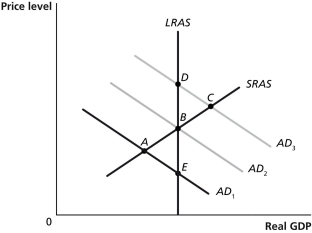 -Refer to Figure 26-7. Suppose the economy is in a recession and no policy is pursued. Using the static AD-AS model in the figure above, this situation would be depicted as a movement from
 (Multiple Choice)
4.7/5 (86)
(86) How do economists generally rate the Fed's performance in the 1980s, 1990s, and the early 2000s? Has the public been supportive of their policies? Is there anything on the horizon for the Fed that might cause the public concern?
(Essay)
4.9/5 (87)
(87) When calculating GDP, the Bureau of Economic Analysis releases its "advanced estimate" of a quarter's GDP approximately
(Multiple Choice)
4.8/5 (86)
(86) Which of the following statements about inflation targeting is true?
(Multiple Choice)
4.9/5 (78)
(78) Which of the following would cause the money demand curve to shift to the left?
(Multiple Choice)
4.8/5 (72)
(72) Use the money demand and money supply model to show graphically and explain the effect on interest rates of the Federal Reserve's open market sale of Treasury securities.
(Essay)
4.8/5 (77)
(77) An advantage of the personal consumption expenditures price index (PCE) over the Consumer Price Index (CPI) as a measure of inflation is that the PCE
(Multiple Choice)
4.7/5 (86)
(86) In reality, the Fed is unable to use monetary policy to keep real GDP exactly at its potential level.
(True/False)
4.8/5 (77)
(77) Suppose that the Federal Reserve Open Market Committee adheres to the ideas expressed by ________. If the economy moves into a recession, the Fed would recommend that the federal funds target rate decrease as long as the inflation rate did not rise above the publicly announced goal for inflation.
(Multiple Choice)
4.9/5 (82)
(82) Give an example of a monetary policy target. Explain why the Fed uses policy targets.
(Essay)
4.8/5 (79)
(79) Figure 26-4 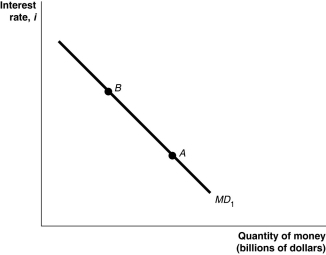 -Refer to Figure 26-4. In the figure above, a movement from point A to point B would be caused by
 (Multiple Choice)
4.8/5 (82)
(82) In March 2008, the Fed announced that primary dealers would be eligible to receive discount loans.
(True/False)
4.8/5 (81)
(81) Article Summary
Concerned about slow economic growth, the Fed announced in September 2013 that it would postpone winding down its $85 billion a month bond purchasing program which has been a key component of its monetary stimulus package. Fed Chairman Ben Bernanke would not commit to a timeline for reducing the bond purchases, stating that the program was "not on a preset course." The Fed's forecasts of economic growth have been lowered for 2013 and 2014, and the Fed does not expect to raise interest rates until 2015. Since late 2008, the Fed has held its benchmark interest rate near zero, while its balance sheet has tripled to more than $3.6 trillion. The Fed also stated that so long as inflation did not become a threat, it would not raise interest rates until the unemployment rate dropped to 6.5 percent. At the time of the announcement, the unemployment rate was 7.3 percent.
Source: Pedro da Costa and Alister Bull, "Fed Surprises, sticks to stimulus as it cuts growth outlook," Reuters, September 18, 2013.
-Refer to the Article Summary. When the Fed announced it did not expect to raise its benchmark interest rate until 2015, it was referring to the
(Multiple Choice)
4.8/5 (70)
(70) Table 26-4
 -Refer to Table 26-4. Suppose the following table illustrates the values of real and potential GDP and the price level, if the Fed does not vote to change their current policy to be more contractionary or expansionary. If the Fed wants to keep real GDP at its potential level in 2015, should the Fed use a contractionary or expansionary policy? How should it conduct open market operations to achieve its goal?
 (Essay)
4.9/5 (71)
(71) Table 26-1
 -Refer to Table 26-1. The hypothetical information in the table shows what the values for real GDP and the price level will be in 2015 if the Fed does not use monetary policy. Which of the following policies makes sense if the Fed wants to keep real GDP at its potential level in 2015?
 (Multiple Choice)
4.7/5 (87)
(87) The Federal Reserve responded to the 2008 financial crisis in several ways. Which of the following is one of the ways the Fed responded?
(Multiple Choice)
4.9/5 (54)
(54) 
Filters
- Essay(0)
- Multiple Choice(0)
- Short Answer(0)
- True False(0)
- Matching(0)