



 Chat with AI
Exam 27: Fiscal Policy

Exam 1: Economics: Foundations and Models444 Questions
Exam 2: Trade-Offs, Comparative Advantage, and the Market System498 Questions
Exam 3: Where Prices Come From: the Interaction of Demand and Supply475 Questions
Exam 4: Economic Efficiency, Government Price Setting, and Taxes419 Questions
Exam 5: Externalities, Environmental Policy, and Public Goods266 Questions
Exam 6: Elasticity: the Responsiveness of Demand and Supply295 Questions
Exam 7: The Economics of Health Care334 Questions
Exam 8: Firms, the Stock Market, and Corporate Governance278 Questions
Exam 9: Comparative Advantage and the Gains From International Trade379 Questions
Exam 10: Consumer Choice and Behavioral Economics302 Questions
Exam 11: Technology, Production, and Costs330 Questions
Exam 12: Firms in Perfectly Competitive Markets298 Questions
Exam 13: Monopolistic Competition: the Competitive Model in a More Realistic Setting276 Questions
Exam 14: Oligopoly: Firms in Less Competitive Markets262 Questions
Exam 15: Monopoly and Antitrust Policy271 Questions
Exam 16: Pricing Strategy263 Questions
Exam 17: The Markets for Labor and Other Factors of Production286 Questions
Exam 18: Public Choice, Taxes, and the Distribution of Income258 Questions
Exam 19: GDP: Measuring Total Production and Income266 Questions
Exam 20: Unemployment and Inflation292 Questions
Exam 21: Economic Growth, the Financial System, and Business Cycles257 Questions
Exam 22: Long-Run Economic Growth: Sources and Policies268 Questions
Exam 23: Aggregate Expenditure and Output in the Short Run306 Questions
Exam 24: Aggregate Demand and Aggregate Supply Analysis284 Questions
Exam 25: Money, Banks, and the Federal Reserve System280 Questions
Exam 26: Monetary Policy277 Questions
Exam 27: Fiscal Policy303 Questions
Exam 28: Inflation, Unemployment, and Federal Reserve Policy257 Questions
Exam 29: Macroeconomics in an Open Economy278 Questions
Exam 30: The International Financial System262 Questions
Select questions type


The tax multiplier is calculated as "one minus the government purchases multiplier."
(True/False)
4.9/5  (67)
(67) Raising taxes on interest and dividend income will increase the level of investment and economic growth.
(True/False)
4.7/5 (73)
(73) The federal government debt as a percentage of GDP did not rise
(Multiple Choice)
4.9/5 (80)
(80) If Congress passed a one-time tax cut in order to stimulate the economy in 2014, and tax rate levels returned to their pre-2014 level in 2015, how should this tax cut affect the economy?
(Multiple Choice)
4.9/5 (77)
(77) If the federal budget goes from a budget deficit in Year 1 to a budget surplus in Year 2, does it follow that the federal government acted to raise taxes or cut government spending in Year 2?
(Essay)
4.9/5 (89)
(89) The tax multiplier is smaller in absolute value than the government purchases multiplier because some portion of the
(Multiple Choice)
4.7/5 (81)
(81) Assume a closed economy, that taxes are fixed, and the marginal propensity to consume is equal to 0.8. What is the government spending multiplier?
(Multiple Choice)
4.9/5 (89)
(89) Figure 27-5  -If real GDP exceeded potential real GDP and inflation was increasing, which of the following would be an appropriate fiscal policy?
 (Multiple Choice)
4.9/5 (89)
(89) ________ and ________ are the largest sources of revenue collected by the federal government.
(Multiple Choice)
4.8/5 (85)
(85) The majority of the federal government debt is held by government agencies.
(True/False)
4.8/5 (76)
(76) The multiplier effect following an increase in expenditure is generated by induced increases in consumption expenditure as income rises.
(True/False)
4.9/5 (82)
(82) Use the dynamic aggregate demand and aggregate supply model and start with Year 1 in a long-run macroeconomic equilibrium. For Year 2, graph aggregate demand, long-run aggregate supply, and short-run aggregate supply such that the condition of the economy will induce the president and the Congress to conduct contractionary fiscal policy. Briefly explain the condition of the economy and what the president and the Congress are attempting to do.
(Essay)
4.9/5 (67)
(67) In the long run, most economists agree that a permanent increase in government spending leads to
(Multiple Choice)
4.8/5 (79)
(79) Figure 27-1 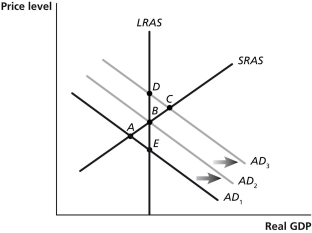 -Refer to Figure 27-1. Suppose the economy is in a recession and expansionary fiscal policy is pursued. Using the static AD-AS model in the figure above, this would be depicted as a movement from
 (Multiple Choice)
4.7/5 (69)
(69) Figure 27-4 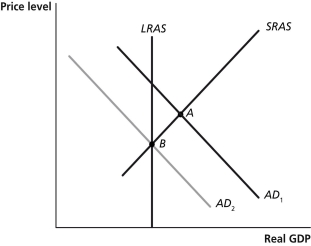 -The problem causing most recessions is too little
 (Multiple Choice)
4.8/5 (87)
(87) Increasing the federal budget deficit will contribute to increasing the federal government debt.
(True/False)
4.8/5 (88)
(88) Of the $840 billion American Recovery and Reinvestment Act stimulus package which was enacted in 2009, the largest tax cuts occurred in which category?
(Multiple Choice)
4.8/5 (75)
(75) A permanent tax cut would likely ________ consumption spending ________ than would a tax rebate like the one issued in 2008.
(Multiple Choice)
4.9/5 (87)
(87) 
Filters
- Essay(0)
- Multiple Choice(0)
- Short Answer(0)
- True False(0)
- Matching(0)