



 Chat with AI
Exam 27: Fiscal Policy

Exam 1: Economics: Foundations and Models444 Questions
Exam 2: Trade-Offs, Comparative Advantage, and the Market System498 Questions
Exam 3: Where Prices Come From: the Interaction of Demand and Supply475 Questions
Exam 4: Economic Efficiency, Government Price Setting, and Taxes419 Questions
Exam 5: Externalities, Environmental Policy, and Public Goods266 Questions
Exam 6: Elasticity: the Responsiveness of Demand and Supply295 Questions
Exam 7: The Economics of Health Care334 Questions
Exam 8: Firms, the Stock Market, and Corporate Governance278 Questions
Exam 9: Comparative Advantage and the Gains From International Trade379 Questions
Exam 10: Consumer Choice and Behavioral Economics302 Questions
Exam 11: Technology, Production, and Costs330 Questions
Exam 12: Firms in Perfectly Competitive Markets298 Questions
Exam 13: Monopolistic Competition: the Competitive Model in a More Realistic Setting276 Questions
Exam 14: Oligopoly: Firms in Less Competitive Markets262 Questions
Exam 15: Monopoly and Antitrust Policy271 Questions
Exam 16: Pricing Strategy263 Questions
Exam 17: The Markets for Labor and Other Factors of Production286 Questions
Exam 18: Public Choice, Taxes, and the Distribution of Income258 Questions
Exam 19: GDP: Measuring Total Production and Income266 Questions
Exam 20: Unemployment and Inflation292 Questions
Exam 21: Economic Growth, the Financial System, and Business Cycles257 Questions
Exam 22: Long-Run Economic Growth: Sources and Policies268 Questions
Exam 23: Aggregate Expenditure and Output in the Short Run306 Questions
Exam 24: Aggregate Demand and Aggregate Supply Analysis284 Questions
Exam 25: Money, Banks, and the Federal Reserve System280 Questions
Exam 26: Monetary Policy277 Questions
Exam 27: Fiscal Policy303 Questions
Exam 28: Inflation, Unemployment, and Federal Reserve Policy257 Questions
Exam 29: Macroeconomics in an Open Economy278 Questions
Exam 30: The International Financial System262 Questions
Select questions type


When President Obama took office in January 2009, he pledged to pursue an expansionary fiscal policy to try to pull the economy out of the recession. The next month, Congress passed the American Recovery and Reinvestment Act of 2009, a $840 billion package of ________ that was the largest fiscal policy action in U.S. history.
(Multiple Choice)
4.8/5  (77)
(77) An increase in individual income taxes ________ disposable income, which ________ consumption spending.
(Multiple Choice)
5.0/5 (88)
(88) Long lags associated with the legislative process in implementing fiscal policy make it more difficult to use than monetary policy.
(True/False)
4.9/5 (82)
(82) Figure 27-6  -Refer to Figure 27-6. In the dynamic model of AD-AS in the figure above, if the economy is at point A in year 1 and is expected to go to point B in year 2, and no fiscal or monetary policy is pursued, then at point B
 (Multiple Choice)
4.9/5 (64)
(64) Figure 27-4 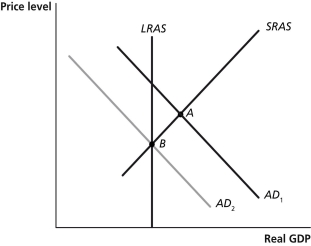 -Expansionary fiscal policy involves increasing government purchases or increasing taxes.
 (True/False)
4.8/5 (78)
(78) A one-time tax rebate, which is not expected to be extended in future years, will
(Multiple Choice)
5.0/5 (77)
(77) Figure 27-11  -Which of the following would increase the size of the government purchases multiplier?
 (Multiple Choice)
4.8/5 (78)
(78) Figure 27-1 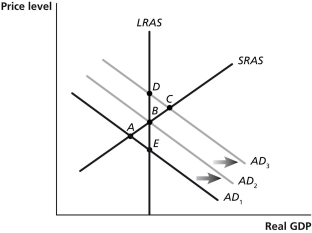 -Refer to Figure 27-1. Suppose the economy is in short-run equilibrium below potential GDP and Congress and the president lower taxes to move the economy back to long-run equilibrium. Using the static AD-AS model in the figure above, this would be depicted as a movement from
 (Multiple Choice)
4.9/5 (88)
(88) In early 2008, the housing crisis and rising oil prices increased the risk of recession in the United States. What fiscal policy action was taken by Congress and the president to counter these events?
(Multiple Choice)
4.7/5 (90)
(90) If the tax multiplier is -1.5 and a $200 billion tax increase is implemented, what is the change in GDP, holding everything else constant? (Assume the price level stays constant.)
(Multiple Choice)
5.0/5 (72)
(72) In an open economy, the government purchases multiplier will be larger the
(Multiple Choice)
4.7/5 (76)
(76) Which of the following is an example of discretionary fiscal policy?
(Multiple Choice)
4.9/5 (86)
(86) Prior to the 1930s, the majority of dollars spent by government was spent at the state and local levels.
(True/False)
5.0/5 (84)
(84) Suppose that Congress allocates $5 billion to an "energy-efficient appliance rebate" program. It also raises taxes by $5 billion to keep the deficit from growing. If the marginal propensity to consume is 0.8, what is the effect on equilibrium GDP?
(Multiple Choice)
5.0/5 (79)
(79) Contractionary fiscal policy to prevent real GDP from rising above potential real GDP would cause the inflation rate to be ________ and real GDP to be ________.
(Multiple Choice)
4.9/5 (93)
(93) The aggregate demand curve will shift to the right ________ the initial decrease in taxes.
(Multiple Choice)
4.9/5 (76)
(76) Figure 27-5  -From an initial long-run equilibrium, if aggregate demand grows more slowly than long-run and short-run aggregate supply, then Congress and the president would most likely
 (Multiple Choice)
5.0/5 (81)
(81) Illustrate and explain the effects of tax reduction and simplification using the dynamic aggregate demand and supply model. To simplify the analysis, assume that aggregate demand is not affected by the tax cut.
(Essay)
4.8/5 (82)
(82) 
Filters
- Essay(0)
- Multiple Choice(0)
- Short Answer(0)
- True False(0)
- Matching(0)