



 Chat with AI
Exam 27: Fiscal Policy

Exam 1: Economics: Foundations and Models444 Questions
Exam 2: Trade-Offs, Comparative Advantage, and the Market System498 Questions
Exam 3: Where Prices Come From: the Interaction of Demand and Supply475 Questions
Exam 4: Economic Efficiency, Government Price Setting, and Taxes419 Questions
Exam 5: Externalities, Environmental Policy, and Public Goods266 Questions
Exam 6: Elasticity: the Responsiveness of Demand and Supply295 Questions
Exam 7: The Economics of Health Care334 Questions
Exam 8: Firms, the Stock Market, and Corporate Governance278 Questions
Exam 9: Comparative Advantage and the Gains From International Trade379 Questions
Exam 10: Consumer Choice and Behavioral Economics302 Questions
Exam 11: Technology, Production, and Costs330 Questions
Exam 12: Firms in Perfectly Competitive Markets298 Questions
Exam 13: Monopolistic Competition: the Competitive Model in a More Realistic Setting276 Questions
Exam 14: Oligopoly: Firms in Less Competitive Markets262 Questions
Exam 15: Monopoly and Antitrust Policy271 Questions
Exam 16: Pricing Strategy263 Questions
Exam 17: The Markets for Labor and Other Factors of Production286 Questions
Exam 18: Public Choice, Taxes, and the Distribution of Income258 Questions
Exam 19: GDP: Measuring Total Production and Income266 Questions
Exam 20: Unemployment and Inflation292 Questions
Exam 21: Economic Growth, the Financial System, and Business Cycles257 Questions
Exam 22: Long-Run Economic Growth: Sources and Policies268 Questions
Exam 23: Aggregate Expenditure and Output in the Short Run306 Questions
Exam 24: Aggregate Demand and Aggregate Supply Analysis284 Questions
Exam 25: Money, Banks, and the Federal Reserve System280 Questions
Exam 26: Monetary Policy277 Questions
Exam 27: Fiscal Policy303 Questions
Exam 28: Inflation, Unemployment, and Federal Reserve Policy257 Questions
Exam 29: Macroeconomics in an Open Economy278 Questions
Exam 30: The International Financial System262 Questions
Select questions type


A decrease in the tax rate will ________ the disposable income of households and ________ the size of the multiplier effect.
(Multiple Choice)
4.8/5  (77)
(77) In Year 1 suppose the economy is at potential GDP and that the federal budget deficit equals $100 billion. In Year 2 the federal budget deficit rises to $150 billion, but the cyclically adjusted budget deficit falls to $75 billion. How can the actual budget deficit rise and the cyclically adjusted budget deficit fall?
(Essay)
4.8/5 (85)
(85) The problem typically during a recession is not that there is too little money, but too little spending. If the problem was too little money, what would be its cause? If the problem was too little spending, what could be its cause?
(Essay)
4.9/5 (72)
(72) Table 27-6
 -Refer to Table 27-6. Suppose the economy is in the state described by the table above. What problem will occur in the economy if no policy is pursued? What fiscal policy tools could be used to combat the problem? Draw a dynamic aggregate demand and aggregate supply diagram to illustrate the appropriate fiscal policy to use in this situation.
 (Essay)
4.9/5 (79)
(79) If real equilibrium GDP is above potential GDP, expansionary fiscal policy should be pursued.
(True/False)
4.8/5 (73)
(73) Figure 27-9 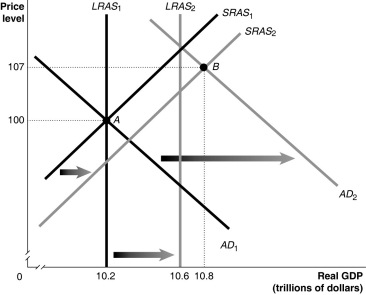 -Refer to Figure 27-9. Given that the economy has moved from A to B in the graph above, which of the following would the appropriate fiscal policy to achieve potential GDP?
 (Multiple Choice)
4.9/5 (88)
(88) What is meant by crowding out? Explain the difference between crowding out in the short run and in the long run.
(Essay)
4.8/5 (74)
(74) As the tax wedge associated with a given economic activity gets smaller, we would expect
(Multiple Choice)
4.9/5 (84)
(84) Congress and the president carry out fiscal policy through changes in
(Multiple Choice)
4.9/5 (66)
(66) Suppose Congress increased spending by $100 billion and raised taxes by $100 billion to keep the budget balanced. What will happen to real equilibrium GDP?
(Multiple Choice)
5.0/5 (75)
(75) Identify each of the following as (i) part of an expansionary fiscal policy, (ii) part of a contractionary fiscal policy, or (iii) not part of fiscal policy.
a. The personal income tax rate is lowered.
b. Congress cuts spending on defense.
c. College students are allowed to deduct tuition costs from their federal income taxes.
d. The corporate income tax rate is lowered.
e. The state of Nevada builds a new tollway in an attempt to expand employment and ease traffic in Las Vegas.
(Essay)
4.8/5 (81)
(81) Figure 27-8 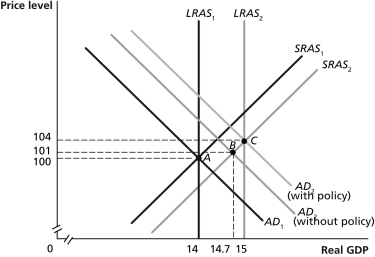 -Refer to Figure 27-8. In the graph above, suppose the economy in Year 1 is at point A and expected in Year 2 to be at point B. Which of the following policies could the Congress and the president use to move the economy to point C?
 (Multiple Choice)
5.0/5 (86)
(86) Compare the effect on the price level and real GDP of a decrease in tax rates assuming a supply-side effect versus no supply-side effect. Compared to no supply-side effect, including a supply-side effect for the decrease in tax rates will cause the price level to increase ________ and real GDP to increase ________.
(Multiple Choice)
4.9/5 (85)
(85) In preparing their estimates of the stimulus package's effect on GDP, Obama administration economists estimated a government purchases multiplier of 1.57. Economist Robert Barro argues that during wartime, the government purchases multiplier would be ________ the administration's estimate, and economists Lawrence Christiano, Martin Eichenbaum, and Sergio Rebelo argued that when short-term interest rates are near zero, the multiplier would be ________ the administration's estimate.
(Multiple Choice)
4.7/5 (75)
(75) Figure 27-3 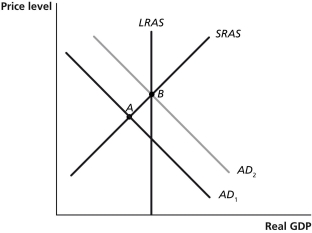 -Refer to Figure 27-3. In the graph above, suppose the economy is initially at point A. The movement of the economy to point B as shown in the graph illustrates the effect of which of the following policy actions by the Congress and the president?
 (Multiple Choice)
4.8/5 (98)
(98) 
Filters
- Essay(0)
- Multiple Choice(0)
- Short Answer(0)
- True False(0)
- Matching(0)