



 Chat with AI
Exam 27: Fiscal Policy

Exam 1: Economics: Foundations and Models444 Questions
Exam 2: Trade-Offs, Comparative Advantage, and the Market System498 Questions
Exam 3: Where Prices Come From: the Interaction of Demand and Supply475 Questions
Exam 4: Economic Efficiency, Government Price Setting, and Taxes419 Questions
Exam 5: Externalities, Environmental Policy, and Public Goods266 Questions
Exam 6: Elasticity: the Responsiveness of Demand and Supply295 Questions
Exam 7: The Economics of Health Care334 Questions
Exam 8: Firms, the Stock Market, and Corporate Governance278 Questions
Exam 9: Comparative Advantage and the Gains From International Trade379 Questions
Exam 10: Consumer Choice and Behavioral Economics302 Questions
Exam 11: Technology, Production, and Costs330 Questions
Exam 12: Firms in Perfectly Competitive Markets298 Questions
Exam 13: Monopolistic Competition: the Competitive Model in a More Realistic Setting276 Questions
Exam 14: Oligopoly: Firms in Less Competitive Markets262 Questions
Exam 15: Monopoly and Antitrust Policy271 Questions
Exam 16: Pricing Strategy263 Questions
Exam 17: The Markets for Labor and Other Factors of Production286 Questions
Exam 18: Public Choice, Taxes, and the Distribution of Income258 Questions
Exam 19: GDP: Measuring Total Production and Income266 Questions
Exam 20: Unemployment and Inflation292 Questions
Exam 21: Economic Growth, the Financial System, and Business Cycles257 Questions
Exam 22: Long-Run Economic Growth: Sources and Policies268 Questions
Exam 23: Aggregate Expenditure and Output in the Short Run306 Questions
Exam 24: Aggregate Demand and Aggregate Supply Analysis284 Questions
Exam 25: Money, Banks, and the Federal Reserve System280 Questions
Exam 26: Monetary Policy277 Questions
Exam 27: Fiscal Policy303 Questions
Exam 28: Inflation, Unemployment, and Federal Reserve Policy257 Questions
Exam 29: Macroeconomics in an Open Economy278 Questions
Exam 30: The International Financial System262 Questions
Select questions type


Assuming a fixed amount of taxes and a closed economy, calculate the value of the government purchases multiplier, the tax multiplier, and the balanced budget multiplier if the marginal propensity to consume equals 0.75.
(Essay)
4.8/5  (64)
(64) Lowering the individual income tax will increase household disposable income and consumption spending.
(True/False)
4.9/5 (79)
(79) Calculate the value of the government purchases multiplier if the marginal propensity to consume equals 0.9, the tax rate equals 0.25, and the marginal propensity to import equals 0.15.
(Essay)
4.8/5 (73)
(73) When President Obama took office in January 2009, he pledged to pursue an expansionary fiscal policy to try to pull the economy out of the recession. The next month, Congress passed the American Recovery and Reinvestment Act of 2009, an $840 billion package of spending increases and tax cuts that was
(Multiple Choice)
4.9/5 (73)
(73) A decrease in which of the following would decrease the tax wedge?
(Multiple Choice)
4.8/5 (71)
(71) Figure 27-1 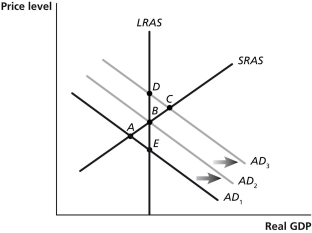 -Refer to Figure 27-1. Suppose the economy is in short-run equilibrium above potential GDP and wages and prices are rising. If contractionary policy is used to move the economy back to long-run equilibrium, this would be depicted as a movement from ________ using the static AD-AS model in the figure above.
 (Multiple Choice)
4.8/5 (80)
(80) The use of fiscal policy to stabilize the economy is limited because
(Multiple Choice)
4.8/5 (80)
(80) A tax rebate, like the one issued in 2008, is likely to ________ consumption spending ________ than would a permanent tax cut.
(Multiple Choice)
4.9/5 (76)
(76) Figure 27-4 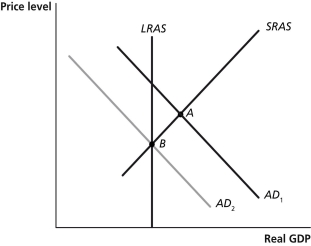 -Refer to Figure 27-4. In the graph above, suppose the economy is initially at point A. The movement of the economy to point B as shown in the graph illustrates the effect of which of the following policy actions by the Congress and the president?
 (Multiple Choice)
4.8/5 (74)
(74) Which of the following would be considered an active fiscal policy?
(Multiple Choice)
4.8/5 (85)
(85) Suppose the federal budget deficit for the year was $100 billion and the economy was in a recession. If the economy had been at potential GDP, it is estimated that tax revenues would have been $60 billion higher and government spending on transfer payments $50 billion lower. Using these estimates, the cyclically adjusted budget
(Multiple Choice)
4.9/5 (87)
(87) What are the key differences between how we illustrate a contractionary fiscal policy in the basic aggregate demand and aggregate supply model and in the dynamic aggregate demand and aggregate supply model?
(Essay)
4.9/5 (68)
(68) Since the Social Security system began in 1935, the number of workers per retiree has
(Multiple Choice)
4.9/5 (83)
(83) The income tax system serves as an automatic stabilizer over the course of the business cycle.
(True/False)
4.7/5 (85)
(85) Some economists argue that the federal government should normally run a deficit at potential GDP, with the borrowed funds applied to
(Multiple Choice)
4.8/5 (80)
(80) Of the $840 billion American Recovery and Reinvestment Act stimulus package which was enacted in 2009, approximately one-third took the form of ________ and two-thirds took the form of increases in ________.
(Multiple Choice)
5.0/5 (82)
(82) 
Filters
- Essay(0)
- Multiple Choice(0)
- Short Answer(0)
- True False(0)
- Matching(0)