



 Chat with AI
Exam 27: Fiscal Policy

Exam 1: Economics: Foundations and Models444 Questions
Exam 2: Trade-Offs, Comparative Advantage, and the Market System498 Questions
Exam 3: Where Prices Come From: the Interaction of Demand and Supply475 Questions
Exam 4: Economic Efficiency, Government Price Setting, and Taxes419 Questions
Exam 5: Externalities, Environmental Policy, and Public Goods266 Questions
Exam 6: Elasticity: the Responsiveness of Demand and Supply295 Questions
Exam 7: The Economics of Health Care334 Questions
Exam 8: Firms, the Stock Market, and Corporate Governance278 Questions
Exam 9: Comparative Advantage and the Gains From International Trade379 Questions
Exam 10: Consumer Choice and Behavioral Economics302 Questions
Exam 11: Technology, Production, and Costs330 Questions
Exam 12: Firms in Perfectly Competitive Markets298 Questions
Exam 13: Monopolistic Competition: the Competitive Model in a More Realistic Setting276 Questions
Exam 14: Oligopoly: Firms in Less Competitive Markets262 Questions
Exam 15: Monopoly and Antitrust Policy271 Questions
Exam 16: Pricing Strategy263 Questions
Exam 17: The Markets for Labor and Other Factors of Production286 Questions
Exam 18: Public Choice, Taxes, and the Distribution of Income258 Questions
Exam 19: GDP: Measuring Total Production and Income266 Questions
Exam 20: Unemployment and Inflation292 Questions
Exam 21: Economic Growth, the Financial System, and Business Cycles257 Questions
Exam 22: Long-Run Economic Growth: Sources and Policies268 Questions
Exam 23: Aggregate Expenditure and Output in the Short Run306 Questions
Exam 24: Aggregate Demand and Aggregate Supply Analysis284 Questions
Exam 25: Money, Banks, and the Federal Reserve System280 Questions
Exam 26: Monetary Policy277 Questions
Exam 27: Fiscal Policy303 Questions
Exam 28: Inflation, Unemployment, and Federal Reserve Policy257 Questions
Exam 29: Macroeconomics in an Open Economy278 Questions
Exam 30: The International Financial System262 Questions
Select questions type


Figure 27-6  -Refer to Figure 27-6. In the dynamic model of AD-AS in the figure above, if the economy is at point A in year 1 and is expected to go to point B in year 2, Congress and the president would most likely
 (Multiple Choice)
4.8/5  (72)
(72) Article Summary
In a letter to Congress, Treasury Secretary Jacob Lew stated that the United States will run out of borrowed money by Thursday, October 17 unless the $16.7 trillion debt ceiling was raised. Every Thursday, the Treasury typically rolls over $100 billion in debt as bonds mature and investors use the proceeds to buy new bonds, and Lew was concerned that without an increase in the debt ceiling, a crisis could emerge from a massive bond sell-off. Since the government had reached its current debt limit, it would only be able to use daily on-hand revenue to pay its bills without the increase in the ceiling. The Treasury expected the government to have only $30 billion per day in cash on hand by October 17, while its typical daily expenses were $60 billion. "If we have insufficient cash on hand, it would be impossible for the United States of America to meet all of its obligations for the first time in our history," Lew said.
Source: Gregory Korte, "Treasury will run out of borrowed money by Oct. 17," USA Today, September 25, 2013.
-Refer to the Article Summary. When does the Treasury Department borrow? Why would the Treasury have to borrow more than it estimated, as was indicated by its letter to Congress to raise the debt ceiling? When would the Treasury repay what it borrowed, and who is it repaying?
(Essay)
4.8/5 (84)
(84) Table 27-4
 -Refer to Table 27-4. Consider the hypothetical information in the table above for potential real GDP, real GDP and the price level in 2013 and in 2014 if the Congress and the president do not use fiscal policy. If the Congress and the president use fiscal policy successfully to keep real GDP at its potential level in 2014, which of the following will be lower than if the Congress and the president had taken no action?
 (Multiple Choice)
4.9/5 (80)
(80) Figure 27-11 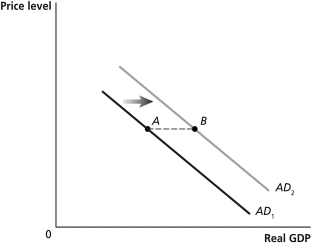 -Refer to Figure 27-11. If government purchases increase by $100 billion and lead to an ultimate increase in aggregate demand as shown in the graph below, the difference in real GDP between point A and point B will be
 (Multiple Choice)
4.8/5 (79)
(79) If the government purchases multiplier equals 2, and real GDP is $14 trillion with potential real GDP $14.5 trillion, then government purchases would need to increase by ________ to restore the economy to potential real GDP.
(Multiple Choice)
4.9/5 (75)
(75) The government purchases multiplier will be larger if the marginal income tax rate decreases.
(True/False)
5.0/5 (68)
(68) Assuming a fixed amount of taxes and a closed economy, calculate the value of the government purchases multiplier, the tax multiplier, and the balanced budget multiplier if the marginal propensity to consume equals 0.5.
(Essay)
4.9/5 (98)
(98) Included in government expenditures are government purchases and transfer payments.
(True/False)
4.9/5 (78)
(78) Give an example of an automatic stabilizer. Explain how automatic stabilizers work in the case of recession.
(Essay)
4.9/5 (82)
(82) The largest and fastest-growing category of federal government expenditures is
(Multiple Choice)
4.9/5 (65)
(65) Suppose the government wants to maintain a balanced budget. To achieve this goal, when the economy falls into recession government would need to ________ taxes, which would cause aggregate demand to ________.
(Multiple Choice)
4.9/5 (90)
(90) Which of the following would be most likely to induce Congress and the president to conduct contractionary fiscal policy? A significant
(Multiple Choice)
4.9/5 (72)
(72) During the twentieth century, the largest budget deficits as a percentage of GDP occurred
(Multiple Choice)
4.9/5 (82)
(82) In a closed economy with fixed or autonomous (non-income dependent) taxes, the balanced budget government purchases multiplier is negative.
(True/False)
4.9/5 (72)
(72) The crowding out of private spending by government spending will be greater the
(Multiple Choice)
4.9/5 (71)
(71) Calculate the government purchases multiplier if the marginal propensity to consume equals 0.8, the tax rate is 0.1, and the marginal propensity to import equals 0.2.
(Multiple Choice)
4.9/5 (87)
(87) If the federal budget has an actual budget deficit of $100 billion and a cyclically adjusted budget deficit of $75 billion, then the economy
(Multiple Choice)
4.8/5 (84)
(84) The Social Security and Medicare programs have been a failure in terms of reducing poverty among elderly U.S. citizens.
(True/False)
4.8/5 (82)
(82) 
Filters
- Essay(0)
- Multiple Choice(0)
- Short Answer(0)
- True False(0)
- Matching(0)