



 Chat with AI
Exam 27: Fiscal Policy

Exam 1: Economics: Foundations and Models444 Questions
Exam 2: Trade-Offs, Comparative Advantage, and the Market System498 Questions
Exam 3: Where Prices Come From: the Interaction of Demand and Supply475 Questions
Exam 4: Economic Efficiency, Government Price Setting, and Taxes419 Questions
Exam 5: Externalities, Environmental Policy, and Public Goods266 Questions
Exam 6: Elasticity: the Responsiveness of Demand and Supply295 Questions
Exam 7: The Economics of Health Care334 Questions
Exam 8: Firms, the Stock Market, and Corporate Governance278 Questions
Exam 9: Comparative Advantage and the Gains From International Trade379 Questions
Exam 10: Consumer Choice and Behavioral Economics302 Questions
Exam 11: Technology, Production, and Costs330 Questions
Exam 12: Firms in Perfectly Competitive Markets298 Questions
Exam 13: Monopolistic Competition: the Competitive Model in a More Realistic Setting276 Questions
Exam 14: Oligopoly: Firms in Less Competitive Markets262 Questions
Exam 15: Monopoly and Antitrust Policy271 Questions
Exam 16: Pricing Strategy263 Questions
Exam 17: The Markets for Labor and Other Factors of Production286 Questions
Exam 18: Public Choice, Taxes, and the Distribution of Income258 Questions
Exam 19: GDP: Measuring Total Production and Income266 Questions
Exam 20: Unemployment and Inflation292 Questions
Exam 21: Economic Growth, the Financial System, and Business Cycles257 Questions
Exam 22: Long-Run Economic Growth: Sources and Policies268 Questions
Exam 23: Aggregate Expenditure and Output in the Short Run306 Questions
Exam 24: Aggregate Demand and Aggregate Supply Analysis284 Questions
Exam 25: Money, Banks, and the Federal Reserve System280 Questions
Exam 26: Monetary Policy277 Questions
Exam 27: Fiscal Policy303 Questions
Exam 28: Inflation, Unemployment, and Federal Reserve Policy257 Questions
Exam 29: Macroeconomics in an Open Economy278 Questions
Exam 30: The International Financial System262 Questions
Select questions type


Describe the differences (in sign and relative magnitude) between the government purchases multiplier and the tax multiplier.
(Essay)
4.8/5  (79)
(79) Expansionary fiscal policy to prevent real GDP from falling below potential real GDP would cause the inflation rate to be ________ and real GDP to be ________.
(Multiple Choice)
4.8/5 (80)
(80) A law requiring the government to balance its budget in each year would serve as an automatic destabilizer.
(True/False)
4.9/5 (77)
(77) What is the government purchases multiplier if the tax rate is 0.1 and the marginal propensity to consume is 0.9? Assume the economy is closed.
(Multiple Choice)
4.9/5 (80)
(80) The cyclically adjusted budget deficit or surplus measures what the deficit or surplus would be if the economy was
(Multiple Choice)
4.9/5 (89)
(89) Contractionary fiscal policy is used to decrease aggregate demand in an attempt to fight rising inflation.
(True/False)
5.0/5 (82)
(82) Figure 27-2 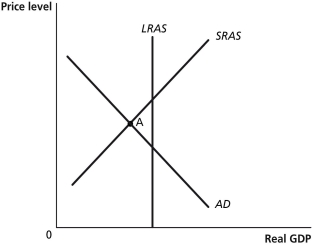 -Refer to Figure 27-2. In the graph above, if the economy is at point A, an appropriate fiscal policy by the Congress and the president would be to
 (Multiple Choice)
4.7/5 (80)
(80) The government budget for the country of Economia is in surplus in 2011, and in deficit in the following year, 2012. We can conclude the
(Multiple Choice)
5.0/5 (90)
(90) An increase in government purchases of $200 billion will shift the aggregate demand curve to the right by
(Multiple Choice)
4.7/5 (81)
(81) The tax increases necessary to fund future Social Security and Medicare benefit payments would be
(Multiple Choice)
4.9/5 (83)
(83) Suppose real GDP is $12.1 trillion and potential GDP is $12.6 trillion. To move the economy back to potential GDP, Congress should
(Multiple Choice)
4.9/5 (75)
(75) During most of the years of the Great Depression, the actual federal budget was in ________, and the cyclically adjusted budget was in ________.
(Multiple Choice)
4.7/5 (93)
(93) If the economy is falling below potential real GDP, which of the following would be an appropriate fiscal policy to bring the economy back to long-run aggregate supply? An increase in
(Multiple Choice)
4.8/5 (79)
(79) The double taxation problem occurs because households pay taxes on dividends and capital gains from stock and corporations pay taxes on corporate profits.
(True/False)
5.0/5 (80)
(80) Figure 27-5  -Refer to Figure 27-5. In the dynamic model of AD-AS in the figure above, if the economy is at point A in year 1 and is expected to go to point B in year 2, and no fiscal or monetary policy is pursued, then at point B
 (Multiple Choice)
4.7/5 (63)
(63) Of the $840 billion American Recovery and Reinvestment Act stimulus package which was enacted in 2009, the largest spending increase occurred in which category?
(Multiple Choice)
4.7/5 (76)
(76) Accumulating debt poses a problem for the U.S. federal government because
(Multiple Choice)
4.9/5 (71)
(71) 
Filters
- Essay(0)
- Multiple Choice(0)
- Short Answer(0)
- True False(0)
- Matching(0)