



 Chat with AI
Exam 27: Fiscal Policy

Exam 1: Economics: Foundations and Models444 Questions
Exam 2: Trade-Offs, Comparative Advantage, and the Market System498 Questions
Exam 3: Where Prices Come From: the Interaction of Demand and Supply475 Questions
Exam 4: Economic Efficiency, Government Price Setting, and Taxes419 Questions
Exam 5: Externalities, Environmental Policy, and Public Goods266 Questions
Exam 6: Elasticity: the Responsiveness of Demand and Supply295 Questions
Exam 7: The Economics of Health Care334 Questions
Exam 8: Firms, the Stock Market, and Corporate Governance278 Questions
Exam 9: Comparative Advantage and the Gains From International Trade379 Questions
Exam 10: Consumer Choice and Behavioral Economics302 Questions
Exam 11: Technology, Production, and Costs330 Questions
Exam 12: Firms in Perfectly Competitive Markets298 Questions
Exam 13: Monopolistic Competition: the Competitive Model in a More Realistic Setting276 Questions
Exam 14: Oligopoly: Firms in Less Competitive Markets262 Questions
Exam 15: Monopoly and Antitrust Policy271 Questions
Exam 16: Pricing Strategy263 Questions
Exam 17: The Markets for Labor and Other Factors of Production286 Questions
Exam 18: Public Choice, Taxes, and the Distribution of Income258 Questions
Exam 19: GDP: Measuring Total Production and Income266 Questions
Exam 20: Unemployment and Inflation292 Questions
Exam 21: Economic Growth, the Financial System, and Business Cycles257 Questions
Exam 22: Long-Run Economic Growth: Sources and Policies268 Questions
Exam 23: Aggregate Expenditure and Output in the Short Run306 Questions
Exam 24: Aggregate Demand and Aggregate Supply Analysis284 Questions
Exam 25: Money, Banks, and the Federal Reserve System280 Questions
Exam 26: Monetary Policy277 Questions
Exam 27: Fiscal Policy303 Questions
Exam 28: Inflation, Unemployment, and Federal Reserve Policy257 Questions
Exam 29: Macroeconomics in an Open Economy278 Questions
Exam 30: The International Financial System262 Questions
Select questions type


A recession tends to cause the federal budget deficit to ________ because tax revenues ________ and government spending on transfer payments ________.
(Multiple Choice)
4.9/5  (85)
(85) Government transfer payments include which of the following?
(Multiple Choice)
4.9/5 (85)
(85) If policy makers are concerned that the economy is in danger of rising inflation because aggregate demand is increasing faster than aggregate supply, the appropriate fiscal policy response is to
(Multiple Choice)
4.7/5 (66)
(66) Poorly timed discretionary policy can do more harm than good. Getting the timing right with fiscal policy is generally
(Multiple Choice)
4.9/5 (81)
(81) The level of crowding out associated with a tax cut will be smaller if the tax change has a supply-side effect than it will be if it only has a demand-side effect.
(True/False)
4.8/5 (81)
(81) Which of the following is the largest category of federal government expenditures?
(Multiple Choice)
4.9/5 (75)
(75) If the absolute value of the tax multiplier equals 1.6, real GDP is $13 trillion, and potential real GDP is $13.4 trillion, then taxes would need to be cut by ________ to restore the economy to potential real GDP.
(Multiple Choice)
4.8/5 (78)
(78) Crowding out refers to a decrease in government purchases as a result of an increase in private expenditures.
(True/False)
4.8/5 (82)
(82) Figure 27-5  -Which of the following would be most likely to induce Congress and the president to conduct expansionary fiscal policy? A significant
 (Multiple Choice)
4.9/5 (74)
(74) Which of the following statements about the Social Security, Medicare, and Medicaid programs is true?
(Multiple Choice)
4.8/5 (62)
(62) In an open economy, the government purchases multiplier will be
(Multiple Choice)
4.8/5 (79)
(79) An increase in government spending may expedite recovery from a recession in the short run, but in the long run this policy may
(Multiple Choice)
4.9/5 (91)
(91) Figure 27-5
-Contractionary fiscal policy to prevent real GDP from rising above potential real GDP would cause the inflation rate to be ________ and real GDP to be ________.
-Contractionary fiscal policy to prevent real GDP from rising above potential real GDP would cause the inflation rate to be ________ and real GDP to be ________. (Multiple Choice)
5.0/5 (77)
(77) Figure 27-1 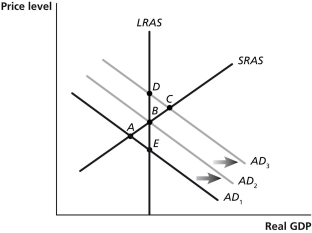 -Refer to Figure 27-1. Suppose the economy is in short-run equilibrium above potential GDP and no policy is pursued. Using the static AD-AS model in the figure above, this would be depicted as a movement from
 (Multiple Choice)
4.7/5 (82)
(82) Which of the following would not be considered an automatic stabilizer?
(Multiple Choice)
4.8/5 (96)
(96) Figure 27-5
-Refer to Figure 27-5. In the dynamic model of AD-AS in the figure above, if the economy is at point A in year 1 and is expected to go to point B in year 2, Congress and the president would most likely pursue
-Refer to Figure 27-5. In the dynamic model of AD-AS in the figure above, if the economy is at point A in year 1 and is expected to go to point B in year 2, Congress and the president would most likely pursue (Multiple Choice)
4.9/5 (84)
(84) Figure 27-1
-Refer to Figure 27-1. Suppose the economy is in short-run equilibrium below potential GDP and no fiscal or monetary policy is pursued. Using the static AD-AS model in the figure above, this would be depicted as a movement from
-Refer to Figure 27-1. Suppose the economy is in short-run equilibrium below potential GDP and no fiscal or monetary policy is pursued. Using the static AD-AS model in the figure above, this would be depicted as a movement from (Multiple Choice)
4.9/5 (70)
(70) Assume a country is required by law to balance the budget every year. Suppose aggregate demand falls, causing a recession and a budget deficit. To balance the budget, what would the government need to do with the level of government spending and taxes? How would these changes in government spending and taxes affect aggregate demand and the economy?
(Essay)
4.7/5 (69)
(69) Suppose real GDP is $13 trillion, potential real GDP is $13.5 trillion, and Congress and the president plan to use fiscal policy to restore the economy to potential real GDP. Assuming a constant price level, Congress and the president would need to increase government purchases by
(Multiple Choice)
4.9/5 (78)
(78) 
Filters
- Essay(0)
- Multiple Choice(0)
- Short Answer(0)
- True False(0)
- Matching(0)