



 Chat with AI
Exam 27: Fiscal Policy

Exam 1: Economics: Foundations and Models444 Questions
Exam 2: Trade-Offs, Comparative Advantage, and the Market System498 Questions
Exam 3: Where Prices Come From: the Interaction of Demand and Supply475 Questions
Exam 4: Economic Efficiency, Government Price Setting, and Taxes419 Questions
Exam 5: Externalities, Environmental Policy, and Public Goods266 Questions
Exam 6: Elasticity: the Responsiveness of Demand and Supply295 Questions
Exam 7: The Economics of Health Care334 Questions
Exam 8: Firms, the Stock Market, and Corporate Governance278 Questions
Exam 9: Comparative Advantage and the Gains From International Trade379 Questions
Exam 10: Consumer Choice and Behavioral Economics302 Questions
Exam 11: Technology, Production, and Costs330 Questions
Exam 12: Firms in Perfectly Competitive Markets298 Questions
Exam 13: Monopolistic Competition: the Competitive Model in a More Realistic Setting276 Questions
Exam 14: Oligopoly: Firms in Less Competitive Markets262 Questions
Exam 15: Monopoly and Antitrust Policy271 Questions
Exam 16: Pricing Strategy263 Questions
Exam 17: The Markets for Labor and Other Factors of Production286 Questions
Exam 18: Public Choice, Taxes, and the Distribution of Income258 Questions
Exam 19: GDP: Measuring Total Production and Income266 Questions
Exam 20: Unemployment and Inflation292 Questions
Exam 21: Economic Growth, the Financial System, and Business Cycles257 Questions
Exam 22: Long-Run Economic Growth: Sources and Policies268 Questions
Exam 23: Aggregate Expenditure and Output in the Short Run306 Questions
Exam 24: Aggregate Demand and Aggregate Supply Analysis284 Questions
Exam 25: Money, Banks, and the Federal Reserve System280 Questions
Exam 26: Monetary Policy277 Questions
Exam 27: Fiscal Policy303 Questions
Exam 28: Inflation, Unemployment, and Federal Reserve Policy257 Questions
Exam 29: Macroeconomics in an Open Economy278 Questions
Exam 30: The International Financial System262 Questions
Select questions type


Figure 27-3 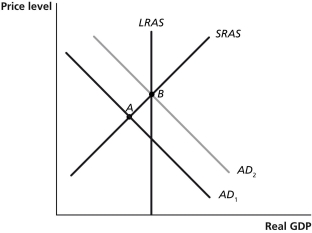 -Decreasing government spending ________ the price level and ________ equilibrium real GDP.
 (Multiple Choice)
4.8/5  (83)
(83) An increase in government spending will force an appreciation of the dollar, which causes net exports to fall.
(True/False)
4.7/5 (79)
(79) A decrease in the marginal income tax rate is a fiscal policy which will increase aggregate demand.
(True/False)
4.8/5 (82)
(82) Active changes in tax and spending by government intended to smooth out the business cycle are called ________, and changes in taxes and spending that occur passively over the business cycle are called ________.
(Multiple Choice)
4.8/5 (79)
(79) Which of the following is a government expenditure, but is not a government purchase?
(Multiple Choice)
4.9/5 (76)
(76) What is the difference between federal purchases and federal expenditures?
(Essay)
4.8/5 (72)
(72) Figure 27-1 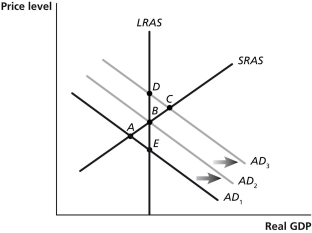 -Refer to Figure 27-1. Suppose the economy is in short-run equilibrium above potential GDP and automatic stabilizers move the economy back to long-run equilibrium. Using the static AD-AS model in the figure above, this would be depicted as a movement from
 (Multiple Choice)
4.8/5 (78)
(78) What are the key differences between how we illustrate an expansionary fiscal policy in the basic aggregate demand and aggregate supply model and in the dynamic aggregate demand and aggregate supply model?
(Essay)
4.9/5 (84)
(84) An increase in the tax wedge associated with a given economic activity will decrease the level of that activity.
(True/False)
4.8/5 (81)
(81) Borrowing to pay for long-lived capital expenditures makes sense as
(Multiple Choice)
4.8/5 (92)
(92) How could the existence of an unemployment insurance system or other transfer programs have reduced the severity of the Great Depression?
(Essay)
4.7/5 (84)
(84) Suppose President Obama is successful in passing a $5 billion tax increase. Assume that taxes are fixed, the economy is closed, and the marginal propensity to consume is 0.75. What happens to equilibrium GDP?
(Multiple Choice)
4.8/5 (91)
(91) If policy makers implement an expansionary fiscal policy but do not take into account the potential for crowding out, the new equilibrium level of GDP is likely to
(Multiple Choice)
4.7/5 (85)
(85) An appropriate fiscal policy response when aggregate demand is growing at a slower rate than aggregate supply is to cut taxes.
(True/False)
4.9/5 (97)
(97) In an open economy, the government purchases multiplier will be smaller the
(Multiple Choice)
4.7/5 (82)
(82) 
Filters
- Essay(0)
- Multiple Choice(0)
- Short Answer(0)
- True False(0)
- Matching(0)