



 Chat with AI
Exam 25: The Chemistry of Metabolism

Exam 1: Remembering General Chemistry: Electronic Structure and Bonding81 Questions
Exam 2: Acids and Bases: Central to Understanding Organic Chemistry37 Questions
Exam 3: An Introduction to Organic Compounds123 Questions
Exam 4: Isomers: the Arrangement of Atoms in Space111 Questions
Exam 5: Alkenes Thermodynamics and Kinetics76 Questions
Exam 6: Reactions of Alkenes93 Questions
Exam 7: Reactions of Alkynes Introduction to Multistep Synthesis119 Questions
Exam 8: Electron Delocalization, Resonance, and Aromaticity More About Molecular Orbital Theory166 Questions
Exam 9: Substitution Reactions of Alkyl Halides118 Questions
Exam 10: Elimination Reactions of Alkyl Halides Competition Between Substitution and Elimination94 Questions
Exam 11: Reactions of Alcohols, Ethers, Epoxides, and Sulfur-Containing Compounds100 Questions
Exam 12: Organometallic Compounds57 Questions
Exam 13: Reactions of Alkanes, Radicals130 Questions
Exam 14: Mass Spectrometry, Infrared Spectroscopy, and Uvvis Spectroscopy127 Questions
Exam 15: Nmr Spectroscopy110 Questions
Exam 16: Reactions of Carboxylic Acids and Carboxylic Acid Derivatives128 Questions
Exam 17: Reactions of Aldehydes and Ketones116 Questions
Exam 18: Reactions at the Alpha Carbon of Carbonyl Compounds113 Questions
Exam 19: Reactions of Benzene and Substituted Benzenes155 Questions
Exam 20: More About Amines Heterocylic Compounds115 Questions
Exam 21: Carbohydrates100 Questions
Exam 22: Amino Acids, Peptides, and Proteins105 Questions
Exam 23: Catalysis85 Questions
Exam 24: The Organic Mechanisms of the Coenzymes92 Questions
Exam 25: The Chemistry of Metabolism94 Questions
Exam 26: Nucleosides, Nucleotides, and Nucleic Acids85 Questions
Exam 27: Synthetic Polymers106 Questions
Exam 28: Pericyclic Reactions92 Questions
Select questions type


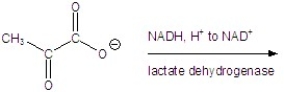

Why are nucleophiles more readily phosphorylated by ATP than by hydrogen phosphate?
(Essay)
4.9/5  (103)
(103) In what three areas of the body does first stage catabolism primarily occur?
(Short Answer)
4.8/5 (77)
(77) Draw the chair form of the compound that results when D-glucopyranose reacts with ATP in the presence of an enzyme that catalyzes the phosphorylation of the 6-OH group.
(Essay)
5.0/5 (83)
(83) Why does phosphorylating a carboxylate make it more susceptible to nucleophilic attack?
(Essay)
4.8/5 (86)
(86) In the citric acid cycle, what type of intermediate occurs as succinyl-CoA is converted into succinate?
(Multiple Choice)
5.0/5 (77)
(77) Which step of the b-oxidation pathway is a conjugate addition of water to the organic substrate?
(Short Answer)
4.9/5 (86)
(86) Each passage through the b-oxidation pathway removes ________ carbons from the fatty acyl-CoA.
(Multiple Choice)
4.9/5 (81)
(81) In the rod cells of the eye, retinol (vitamin
A)can be oxidized and then isomerized into an aldehyde and a cis double bond at C-11 to form a molecule called 11Z-retinal. Propose a structure for 11Z-retinal. 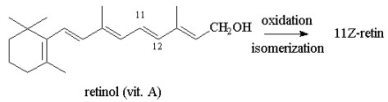
(Essay)
4.7/5 (70)
(70) What coenzyme is required to facilitate the conversion of glycerol-3-phosphate into dihydroxyacetone?
(Short Answer)
4.8/5 (83)
(83) What compounds are formed when a carboxylate is phosphorylated by the attack at the b-phosphorus of ATP?
(Short Answer)
4.7/5 (76)
(76) In the first stage of catabolism, carbohydrates are hydrolyzed to ________.
(Short Answer)
4.8/5 (84)
(84) In glycolysis, each molecule of glucose is converted to two molecules of ________.
(Multiple Choice)
5.0/5 (95)
(95) 
Filters
- Essay(0)
- Multiple Choice(0)
- Short Answer(0)
- True False(0)
- Matching(0)