



 Chat with AI
Exam 22: Amino Acids, Peptides, and Proteins

Exam 1: Remembering General Chemistry: Electronic Structure and Bonding81 Questions
Exam 2: Acids and Bases: Central to Understanding Organic Chemistry37 Questions
Exam 3: An Introduction to Organic Compounds123 Questions
Exam 4: Isomers: the Arrangement of Atoms in Space111 Questions
Exam 5: Alkenes Thermodynamics and Kinetics76 Questions
Exam 6: Reactions of Alkenes93 Questions
Exam 7: Reactions of Alkynes Introduction to Multistep Synthesis119 Questions
Exam 8: Electron Delocalization, Resonance, and Aromaticity More About Molecular Orbital Theory166 Questions
Exam 9: Substitution Reactions of Alkyl Halides118 Questions
Exam 10: Elimination Reactions of Alkyl Halides Competition Between Substitution and Elimination94 Questions
Exam 11: Reactions of Alcohols, Ethers, Epoxides, and Sulfur-Containing Compounds100 Questions
Exam 12: Organometallic Compounds57 Questions
Exam 13: Reactions of Alkanes, Radicals130 Questions
Exam 14: Mass Spectrometry, Infrared Spectroscopy, and Uvvis Spectroscopy127 Questions
Exam 15: Nmr Spectroscopy110 Questions
Exam 16: Reactions of Carboxylic Acids and Carboxylic Acid Derivatives128 Questions
Exam 17: Reactions of Aldehydes and Ketones116 Questions
Exam 18: Reactions at the Alpha Carbon of Carbonyl Compounds113 Questions
Exam 19: Reactions of Benzene and Substituted Benzenes155 Questions
Exam 20: More About Amines Heterocylic Compounds115 Questions
Exam 21: Carbohydrates100 Questions
Exam 22: Amino Acids, Peptides, and Proteins105 Questions
Exam 23: Catalysis85 Questions
Exam 24: The Organic Mechanisms of the Coenzymes92 Questions
Exam 25: The Chemistry of Metabolism94 Questions
Exam 26: Nucleosides, Nucleotides, and Nucleic Acids85 Questions
Exam 27: Synthetic Polymers106 Questions
Exam 28: Pericyclic Reactions92 Questions
Select questions type


Give a detailed, stepwise mechanism for the formation of the activated acyl derivative from the reaction of an amino acid with N,N'-dicyclohexylcarbodiimide.

Free
(Essay)
4.8/5  (78)
(78) Correct Answer: Verified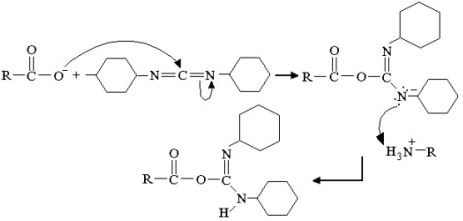
Treatment of a decapeptide with Edman's reagent releases PTH-Ala. What conclusion can be drawn regarding the decapeptide's primary structure?
Free
(Essay)
4.7/5 (77)
(77) Correct Answer:Verified
VerifiedThe N-terminal residue of the decapeptide is alanine.
What is the major force responsible for the formation of an α-helix in protein secondary structure?
Free
(Short Answer)
4.8/5 (79)
(79) Correct Answer:Verified
Verifiedhydrogen bonding
Which labeled bond in the following molecule is known as the peptide bond? 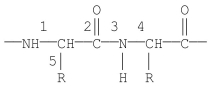
(Multiple Choice)
4.7/5 (65)
(65) 
In nature, which is the most commonly found isomer, L-amino acids or D-amino acids?
(Essay)
4.8/5 (81)
(81) What is the name of the amino acid produced when propanoic acid is subjected to the following sequence of reagents:? 1. PBr3, Br2;
2) H2O;
3) NH3, Δ?
(Multiple Choice)
4.8/5 (85)
(85) Which of the following molecules is the skeletal structure of an amino acid?
(Multiple Choice)
4.8/5 (87)
(87) 
In a globular protein, would the side chain of isoleucine most probably be oriented toward the interior of the protein or outward toward the aqueous surroundings? Explain.
(Essay)
4.9/5 (79)
(79) In a globular protein, would the side chain of aspartic acid most probably be oriented toward the interior of the protein or outward toward the aqueous surroundings? Explain.
(Essay)
4.9/5 (81)
(81) Consider the two peptides shown below. Which of the following methods would be able to distinguish between these two sequences? Ala-Met-Val-Leu-Gly-Gly-Phe-Glu-Arg-Val
And
Ala-Val-Gly-Glu-Val-Met-Leu-Gly-Arg-Phe
(Multiple Choice)
4.7/5 (74)
(74) Which of the following amino acids has a sulfur in the R group?
(Multiple Choice)
4.9/5 (86)
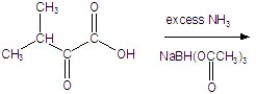
(86) What amino acid can be obtained by the reductive amination of γ-ketoglutaric acid, HO2CCH2CH2COCO2H?
(Multiple Choice)
4.7/5 (71)
(71) Which of the following terms best describes the side chain of valine?
(Multiple Choice)
4.9/5 (77)
(77) 
Filters
- Essay(0)
- Multiple Choice(0)
- Short Answer(0)
- True False(0)
- Matching(0)