



 Chat with AI
Exam 22: Amino Acids, Peptides, and Proteins

Exam 1: Remembering General Chemistry: Electronic Structure and Bonding81 Questions
Exam 2: Acids and Bases: Central to Understanding Organic Chemistry37 Questions
Exam 3: An Introduction to Organic Compounds123 Questions
Exam 4: Isomers: the Arrangement of Atoms in Space111 Questions
Exam 5: Alkenes Thermodynamics and Kinetics76 Questions
Exam 6: Reactions of Alkenes93 Questions
Exam 7: Reactions of Alkynes Introduction to Multistep Synthesis119 Questions
Exam 8: Electron Delocalization, Resonance, and Aromaticity More About Molecular Orbital Theory166 Questions
Exam 9: Substitution Reactions of Alkyl Halides118 Questions
Exam 10: Elimination Reactions of Alkyl Halides Competition Between Substitution and Elimination94 Questions
Exam 11: Reactions of Alcohols, Ethers, Epoxides, and Sulfur-Containing Compounds100 Questions
Exam 12: Organometallic Compounds57 Questions
Exam 13: Reactions of Alkanes, Radicals130 Questions
Exam 14: Mass Spectrometry, Infrared Spectroscopy, and Uvvis Spectroscopy127 Questions
Exam 15: Nmr Spectroscopy110 Questions
Exam 16: Reactions of Carboxylic Acids and Carboxylic Acid Derivatives128 Questions
Exam 17: Reactions of Aldehydes and Ketones116 Questions
Exam 18: Reactions at the Alpha Carbon of Carbonyl Compounds113 Questions
Exam 19: Reactions of Benzene and Substituted Benzenes155 Questions
Exam 20: More About Amines Heterocylic Compounds115 Questions
Exam 21: Carbohydrates100 Questions
Exam 22: Amino Acids, Peptides, and Proteins105 Questions
Exam 23: Catalysis85 Questions
Exam 24: The Organic Mechanisms of the Coenzymes92 Questions
Exam 25: The Chemistry of Metabolism94 Questions
Exam 26: Nucleosides, Nucleotides, and Nucleic Acids85 Questions
Exam 27: Synthetic Polymers106 Questions
Exam 28: Pericyclic Reactions92 Questions
Select questions type


Provide the structure of the tripeptide val-gly-ser at biological pH.
(Essay)
4.9/5  (73)
(73) Complete hydrolysis of a hexapeptide gives 2 Gly, Leu, Phe, Pro, and Tyr. Reaction of the peptide with phenylisothiocyanate gave the phenylthiohydantoin of Pro. Partial hydrolysis of the peptide gave the following fragments: Phe-Gly-Tyr, Gly-Phe-Gly, Pro-Leu-Gly, Leu-Gly-Phe. What is the structure of the peptide?
(Short Answer)
4.7/5 (77)
(77) 
What is the pI of arginine? The structure and pKa values are shown below. 
(Multiple Choice)
5.0/5 (72)
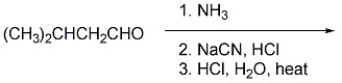
(72) 

In conventional peptide synthesis, the nitrogen of a given amino acid must be deactivated or blocked while the carboxyl group is activated. Which of the following reagents is used to protect the amino group of an amino acid?
(Multiple Choice)
4.9/5 (75)
(75) Which of the following is an acceptable name for the peptide sequence shown below? Glu-Glu-His-Val-Cys
(Multiple Choice)
5.0/5 (81)
(81) In peptide synthesis, give the use of dicyclohexylcarbodiimide.
(Multiple Choice)
4.9/5 (68)
(68) You are given a mixture that contains glutamic acid (pI = 3.2), arginine (pI = 10.8), and valine (pI = 6.0), and you subject the mixture to electrophoresis.
a) Which amino acids migrate toward the cathode when the electrophoresis is carried out at a pH of 7.1?
b) Which amino acids migrate toward the anode when the electrophoresis is carried out at a pH of 7.1?
c) Which amino acid migrates farthest toward the anode at a pH of 7.1?
d) Since amino acids themselves are colorless, how is the separation of amino acids after electrophoresis detected?
(Essay)
4.7/5 (85)
(85) Which of the following is the first step in the determination of the primary structure of proteins?
(Multiple Choice)
5.0/5 (98)
(98) How is the enzyme chymotrypsin used in peptide structure determination?
(Essay)
5.0/5 (76)
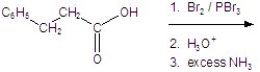
(76) 
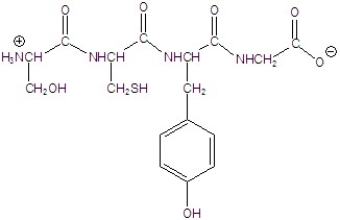
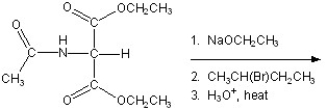
Carboxypeptidase is an enzyme used in the determination of the primary structure of a protein. Specifically, which of the following does it identify?
(Multiple Choice)
4.9/5 (81)
(81) 
Filters
- Essay(0)
- Multiple Choice(0)
- Short Answer(0)
- True False(0)
- Matching(0)