



 Chat with AI
Exam 27: Synthetic Polymers

Exam 1: Remembering General Chemistry: Electronic Structure and Bonding81 Questions
Exam 2: Acids and Bases: Central to Understanding Organic Chemistry37 Questions
Exam 3: An Introduction to Organic Compounds123 Questions
Exam 4: Isomers: the Arrangement of Atoms in Space111 Questions
Exam 5: Alkenes Thermodynamics and Kinetics76 Questions
Exam 6: Reactions of Alkenes93 Questions
Exam 7: Reactions of Alkynes Introduction to Multistep Synthesis119 Questions
Exam 8: Electron Delocalization, Resonance, and Aromaticity More About Molecular Orbital Theory166 Questions
Exam 9: Substitution Reactions of Alkyl Halides118 Questions
Exam 10: Elimination Reactions of Alkyl Halides Competition Between Substitution and Elimination94 Questions
Exam 11: Reactions of Alcohols, Ethers, Epoxides, and Sulfur-Containing Compounds100 Questions
Exam 12: Organometallic Compounds57 Questions
Exam 13: Reactions of Alkanes, Radicals130 Questions
Exam 14: Mass Spectrometry, Infrared Spectroscopy, and Uvvis Spectroscopy127 Questions
Exam 15: Nmr Spectroscopy110 Questions
Exam 16: Reactions of Carboxylic Acids and Carboxylic Acid Derivatives128 Questions
Exam 17: Reactions of Aldehydes and Ketones116 Questions
Exam 18: Reactions at the Alpha Carbon of Carbonyl Compounds113 Questions
Exam 19: Reactions of Benzene and Substituted Benzenes155 Questions
Exam 20: More About Amines Heterocylic Compounds115 Questions
Exam 21: Carbohydrates100 Questions
Exam 22: Amino Acids, Peptides, and Proteins105 Questions
Exam 23: Catalysis85 Questions
Exam 24: The Organic Mechanisms of the Coenzymes92 Questions
Exam 25: The Chemistry of Metabolism94 Questions
Exam 26: Nucleosides, Nucleotides, and Nucleic Acids85 Questions
Exam 27: Synthetic Polymers106 Questions
Exam 28: Pericyclic Reactions92 Questions
Select questions type


In a recycling symbol, the ________ the number in the middle of the symbol, the more easily the compound can be recycled.

Free
(Short Answer)
4.8/5  (80)
(80) Correct Answer: Verified
lower
The choice of mechanism in chain-growth polymerization depends on which of the following?
Free
(Multiple Choice)
5.0/5 (83)
(83) Correct Answer:Verified
VerifiedA
List the two major classes of synthetic polymers and give one example of each.
Free
(Essay)
4.9/5 (76)
(76) Correct Answer:Verified
Verifieda) Addition polymers, also known as chain-growth polymers; polystyrene for example.
b) Condensation polymers, also known as step-growth polymers; nylon for example.
Which of the following are characteristics of thermosetting polymers?
(Multiple Choice)
4.8/5 (78)
(78) List the three phases in the mechanism of chain-growth polymerization.
(Essay)
4.8/5 (83)
(83) Chain-growth polymerization proceeds by which of the following mechanisms?
(Multiple Choice)
4.9/5 (69)
(69) Which of the following statements concerning the stereochemistry of polymerization is (are)correct?
(Multiple Choice)
4.9/5 (81)
(81) Which of the following is more likely to undergo both radical and cationic polymerization? 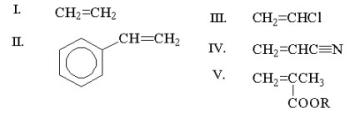
(Multiple Choice)
4.8/5 (80)
(80) Draw the structure of the polymer and by-product that result when the two monomers below are heated together. 
(Essay)
5.0/5 (75)
(75) Provide a mechanism to show how H2C  C(CH3)2 is polymerized using BF3 as the initiator.
 (Essay)
4.9/5 (96)
(96) Which of the following is the first chain propagating step in the radical polymerization of ethylene?
(Multiple Choice)
4.9/5 (89)
(89) 
Give the purpose of the amine in the formation of the epoxy resin.
(Multiple Choice)
4.8/5 (82)
(82) Which of the following initiators are known as Ziegler-Natta catalysts, which were discovered in 1953 in order to control the stereochemistry of polymers?
(Multiple Choice)
4.8/5 (89)
(89) Which of the following monomers has the greatest ability to undergo cationic polymerization? 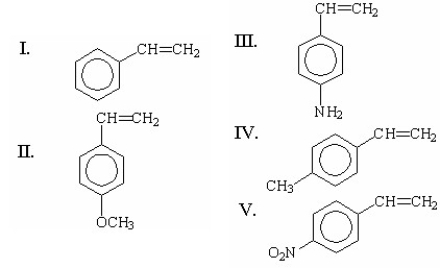
(Multiple Choice)
4.8/5 (84)
(84) 
Filters
- Essay(0)
- Multiple Choice(0)
- Short Answer(0)
- True False(0)
- Matching(0)