



 Chat with AI
Exam 27: Synthetic Polymers

Exam 1: Remembering General Chemistry: Electronic Structure and Bonding81 Questions
Exam 2: Acids and Bases: Central to Understanding Organic Chemistry37 Questions
Exam 3: An Introduction to Organic Compounds123 Questions
Exam 4: Isomers: the Arrangement of Atoms in Space111 Questions
Exam 5: Alkenes Thermodynamics and Kinetics76 Questions
Exam 6: Reactions of Alkenes93 Questions
Exam 7: Reactions of Alkynes Introduction to Multistep Synthesis119 Questions
Exam 8: Electron Delocalization, Resonance, and Aromaticity More About Molecular Orbital Theory166 Questions
Exam 9: Substitution Reactions of Alkyl Halides118 Questions
Exam 10: Elimination Reactions of Alkyl Halides Competition Between Substitution and Elimination94 Questions
Exam 11: Reactions of Alcohols, Ethers, Epoxides, and Sulfur-Containing Compounds100 Questions
Exam 12: Organometallic Compounds57 Questions
Exam 13: Reactions of Alkanes, Radicals130 Questions
Exam 14: Mass Spectrometry, Infrared Spectroscopy, and Uvvis Spectroscopy127 Questions
Exam 15: Nmr Spectroscopy110 Questions
Exam 16: Reactions of Carboxylic Acids and Carboxylic Acid Derivatives128 Questions
Exam 17: Reactions of Aldehydes and Ketones116 Questions
Exam 18: Reactions at the Alpha Carbon of Carbonyl Compounds113 Questions
Exam 19: Reactions of Benzene and Substituted Benzenes155 Questions
Exam 20: More About Amines Heterocylic Compounds115 Questions
Exam 21: Carbohydrates100 Questions
Exam 22: Amino Acids, Peptides, and Proteins105 Questions
Exam 23: Catalysis85 Questions
Exam 24: The Organic Mechanisms of the Coenzymes92 Questions
Exam 25: The Chemistry of Metabolism94 Questions
Exam 26: Nucleosides, Nucleotides, and Nucleic Acids85 Questions
Exam 27: Synthetic Polymers106 Questions
Exam 28: Pericyclic Reactions92 Questions
Select questions type


Show how branching could occur during the free-radical polymerization of styrene.
(Essay)
4.9/5  (78)
(78) Explain why some monomers are better able to undergo chain-growth polymerization by a radical mechanism.
(Essay)
4.9/5 (82)
(82) Which of the following is more likely to form non-terminated polymeric chains called living polymers?
(Multiple Choice)
4.9/5 (78)
(78) A substituted ethylene polymer in which the substituents are randomly oriented is called ________.
(Multiple Choice)
4.8/5 (89)
(89) When 2,2-dimethyloxirane (see figure below)undergoes anionic polymerization, the nucleophile attacks the least substituted carbon of the epoxide, but when it undergoes cationic polymerization, the nucleophile attacks the most substituted carbon of the epoxide. Explain why this is so. 
(Essay)
5.0/5 (87)
(87) From which of the following monomers is neoprene synthesized?
(Multiple Choice)
4.8/5 (82)
(82) Identify the monomers that undergo cationic polymerization.
(Multiple Choice)
4.8/5 (78)
(78) What is the structure of the monomer from which the following polymer is made? 
(Multiple Choice)
4.8/5 (76)
(76) What is the structure of the monomer from which the following polymer is made? 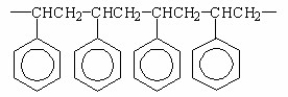
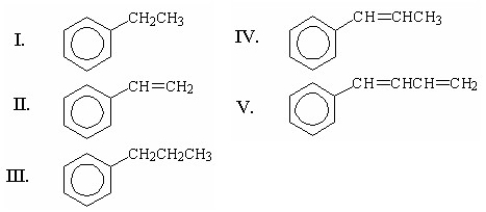
(Multiple Choice)
4.9/5 (83)
(83) 
Chain-growth polymerization exhibits a marked preference for ________.
(Multiple Choice)
4.8/5 (93)
(93) 

Filters
- Essay(0)
- Multiple Choice(0)
- Short Answer(0)
- True False(0)
- Matching(0)