



 Chat with AI
Exam 13: Reactions of Alkanes, Radicals

Exam 1: Remembering General Chemistry: Electronic Structure and Bonding81 Questions
Exam 2: Acids and Bases: Central to Understanding Organic Chemistry37 Questions
Exam 3: An Introduction to Organic Compounds123 Questions
Exam 4: Isomers: the Arrangement of Atoms in Space111 Questions
Exam 5: Alkenes Thermodynamics and Kinetics76 Questions
Exam 6: Reactions of Alkenes93 Questions
Exam 7: Reactions of Alkynes Introduction to Multistep Synthesis119 Questions
Exam 8: Electron Delocalization, Resonance, and Aromaticity More About Molecular Orbital Theory166 Questions
Exam 9: Substitution Reactions of Alkyl Halides118 Questions
Exam 10: Elimination Reactions of Alkyl Halides Competition Between Substitution and Elimination94 Questions
Exam 11: Reactions of Alcohols, Ethers, Epoxides, and Sulfur-Containing Compounds100 Questions
Exam 12: Organometallic Compounds57 Questions
Exam 13: Reactions of Alkanes, Radicals130 Questions
Exam 14: Mass Spectrometry, Infrared Spectroscopy, and Uvvis Spectroscopy127 Questions
Exam 15: Nmr Spectroscopy110 Questions
Exam 16: Reactions of Carboxylic Acids and Carboxylic Acid Derivatives128 Questions
Exam 17: Reactions of Aldehydes and Ketones116 Questions
Exam 18: Reactions at the Alpha Carbon of Carbonyl Compounds113 Questions
Exam 19: Reactions of Benzene and Substituted Benzenes155 Questions
Exam 20: More About Amines Heterocylic Compounds115 Questions
Exam 21: Carbohydrates100 Questions
Exam 22: Amino Acids, Peptides, and Proteins105 Questions
Exam 23: Catalysis85 Questions
Exam 24: The Organic Mechanisms of the Coenzymes92 Questions
Exam 25: The Chemistry of Metabolism94 Questions
Exam 26: Nucleosides, Nucleotides, and Nucleic Acids85 Questions
Exam 27: Synthetic Polymers106 Questions
Exam 28: Pericyclic Reactions92 Questions
Select questions type


Explain how CFCs are linked to depletion of stratospheric ozone.

Free
(Essay)
4.7/5  (77)
(77) Correct Answer: Verified
CFCs are persistent in the environment until they encounter ultraviolet light in the stratosphere. This interaction with a UV photon will cleave the C-Cl bond in the CFC and generate a chlorine radical. The chlorine radical reacts with ozone to form chlorine monoxide radical and molecular oxygen. The chlorine monoxide radical then reacts with a molecule of ozone to produce oxygen and to regenerate a chlorine radical. The two steps are the propagating steps in a radical chain reaction whereby a single chlorine radical can destroy about 100,000 ozone molecules.
An alkane with the molecular formula C5H10 forms only one monochlorinated product when heated with Cl2/hv. Give the structure and the IUPAC name for this alkane.
Free
(Essay)
4.7/5 (93)
(93) Correct Answer:Verified
Verified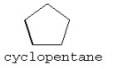
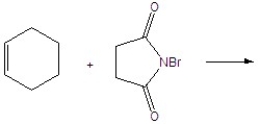
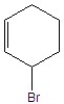
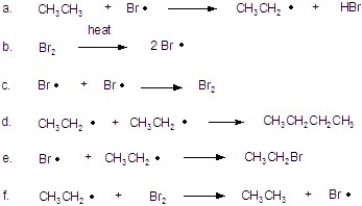
Which of the following does not occur in a propagation step in the free radical bromination of ethane to form bromoethane?
(Multiple Choice)
4.8/5 (74)
(74) When petroleum is distilled, the fraction that contains compounds with 5 to 11 carbons is known as ________.
(Multiple Choice)
4.7/5 (83)
(83) 
Show the propagating steps in the addition of HBr to 1-pentene in the presence of peroxide.
(Essay)
4.8/5 (88)
(88) 
When (R)-2-chlorobutane reacts with Br2/hv, which of the following is true? 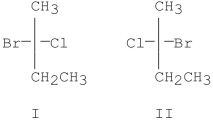
(Multiple Choice)
4.9/5 (80)
(80) The reaction Br2 + CH3Br → CH2Br2 + HBr was carried out. Which of the following mechanism steps is productive, but relatively unlikely to occur?
(Multiple Choice)
4.9/5 (64)
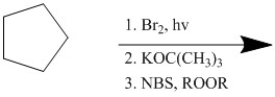
(64) 
When (R)-2-bromobutane reacts with Cl2/hv, which of the following is true? 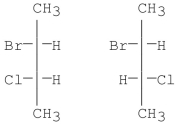 I II
I II (Multiple Choice)
4.9/5 (85)
(85) Rank the following fractions which result from the fractional distillation of petroleum in order of increasing boiling point: asphalt, gasoline, kerosene, natural gas, heating oil.
(Essay)
4.9/5 (81)
(81) 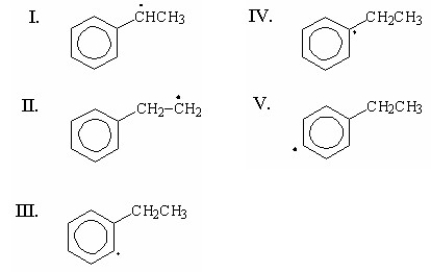
Which of the following products result from the disproportionation reaction between two propyl radicals? 
(Multiple Choice)
4.8/5 (69)
(69) When Br ∙ reacts with 1-butene (CH3CH2CH  CH2), the hydrogen atom which is preferentially abstracted is the one which produces a resonance stabilized radical. Draw the major resonance contributing forms of this radical.
 (Essay)
4.7/5 (75)
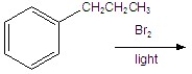
(75) Consider the following monobromination reaction, then answer the following questions. 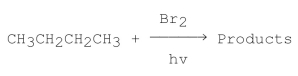 a) Give the structures and the IUPAC names for the products.
b) Give the common names for the products.
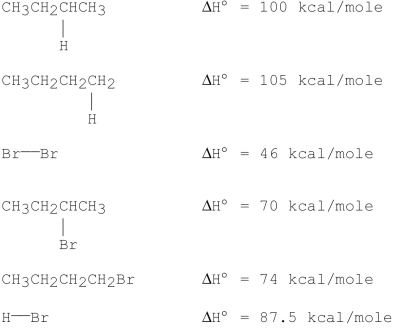
c) Calculate ΔH° for the overall reaction using the following data for the indicated bond dissociation energies:
 d) Calculate the percent yield for each product. (relative rate of abstraction of 3° hydrogen is 1600; 2° is 82; and 1° is 1.)
e) Propose a step-by-step mechanism for the major product only.
f) Draw a schematic potential energy diagram for the rate-determining step (RDS)only.
g) Does the transition state of the RDS resemble more closely the reactants or the products?
h) Would the value of the activation energy be different for different alkanes? Explain.
i) Would the reaction slow down or speed up if I2 is used instead of Br2? Explain.
a) Give the structures and the IUPAC names for the products.
b) Give the common names for the products.
c) Calculate ΔH° for the overall reaction using the following data for the indicated bond dissociation energies: d) Calculate the percent yield for each product. (relative rate of abstraction of 3° hydrogen is 1600; 2° is 82; and 1° is 1.)
e) Propose a step-by-step mechanism for the major product only.
f) Draw a schematic potential energy diagram for the rate-determining step (RDS)only.
g) Does the transition state of the RDS resemble more closely the reactants or the products?
h) Would the value of the activation energy be different for different alkanes? Explain.
i) Would the reaction slow down or speed up if I2 is used instead of Br2? Explain. (Essay)
4.9/5 (76)
(76) Which of the following is true about the halogenation of methane, CH4?
(Multiple Choice)
5.0/5 (73)
(73) The reaction Br2 + CH3Br → CH2Br2 + HBr was carried out. Which of the following mechanism steps is both productive and relatively likely to occur?
(Multiple Choice)
4.8/5 (80)
(80) 
Filters
- Essay(0)
- Multiple Choice(0)
- Short Answer(0)
- True False(0)
- Matching(0)